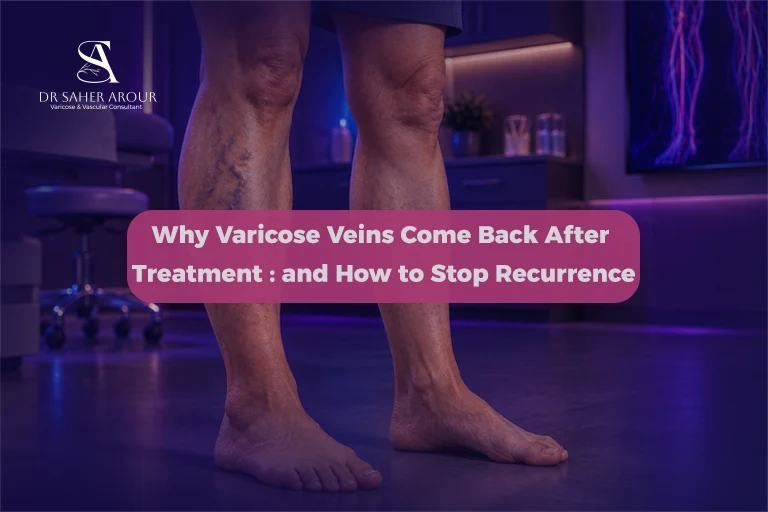
In fact, to know why varicose veins come back after treatment, we need to learn about new vein growth, the reopening of treated veins, or the natural progression of your underlying vein disease. Pinpointing the exact cause always requires an expert ultrasound evaluation.
I know how disappointing it is to see new veins appear months or years after you thought a successful procedure solved the problem. If you’re experiencing this, actually there are many who suffer from this too.. I evaluate this presentation frequently in my practice. I have to tell you that major clinical guidelines confirm that new varicose veins can develop after treatment, and the chance of them coming back after treating recurrent disease is actually higher than after your first treatment [1].
Medically Reviewed & Written by Dr. Saher Arour,
Board-Certified Vascular Surgeon
When new symptoms appear, here’s exactly what our clinical assessment focuses on:
- Reviewing your specific symptoms to understand their daily impact.
- Performing a targeted physical examination.
- Identifying the anatomical root cause rather than guessing.
- Using painless imaging to accurately map your venous blood flow.
Table of Contents
Why Varicose Veins Come Back After Treatment?
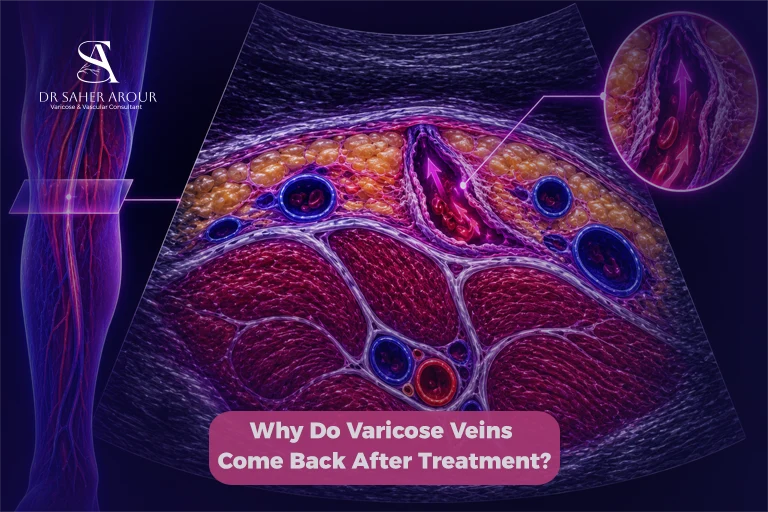
Spotting new veins might make you worry your initial procedure failed. While technical issues occasionally happen, the cause is usually biological. If you’re dealing with painful returning veins (symptomatic recurrent varicosities), the issue often stems from persistent or recurrent reflux (backward blood flow) in your main surface veins, such as the great saphenous vein. It’s an established source of symptomatic recurrence [2].
The specific way these veins come back actually differs based on the treatment you received [5]. Your body responds to procedures in unique ways, and the disease can simply progress to new areas over time. Returning veins don’t automatically mean a technical error occurred. It’s usually just a reflection of the natural progression of your underlying vein disease [3].
Five Main Reasons Varicose Veins Return After Treatment
When you notice new veins appearing, you’ll naturally want to know exactly why it’s happening. In my experience, it usually comes down to one of four clear biological reasons—and none of them mean you’ve done anything wrong.
Reason 1 : Incomplete Closure or Reopening of the Treated Vein
Sometimes the treated vein doesn’t close completely or reopens over time. This reopening (known medically as non-closure or recanalization) is a well-recognized cause of recurrent varicose veins following endovenous laser or radiofrequency ablation [3].
When we evaluate recurrent veins using duplex ultrasound, recanalization of a previously treated vein is one of the most commonly identified patterns [6].
Reason 2 : Neovascularization (New Veins Growing Around the Treated Area)
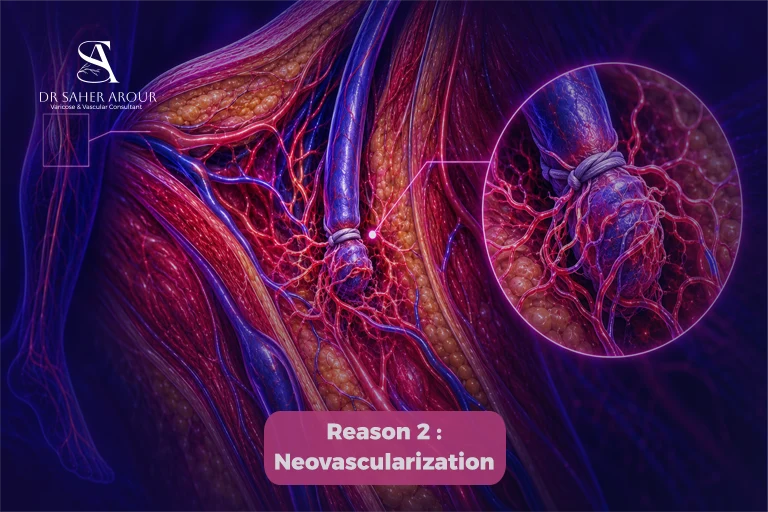
Your body is incredibly resilient and often attempts to build new pathways for blood flow as a natural healing response. The way this happens usually depends on the type of treatment you previously had:
- If you’ve had traditional surgery (high ligation and stripping): The most common finding is neovascularization, which is simply the growth of tiny, new blood vessels trying to reconnect the treated area [4], [5].
- If you’ve had laser or radiofrequency treatments (endovenous ablation): recurrence is more commonly associated with a residual vein stump, an untreated accessory vein, or a newly incompetent venous branch [5]
Reason 3 : Untreated Hidden Reflux in Other Veins (Saphenous Tributaries)
The originally treated vein may stay completely closed, but another neighboring vein can become incompetent over time. Common sources of this hidden reflux include [7]:
- New reflux within the anterior accessory saphenous vein or small saphenous vein [6] [7]
- Incompetent perforating veins connecting the deep and superficial venous systems [7].
- Residual or previously untreated tributaries.
- Progressive reflux in another segment of the superficial venous system.
- Delayed reopening of the originally treated vein [7].
A complete duplex ultrasound examination is therefore necessary to identify the actual source before further treatment is planned.
Reason 4 : Pelvic Venous Disorders in Women
In women, recurrent or unusually distributed varicose veins may originate from the pelvic venous system rather than from leg veins alone.
Pelvic venous reflux or obstruction can transmit abnormal venous pressure downward toward the groin, vulvar, perineal, gluteal, and lower-limb veins. This can produce recurrent or atypical varicosities involving the upper inner thigh, back of the thigh, outer thigh, buttocks, or pelvic-floor escape points.
Possible underlying pelvic conditions include:
- Pelvic venous insufficiency or pelvic congestion syndrome: particularly when associated with chronic pelvic pain, pelvic heaviness, abdominal bloating, or discomfort that worsens with prolonged standing.
- Nutcracker syndrome: in which compression of the left renal vein causes backward blood flow (reflux) through the left ovarian vein, contributing to pelvic venous congestion.
- May-Thurner syndrome: in which compression of the left common iliac vein impairs venous outflow, leading to pelvic collateral formation, disproportionate left leg swelling, or recurrent varicosities.
When the pattern of returning veins or your symptoms point toward a pelvic source, further evaluation with specialized duplex ultrasound, CT or MR venography, catheter venography, or intravascular ultrasound (IVUS) may be required before repeating lower-limb treatment.
Reason 5 : Disease Progression and Patient-Related Factors
Chronic venous disease is an ongoing condition that can continue to progress over time, even after a technically successful treatment. Factors associated with vein recurrence include:
- Multiple pregnancies
- Higher body mass index (BMI)
- Hormonal and age-related vascular changes
- Family predisposition or genetic factors
- Prolonged periods of sitting or standing
- Reduced mobility
- Progressive failure of previously healthy venous segments
New groin or lower-limb varicose veins often result from disease progression in other veins rather than a failure of your original procedure [2].
Recurrence Rates by Treatment Type : Which Procedures Have Lower Recurrence Rates?
A question patients constantly ask me in the clinic is which procedure guarantees their veins will never return. Because studies define recurrence differently, it’s actually quite difficult to compare published recurrence rates directly [3]. Currently, there’s insufficient evidence to definitively state that one specific procedure has the absolute lowest recurrence rate [3].
However, long-term studies do provide clear data we can review together:
| Treatment Type | Reported 5-Year Recurrence Findings |
| Surgery (High Ligation/Stripping) | Clinical recurrence was 34.3% in one trial [8]. Other literature notes recurrence upwards of 50% at 5 years [2]. |
| Endovenous Laser Ablation (EVLA) | Clinical recurrence was 20.9% in the same comparative trial [8]. Another trial showed EVLA at 38.6% [10]. |
| Radiofrequency Ablation (RFA) | In a four-arm trial, 18.7% of legs developed recurrent varicose veins at 5 years [10]. |
| Ultrasound-Guided Foam Sclerotherapy (UGFS) | In the same trial, 31.7% developed recurrent varicose veins [10]. |
Warning Signs That Varicose Veins Are Coming Back
Symptomatic recurrent varicose veins are usually identified by specific symptoms in your lower legs [1].
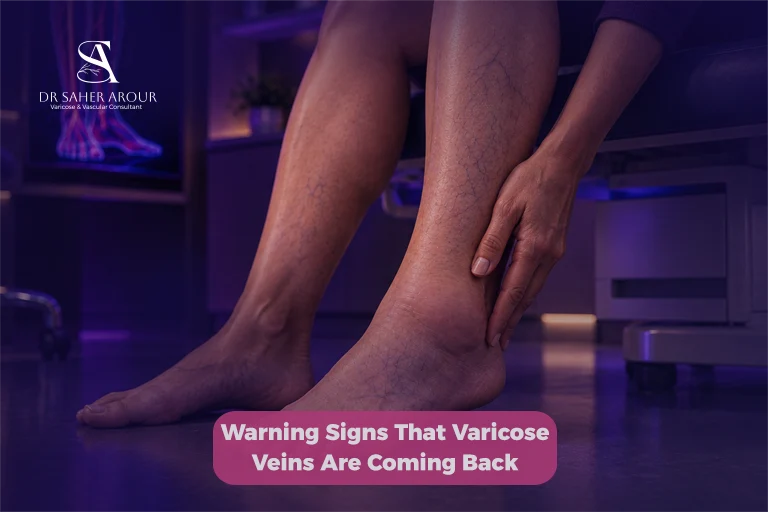
Watch out for these specific signs:
- Pain or aching in the legs [1].
- General lower limb discomfort [1].
- Swelling around the ankles or calves [1].
- A feeling of heaviness or itching [1].
If you’ve had treatment recently and still feel these symptoms, clinical guidelines recommend a follow-up three months or more after your initial ablation. This helps us assess whether you’ll need staged treatments—like phlebectomy or sclerotherapy—to resolve those persistent symptoms [2].
Prevention Plan : How to Reduce the Risk of Varicose Veins Returning
Effectively managing recurrent veins relies on highly accurate anatomical mapping. If you’re dealing with painful returning veins, we’ll perform a clinical evaluation and a duplex ultrasound before trying any new treatment. This isolates the exact source of the recurrence [2]. I rely heavily on this step because duplex ultrasound is the recommended diagnostic test of choice to evaluate for venous reflux [2].
Regarding compression stockings, there’s no consensus on the exact class of compression needed, and there’s actually no evidence that wearing compression slows the progression or recurrence of varicose veins [11]. Because of this, routine, prolonged use of medical compression stockings solely to improve clinical success isn’t recommended—except for patients with ongoing symptomatic disease who specifically benefit from continued use [11].
For everyday prevention and symptom management, focusing on weight loss if needed, maintaining light to moderate physical activity, and avoiding factors known to aggravate your symptoms remain solid daily habits [1].
FAQ Section : People Also Ask
How common is varicose vein recurrence after treatment?
Recurrence is definitely possible after treatment. Reported rates vary widely based on the procedure, your follow-up duration, and exactly how the study defines recurrence [3].
Why did my varicose veins come back after laser ablation?
Recurrent veins after laser ablation can result from recanalization of the treated segment, or new reflux developing in your anterior accessory and small saphenous veins [6]. It can also stem from persistent reflux or the natural progression of the disease from other vein segments [2].
Can varicose veins come back after surgery (stripping)?
Yes. Recurrent varicose veins after surgery have been reported in upwards of 50% of patients at the 5-year mark [2]. This recurrence is usually driven by residual or recurrent reflux, progression elsewhere in the leg, or neovascularization—which is a well-recognized mechanism after high ligation and stripping [4].
What is the best way to prevent varicose vein recurrence?
The absolute best approach is a proper medical evaluation. A clinical evaluation and duplex ultrasound (DUS) should always be performed when symptoms recur, so we can accurately locate the potential source of the recurrence before any retreatment [2].
Is recurrence a sign that my doctor did the procedure wrong?
No. Recurrence doesn’t by itself prove a technical error. It most often reflects the natural progression of your underlying disease [3], alongside biological factors like neovascularization and new reflux in previously healthy veins.
References
- [1] Varicose veins: diagnosis and management (NICE guidelines)
- [2] Society for Vascular Surgery, American Venous Forum, and American Vein and Lymphatic Society clinical practice guidelines for the management of varicose veins of the lower extremities
- [3] S2k guidelines: Diagnosis and treatment of varicose veins
- [4] De Maeseneer & Cavezzi — Etiology and pathophysiology of varicose vein recurrence at the saphenofemoral or saphenopopliteal junction: an update
- [5] Nelzén — Reconsidering the endovenous revolution
- [6] Winokur, Khilnani & Min — Recurrence patterns after endovenous laser treatment of saphenous vein reflux
- [7] Recurrent varicose veins after endovenous ablation (REVATA)
- [8] Five-year results of a randomized clinical trial comparing endovenous laser ablation with conventional surgery
- [9] Five-year results of a randomized controlled trial comparing endovenous laser ablation and high ligation and stripping
- [10] Five-year results of a randomized clinical trial comparing four treatments for varicose veins
- [11] Compression therapy after endovenous thermal ablation