Worrying about What Happens to your veins during pregnancy is something I see in the clinic every day. If you’re researching varicose vein treatment and pregnancy safety, you’ve already taken a great step for your health. I want to reassure you: managing these vascular changes is completely normal. The physical demands of carrying a baby naturally put an extra load on your circulation,
Medically Reviewed & Written by Dr. Saher Arour, Board-Certified Vascular Surgeon
but knowing exactly what to expect helps you stay comfortable.
- Your prior treatments still provide a strong foundation for your long-term vascular health.
- Your body naturally increases blood volume to support your growing baby.
- Some vein changes are entirely temporary and fade after childbirth.
- Gentle, non-invasive methods will keep your legs comfortable across all three trimesters.
Table of Contents

Can pregnancy affect veins after varicose vein treatment?
Yes. Pregnancy can dilate new veins and stress older ones because of hormonal shifts, increased blood volume, and uterine pressure.
Medically, pregnancy is a significant risk factor for varicose veins; multiparity is associated with a higher prevalence than nulliparity [1]. Even if you’ve had successful vein treatments before, carrying a baby alters how your circulation works. Pregnancy causes venous stasis through reduced venous tone and uterine compression of venous flow [2]. Simply put, venous stasis means your blood flow slows down while traveling against gravity.
Because of the extra weight and fluid, some women experience varicose veins recurrence after treatment in pregnancy. Recognizing that these shifts are mechanical and hormonal helps us plan the exact steps to keep your legs healthy.
Normal Pregnancy Vein Changes vs Pathological Recurrence: How to Tell Them Apart
It’s normal to feel anxious if you spot a new vein, but not every visual change means your past treatment failed.
Signs That Pregnancy Vein Changes Are Simply Hormonal (Normal)
- Varicose veins can become more visible early in pregnancy because of progesterone over-secretion [1].
- Leg swelling is common in pregnancy and can mimic DVT [3].
- Pregnancy-related venous changes often settle after birth [1].
Signs That Suggest Recurrence or New Vein Disease After Treatment
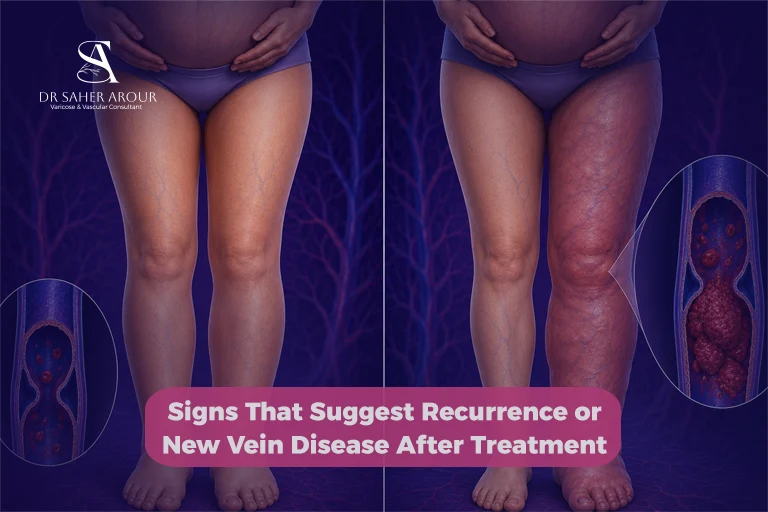
- Varicose veins are dilated tortuous subcutaneous veins measuring at least 3 mm in the standing position [4].
- Common symptoms include leg heaviness and swelling [4] that doesn’t improve when you rest.
- Advanced venous disease can cause hyperpigmentation, eczema, lipodermatosclerosis, and venous ulcers [4].
| Observation | Normal Pregnancy Changes | Signs of Venous Disease |
| Appearance | Faint blue lines or mild surface veins | Bulging, twisted cords over 3 mm |
| Swelling | End-of-day swelling that improves with rest | Persistent heavy swelling and aching |
| Skin Changes | Normal skin color | Hyperpigmentation or eczema |
The Hormonal and Mechanical Vein: Why Pregnancy Stresses Previously Treated Veins
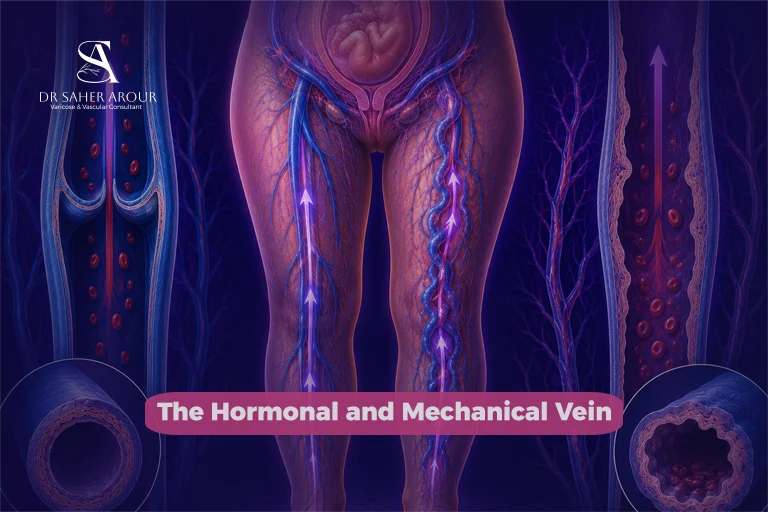
Your body goes through remarkable adaptations right now. Pregnancy-related contributors include weight gain, increased blood volume, vasodilation, fetal growth, and abdominal pressure [1]. Key maternal vascular adaptations are plasma volume expansion, increased cardiac output, decreased peripheral resistance, and increased uteroplacental blood flow [5]. These necessary shifts ask a lot of your venous valves.
What to Expect Each Trimester: How Your Veins Evolve
- First Trimester: Your body produces extra progesterone [1]. This hormone relaxes your vein walls early on, making them look slightly more prominent or bluish before the baby even gets heavy.
- Second Trimester: Your overall blood volume expands massively to support your growing baby [5]. This extra fluid puts more outward physical pressure on your already relaxed veins.
- Third Trimester: Your baby is now much larger. The heavy uterus physically presses directly against your pelvic veins, creating a mechanical roadblock that makes it harder for blood to travel back up your legs [2].
How Progesterone Relaxes Vein Walls During Pregnancy
Pregnancy-related physiologic changes can lead to venous valve incompetence and backflow [1]. Progesterone relaxes your smooth muscle tissue. This is perfect for your baby’s environment, but it causes your leg veins to stretch. When the vein walls relax, the tiny one-way valves inside them can’t close tightly, which lets some blood pool backward.
What Happens to Treated Trunks When Uterine Pressure Rises
As your baby grows, the physical space in your pelvis gets crowded. Leg venous flow velocity falls by approximately 50% by weeks 25 to 29 and returns to normal by about 6 weeks postpartum [2]. If you’ve had treatment on your Great Saphenous Vein (GSV), that specific trunk remains securely sealed. But this intense downward pressure pushes blood into smaller collateral paths, causing temporary swelling in tributary veins pregnancy after ablation.
Three Previous Treatments and How Each Holds Up in Pregnancy
If you’ve had a pregnancy safe varicose vein treatment before conceiving, you’ve already reduced your baseline risk. Let’s look at how the main varicose vein treatment options hold up when you’re expecting.
Endovenous Laser Ablation (EVLA) and Radiofrequency Ablation (RFA)
These thermal techniques seal the faulty vein with excellent long-term results. Clinical evidence shows EVLA has a 94.9% occlusion rate, RFA 94.4%, and surgical stripping 92.0% [6]. Looking at long-term results, the 5-year recurrence is EVLA 38.6%, RFA 18.7%, and surgery 34.6% [6]. Because modern ablations securely close the problem vein, they hold up incredibly well during your pregnancy, keeping major recurrences minimal.
Ultrasound-Guided Foam Sclerotherapy
We discuss sclerotherapy before pregnancy safety often. If you had foam sclerotherapy to treat branching veins, your body absorbed those specific veins. However, because pregnancy drives up your blood volume, your body might open new small collateral paths nearby. Your previous results remain intact, but you might notice new spider veins appearing in the surrounding skin.
Surgical Stripping and Phlebectomy
Older surgical methods physically removed the vein, but surgery has a 34.6% recurrence rate at five years [6]. A varicose veins second pregnancy recurrence happens more easily here because your body can form new, fragile blood vessels in the healing tissue of the old surgical track.
Practical Steps to Protect Previously Treated Veins During Pregnancy
Right now, protecting your legs comes down to gentle, daily support. We treat venous insufficiency during pregnancy with non-invasive methods [7]. Interventional procedures are paused because pregnancy is a patient-related factor that can make EVLA inappropriate [7], and endovenous ablation cannot be recommended during pregnancy because evidence is lacking [7].
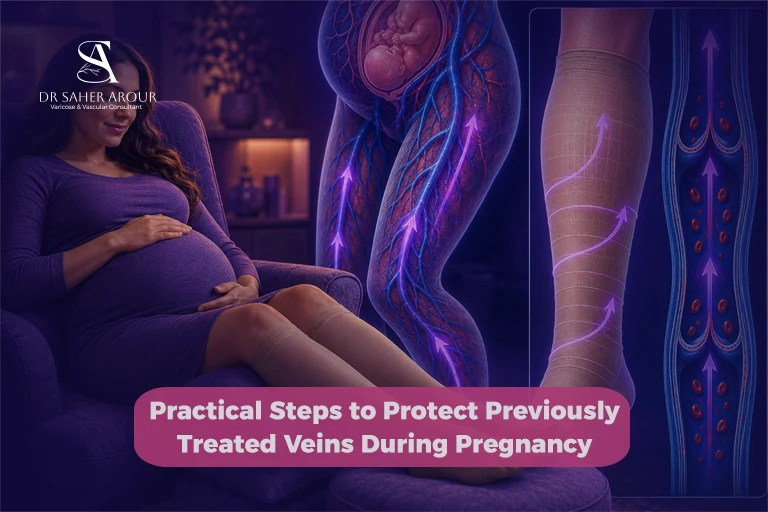
During pregnancy, treatment is mainly symptomatic rather than curative [7]. In clinical studies, seven trials involving 326 women used phlebotonic and compression therapies for symptom relief [7]. Wearing compression stockings pregnancy after vein treatment manages leg heaviness by gently squeezing the tissues to push blood upwards. I specifically recommend medical-grade graduated compression stockings, ideally 20 to 30 mmHg. Put them on right before you get out of bed in the morning to prevent swelling before gravity takes over. Staying active with light walking and elevating your legs when you rest will also keep your blood moving effectively.
When to See a Vascular Specialist During Pregnancy After Previous Treatment
While most vein changes are harmless, we never ignore vascular safety. Pregnancy is a prothrombotic state with venous stasis, endothelial damage, and hypercoagulability [2]. Your blood naturally clots more easily to protect you during delivery, but this means varicose veins are an independent additional risk factor for incident VTE in pregnancy [8].
If you suspect a Deep Vein Thrombosis (DVT), you need immediate evaluation. Statistically, 82% of DVT in pregnant and postpartum women occurs in the left lower extremity [2]. Contact your doctor right away if you notice sudden, severe leg pain, intense localized swelling, or red, hot skin. Remember that postpartum VTE risk is around 5-fold higher than during pregnancy [8], so please remain watchful even after your baby arrives.
FAQ Section: People Also Ask
Can varicose veins come back during pregnancy after treatment?
Yes, pregnancy is a known risk factor for recurrence or new varicose veins due to hormonal and mechanical changes, even after prior treatment.
Is it safe to have varicose vein treatment before getting pregnant?
Yes, most treatments like EVLA or RFA are considered safe before pregnancy, but pregnancy can still cause new vein changes later.
Which varicose vein treatments are unsafe during pregnancy?
Interventional treatments like sclerotherapy or ablation are generally avoided during pregnancy unless medically necessary.
Should I wear compression stockings during pregnancy if I had ablation before?
Yes, compression stockings are commonly recommended to help manage symptoms and support venous circulation during pregnancy.
Will pregnancy ruin my previous varicose vein results permanently?
Not necessarily; some vein changes improve after delivery, but recurrence or new veins can occur, especially with multiple pregnancies.
References
- [1] Global impact and contributing factors in varicose vein disease development
- [2] Cardiovascular changes during pregnancy
- [3] 2018 ESC Guidelines for the management of cardiovascular diseases during pregnancy
- [4] Varicose veins and chronic venous disease characteristics
- [5] Maternal Cardiovascular Changes During Pregnancy
- [6] Comparison of Varicose Vein Treatments and Recurrence Rates
- [7] Management of Venous Insufficiency During Pregnancy
- [8] Pregnancy and Venous Thromboembolism