
Today I will share with you one of the most searched topics: Vascular Disease with No Symptoms. You can feel perfectly healthy while plaque quietly builds up inside your arteries. Many patients I treat are completely caught off guard by a diagnosis, simply because vascular disease no symptoms silent progression is a very common reality. Instead of waiting for an emergency,
Medically Reviewed & Written by Dr. Saher Arour,
Board-Certified Vascular Surgeon
understanding this silent window is the smartest step you can take to protect your Vascular Health Pillar.
- Atherosclerosis develops slowly; early on, you won’t feel it at all [1].
- Peripheral artery disease (PAD) is often completely silent, or it causes vague leg discomfort you might easily brush off [1].
- Not everyone needs a scan. But if you have specific risk factors, a simple Vascular Screening using a resting ABI test is a smart, preventive step [2].
Table of Contents
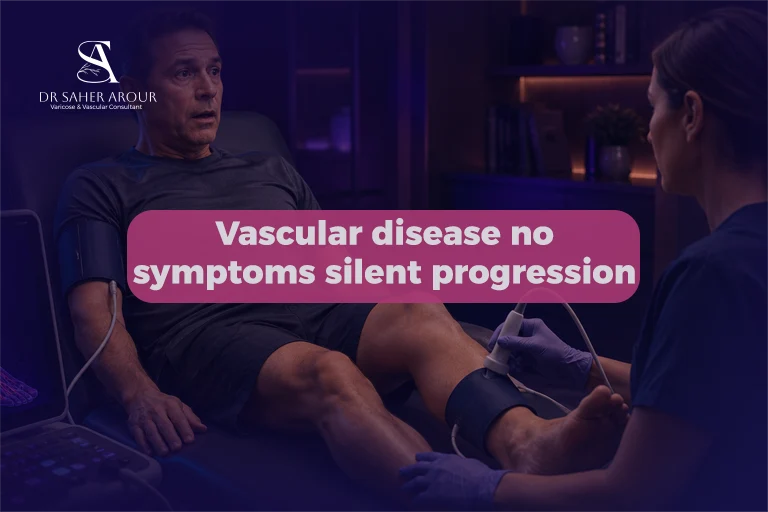
Can Vascular Disease with No Symptoms and Progress Silently?
Yes. Vascular diseases like atherosclerosis and PAD often develop slowly without symptoms, silently narrowing arteries for years before causing pain or limiting blood flow.
It starts with atherosclerosis: a slow process where plaque forms inside your arterial walls [3]. A lot of people assume they’ll feel a blockage growing, but your body doesn’t work that way. You can actually have a significant burden of arterial lesions without ever feeling that classic leg pain [2].
Medically, asymptomatic PAD is a formally recognized clinical subset of peripheral artery disease [2].
Just because you don’t have symptoms doesn’t mean a severe event is right around the corner. The disease progresses differently for everyone [1]. However, if an abnormal ABI test reveals you have asymptomatic PAD, we know it’s linked to poorer cardiovascular health overall. So, we never treat it as harmless just because your legs don’t hurt yet [2].
Why Vascular Disease Progresses Without Symptoms: The Anatomy of Silent Damage
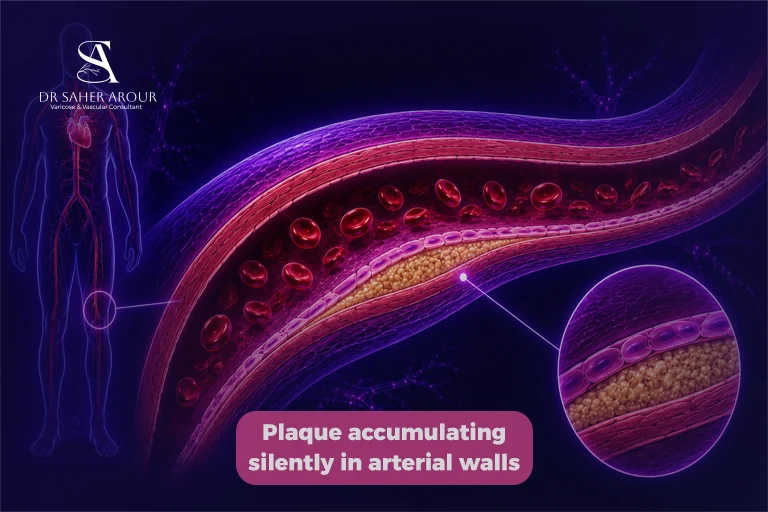
Your vascular system is incredibly resilient. While that resilience keeps you moving, it is also the exact reason early atherosclerosis rarely causes symptoms [1].
Slow Narrowing: How Arteries Compensate Until Symptoms Appear
Arterial disease stays clinically silent long before ischemia (a lack of oxygen to your tissues) actually sets in [1]. As plaque slowly builds up, your arteries narrow, reducing the oxygen-rich blood reaching your body [3].
Whether you feel this depends entirely on which artery is affected and how much the blood flow drops. There is no magic percentage of narrowing that universally triggers pain [1].
Collateral Circulation: The Body’s Hidden Backup That Can Mask Disease
One of the body’s most remarkable survival tools is collateral circulation. When a main artery slowly blocks, chronic PAD triggers nearby smaller blood vessels to remodel and expand, literally building a natural detour around the blockage [4].
This hidden backup system keeps blood flowing, but it doesn’t mean you’ll stay symptom-free forever [4].
Three Stages of Silent Vascular Disease Progression
Honestly, we don’t use a rigid percentage rule to stage every vascular disease.
PAD, for example.. is divided into 4 recognized clinical subsets [2]. However, breaking down the general progression helps explain why you feel fine while the disease advances, now let’s explain these stages:
Stage 1: Subclinical Plaque Buildup (No Symptoms)
During this initial phase, early atherosclerosis is entirely asymptomatic [1]. We can sometimes spot it using noninvasive markers, like checking your carotid intima-media thickness (CIMT) to measure early arterial injury, which is tied to future cardiovascular risk [5]. Understanding the link between Cholesterol and Artery Narrowing at this stage is crucial for prevention.
Stage 2: Hemodynamically Significant Stenosis (May Have Subtle or No Symptoms)
Even as the narrowing becomes severe, your body might still hide it. Surprisingly, only about one-third of PAD patients ever experience typical claudication: that classic cramping pain in the calf when you walk [2].
Stage 3: Critical Stenosis or Acute Event (Sudden Symptoms)
If a plaque suddenly ruptures, a blood clot (thrombosis) forms. This leads to an acute arterial blockage [3]. At this advanced stage, the obstruction can trigger major cardiovascular, cerebrovascular, or limb-threatening complications [3].
Who Is Most at Risk of Silent Vascular Disease?
Silent plaque buildup doesn’t happen by accident. Knowing your personal risk profile is your best defense. We typically evaluate several key factors:
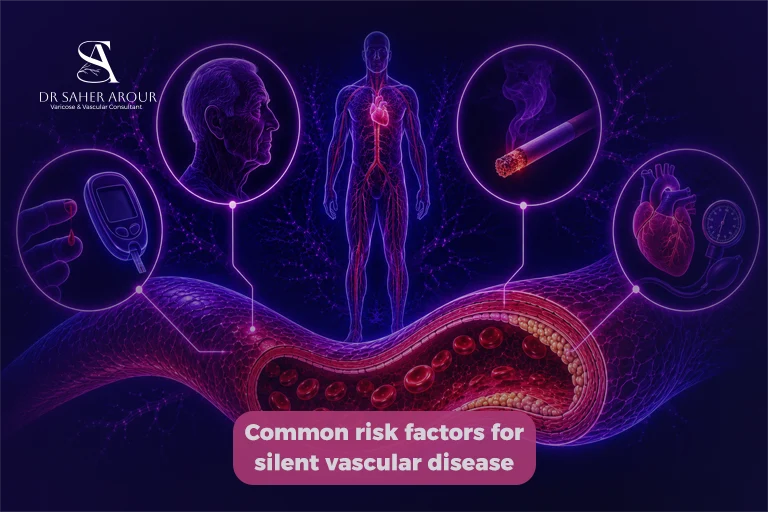
Risk Factors: Diabetes, Smoking, Hypertension, Family History, Age
- Age and Lifestyle: If you are between 50 and 64 and have a history of smoking, you are in a higher-risk group for PAD [2].
- Underlying Conditions: High blood pressure (hypertension), high cholesterol, and heart disease strongly increase your risk for both PAD and asymptomatic carotid stenosis [6].
- Biological Factors: Being male and having a family history of PAD also elevate your baseline risk [6].
Why Diabetics Are Vulnerable to Silent PAD
Diabetes is a major, established driver of PAD [7]. In one major screening program, nearly half of the people newly diagnosed with PAD had zero symptoms [7]. Managing Peripheral Artery Disease in Diabetics is challenging because diabetes often causes nerve damage (neuropathy) that blunts pain. It can also limit a person’s daily physical activity enough that they never push their legs hard enough to trigger the cramping [2].
Hidden Signs Your Body May Be Showing: Subtle Clues Often Missed
Even without sharp pain, your body leaves clues. When I examine patients, I look for physical changes that you might miss at home:
- Classic Claudication: An aching or cramping in the leg muscles when you walk, which completely goes away after less than 10 minutes of rest [2].
- Reduced Stamina: Noticeably shorter walking distances or odd, atypical leg fatigue [2].
- Skin and Color Changes: A red discoloration when the legs hang down, known as dependent rubor [2].
- Hair and Muscle Loss: Asymmetric hair loss on the shins or a visibly shrinking calf muscle (atrophy) [2].
Screening Tests That Can Detect Asymptomatic Vascular Disease in Appropriate Risk Groups
You don’t need every vascular test available just because you feel fine. Tests like CIMT, CAC, ABI, and carotid ultrasounds are not interchangeable, and they aren’t meant for universal screening [6]. We rely strictly on clinical guidelines to decide what makes sense for you:
| Condition | Screening Method | Clinical Recommendation Details |
| Peripheral Artery Disease (PAD) | Resting Ankle-Brachial Index (ABI) | Reasonable in patients at increased PAD risk [2]. Routine screening is not recommended for people who are not at increased risk [2]. An ABI of 0.9 or lower may indicate PAD [8]. |
| Abdominal Aortic Aneurysm (AAA) | Abdominal duplex ultrasonography | One-time screening is recommended for men aged 65 to 75 years who have ever smoked [9]. Most AAAs remain asymptomatic until rupture [9]. |
| Asymptomatic Carotid Artery Stenosis | Carotid duplex ultrasound | Routine screening is not recommended for asymptomatic adults in the general population because potential harms outweigh benefits [6]. |
FAQ Section: People Also Ask
Can you have vascular disease without any symptoms?
Yes. PAD can be completely asymptomatic or present with nonclassic symptoms [1]. You can actually have significant arterial lesions without noticing any leg symptoms [2].
How long can vascular disease develop silently?
Atherosclerosis is a slowly developing process that involves plaque forming in your arterial walls, and the early stages often don’t cause any symptoms [3]. The exact timeline varies significantly depending on the condition and your personal risk factors.
What tests detect silent vascular disease?
The right test depends entirely on the suspected condition and your personal risk profile. For example, a resting ABI is reasonable if you are at an increased risk for PAD [2]. Meanwhile, abdominal duplex ultrasonography is the primary method for AAA screening in specific at-risk groups [9].
What are the earliest hidden signs of vascular disease?
You might notice a reduced walking function or atypical leg fatigue when you exert yourself. These subtle changes warrant a professional clinical assessment rather than trying to self-diagnose [2].
Should I get screened for vascular disease if I feel fine?
Routine ABI screening isn’t recommended if you aren’t at an increased risk for PAD [2]. However, the USPSTF does recommend a one-time AAA ultrasound for men aged 65 to 75 who have ever smoked [9].
Can asymptomatic carotid artery stenosis be found through routine screening?
While testing modalities like a carotid ultrasound do exist, routine screening isn’t recommended for asymptomatic adults in the general population because the potential harms outweigh the clinical benefits [6].
References
- [1] Early stages of atherosclerosis often do not cause symptoms. https://www.nhlbi.nih.gov/health/atherosclerosis/symptoms
- [2] The clinical presentation of PAD can be classified into 4 clinical subsets… https://pmc.ncbi.nlm.nih.gov/articles/PMC12782132/
- [3] Atherosclerosis develops slowly… https://www.nhlbi.nih.gov/health/atherosclerosis
- [4] Collateral circulation… https://pmc.ncbi.nlm.nih.gov/articles/PMC2655423/
- [5] Carotid IMT and plaque predict incident CVD… https://pmc.ncbi.nlm.nih.gov/articles/PMC4213289/
- [6] USPSTF Carotid artery stenosis screening. https://www.uspreventiveservicestaskforce.org/uspstf/recommendation/carotid-artery-stenosis-screening
- [7] Diabetes increases the risk of PAD… https://pmc.ncbi.nlm.nih.gov/articles/PMC10725811/
- [8] USPSTF PAD screening with the ankle-brachial index. https://www.uspreventiveservicestaskforce.org/uspstf/document/RecommendationStatementFinal/peripheral-artery-disease-in-adults-screening-with-the-ankle-brachial-index
- [9] USPSTF AAA screening. https://www.uspreventiveservicestaskforce.org/uspstf/recommendation/abdominal-aortic-aneurysm-screening