Can Varicose Veins Cause Back Pain? If you’re dealing with a stubborn backache and wondering if those visible veins on your legs are to blame, I’ll give you a straightforward answer.. Ordinary leg varicose veins don’t directly cause back pain [1]. However, there’s a deeper vascular connection that often goes unnoticed. Some people experience back pain due to a related condition called pelvic congestion syndrome, a type of pelvic venous disorder affecting the veins hidden deeper inside the body.
When you’ve got leg vein issues alongside lower back discomfort, it helps to understand what’s actually happening beneath the surface.
Medically Reviewed & Written by Dr. Saher Arour,
Board-Certified Vascular Surgeon
Here’s how we typically make sense of these symptoms:
- Normal varicose veins on your legs aren’t considered a direct source of spinal or back pain.
- Pelvic venous disorders are linked to chronic pelvic pain, and they can sometimes involve back discomfort [1].
- Finding the real cause requires careful clinical assessment rather than just relying on the pain alone [2].
It’s normal to feel confused about how a vein issue could cause back pain. Let’s look closely at how your venous system works and figure out when your back pain might actually have a vascular link.
Table of Contents
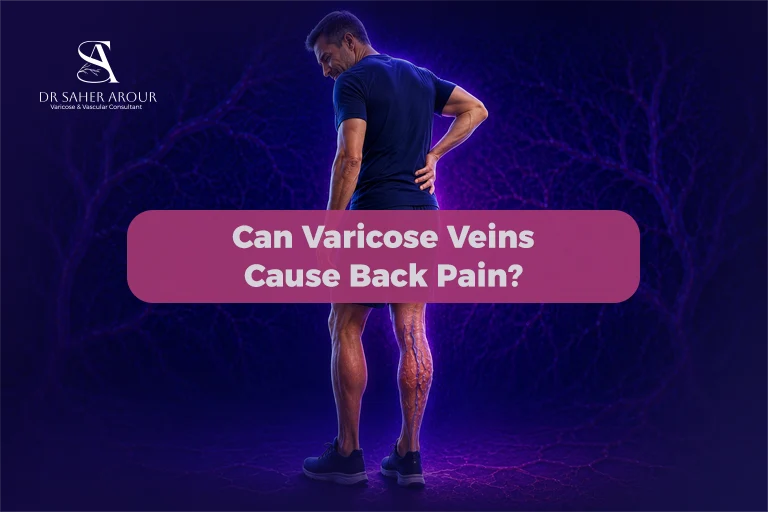
Can Varicose Veins Cause Back Pain Through Pelvic Venous Disorders or Related Changes?
You might wonder if those swollen veins on your calves are somehow pulling on your back muscles. The reality is they aren’t. But if we look higher up, we find a condition called pelvic venous disorder (PeVD). This disorder is associated with chronic pelvic pain [1].
In certain cases, chronic lower back pain is reported as an atypical presentation of pelvic congestion syndrome (PCS) [3]. This means that while the twisted veins on your legs aren’t triggering your back ache, a deeper issue in your pelvic veins might be contributing to the heavy discomfort you feel.
To give you an idea of how often these issues overlap, a recent medical review of 54 women with pelvic congestion syndrome found that nearly half of them “48% to be exact” reported having lower back pain [4].
While we shouldn’t automatically apply those exact numbers to men, it clearly shows how strong the connection can be between pelvic veins and your back [4].
Orthopaedic Back Pain vs Signs of a Possible Vascular Cause — How to Tell Them Apart
Since low-back pain and sciatica-like symptoms are extremely common and nonspecific, a possible pelvic venous cause requires careful medical evaluation rather than guessing based on how it feels [5].
You simply can’t diagnose a vascular issue just by the presence of pain. We’ve got to separate standard muscle or spinal problems from possible vein-related pressure.
Symptoms That Suggest an Orthopaedic Cause (Muscle Strain, Disc Issues)
Most back pain is mechanical. If your pain started right after lifting something heavy, twisting awkwardly, or sitting at your desk all day, it’s likely related to your muscles, ligaments, or the lumbar spine.
Orthopaedic pain usually gets sharper when you bend, twist, or walk. If lying down and resting your back immediately stops the pain, we first consider standard musculoskeletal causes [5].
Symptoms That May Suggest Pelvic Venous Disease as a Possible Cause of Back Pain
If your back pain doesn’t fit the usual orthopaedic patterns, we start looking at vascular causes. Pelvic venous disease may involve obstruction or reflux affecting the renal, ovarian, or iliac veins [1]. You might suspect a vascular link if you notice:
- A heavy, aching feeling deep in your pelvis or lower back that gets much worse after standing for a long time.
- Visible varicose veins around the pelvic area, groin, or upper thighs, not just the lower legs.
- Pain that simply doesn’t respond to physical therapy, standard pain medications, or chiropractic adjustments.
- Symptoms that seem to flare up at specific times, especially if you’ve got a known history of pelvic varicose veins.
The Anatomy and Mechanism — Why Varicose Veins Develop and May Be Associated With Back Pain
To understand the connection, we’ve got to talk about how blood flows. Your veins carry blood back up to your heart. When the tiny valves inside them fail, blood flows backward and pools up. Medically, we call this venous reflux.
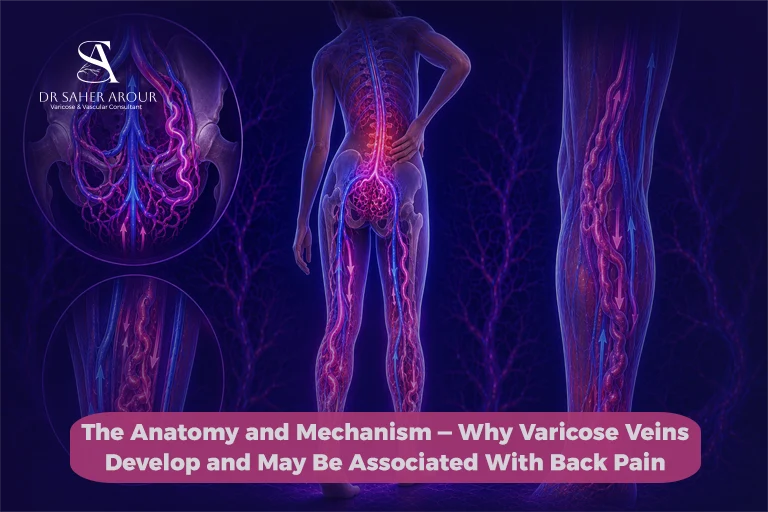
How Pelvic Varicose Veins and Venous Reflux May Be Associated With Lower Back Pain
When reflux happens deep inside the pelvic area, it creates localized pressure. The manifestations of pelvic venous disease depend entirely on the underlying venous disorder [1]. As the veins stretch and swell with pooled blood, the surrounding tissues can become irritated. Because the nerves in the pelvic region run so close to the lower back, this internal pressure can sometimes feel like a dull, dragging ache in your lower spine.
How Altered Gait From Leg Vein Pain May Affect the Lower Back
While ordinary leg varicose veins don’t directly cause back pain [1], severe leg pain from venous insufficiency can make you walk differently. This is called an altered gait. Here’s exactly how this chain reaction happens in your body:
- Your stride changes: You might limp or favor one leg simply because it feels heavy and painful to walk on.
- Your posture shifts: To handle this uneven movement, your body naturally adopts a compensatory posture.
- Your back takes the strain: Over time, walking unevenly puts extra stress on your lumbar spine and back muscles, which can eventually lead to secondary orthopaedic back pain.
Three Common Misdiagnoses and Why a Vascular Cause May Be Overlooked
Because pelvic congestion syndrome back pain is an atypical presentation [3], it’s very easy to miss. PCS can present with low-back pain or sciatica-like symptoms in individual cases [5].
Here’s how it frequently gets confused with other conditions.
Misdiagnosed as Lumbar Disc Herniation
Many people with back pain get an MRI of their spine. If a small disc bulge shows up, the pain is instantly blamed on that bulge. But if treatments for the disc don’t help at all, it might be because the pain is actually coming from inflamed pelvic veins mimicking spinal nerve irritation. Alternative spinal and musculoskeletal causes must always be considered first [5], but if they’re ruled out, vascular sources should be checked.
Misdiagnosed as Chronic Muscle Spasms
A deep, dull ache in the lower back is often treated as a chronic muscle spasm. You might go through months of massages and muscle relaxers. If the real issue is pelvic venous congestion, these muscle treatments will only offer temporary relief because they don’t address the blood pooling in your veins.
Misdiagnosed as Isolated Sciatica
Because PCS can present with sciatica-like symptoms [5], you might be told you simply have isolated sciatica. But true sciatica involves a pinched nerve in the back that follows a very specific path down the leg. If your leg and back pain don’t match those typical nerve compression patterns on an exam, taking a closer look at your vascular health might finally give you the answers you need.
Practical Steps to Get the Right Diagnosis for Possible Vascular-Related Back Pain
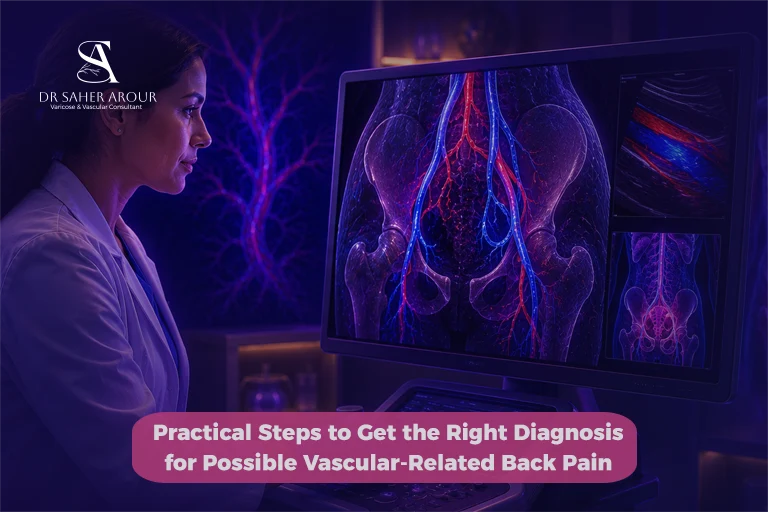
To find out if your back pain is truly connected to your veins, clinical assessment plus appropriate imaging is absolutely required [2]. Figuring out whether your veins are behind your back pain requires a structured approach. Here’s exactly what we evaluate to reach a clear diagnosis:
| Step | What We Do | Why It Matters |
| Clinical History | Detailed discussion of when the pain starts and what makes it worse. | Helps separate mechanical back pain from pressure-related vein pain. |
| Noninvasive Imaging | Using Doppler ultrasound or MRI. | Noninvasive imaging can assist with diagnosis and treatment planning [2]. |
| Advanced Imaging | Catheter venography. | This is the criterion standard for imaging diagnosis in pelvic venous congestion syndrome [2]. |
Keep in mind that pelvic venous dilation and reflux can occur without pelvic pain, which means imaging findings must always be interpreted alongside your actual symptoms [2]. Just seeing a swollen vein on a scan doesn’t automatically prove it’s the source of your discomfort.
When to See a Vascular Specialist for Back and Leg Pain
If you’ve tried standard back pain treatments for months without any real relief, it might be time to look beyond your spine. You should consider consulting a vascular specialist, particularly if you notice:
- Persistent discomfort: Your back pain continues despite physical therapy, rest, or standard medications.
- Visible signs: You have noticeable varicose veins on your legs or heavy discomfort in your pelvic area.
- Complex symptoms: Your pain involves multiple areas, making it hard for just one medical specialty to figure out the exact cause.
If we find that pelvic veins are the root problem, treatments like transcatheter embolization—a minimally invasive procedure used to close off the faulty veins—can be highly effective. Here’s what the medical data tells us about this approach:
- High success rates: When researchers reviewed the outcomes of over 2,000 women across 25 different studies, they found a 94% technical success rate with an overall complication rate of just 9.0% [6]. While these specific figures come from female patients and shouldn’t be presented as male-specific, they give you a very clear picture of how safe and effective this approach can be [6].
- Potential for rapid relief: Even though large studies give us the best overall data, smaller reports show us just how much personal relief is possible. For instance, in one small report of four selected patients, they experienced almost complete symptom resolution just one month after treatment. Because this is a tiny group, it’s considered low-level evidence and we can’t promise that exact general treatment effect for everyone, but it shows the real potential for getting your life back [3].
To learn more about how to differentiate between joint pain and vein pain, you can read our guide on orthopaedic vs vascular leg pain or return to our main Varicose Veins Pillar.
FAQ Section — People Also Ask
Can varicose veins cause lower back pain?
Ordinary leg varicose veins don’t directly cause back pain [1]. However, abnormal veins in the pelvic area, known as pelvic venous disorders, are associated with chronic pelvic pain and can sometimes present with lower back discomfort [1] [3].
How do you know if back pain may have a vascular cause?
Low-back pain and sciatica are nonspecific [5]. A possible pelvic venous cause requires clinical assessment plus appropriate imaging rather than symptom-based diagnosis alone [2] [5].
Can pelvic congestion syndrome cause back pain?
Yes, chronic lower back pain has been reported as an atypical presentation of PCS [3]. In a 2026 retrospective study of 54 women with PCS, lower back pain was reported in 48% of the cohort [4].
Does treating varicose veins relieve back pain?
Treating normal leg veins won’t fix a back problem. However, if back pain is linked to pelvic venous congestion, treating the pelvic reflux may help. In a small series of 4 selected patients, almost complete symptom resolution was reported at 1 month after treatment, though this is low-level evidence [3].
What are the symptoms of a possible vascular cause of back pain?
PCS can present with low-back pain or sciatica-like symptoms in individual cases [5]. It often involves a dull ache that worsens with prolonged standing and may be accompanied by visible pelvic varicosities.
References
- [1] Pelvic Venous Disorders: Comprehensive Review of Pathophysiology, Diagnosis, and Management
- [2] Diagnosis and Management of Pelvic Venous Congestion Syndrome
- [3] Case report: Atypical presentation of pelvic congestion syndrome
- [4] Lower Back Pain as a Clinical Manifestation in Women with Pelvic Congestion Syndrome
- [5] Pelvic congestion syndrome masking as a sciatica-like condition
- [6] Efficacy of transcatheter embolisation for pelvic congestion syndrome