
I know how difficult it is to go through an unsuccessful IVF cycle, especially emotionally. You’re probably thinking right now about exactly what went wrong and how to fix it before you try again. Often, we find that the male partner’s health is overlooked. If you’re exploring male factors, the question of a varicocele IVF failure should treat first approach often arises.
A varicocele is an abnormal enlargement of the pampiniform plexus veins in the scrotum [1], and it’s one of the most common reversible causes of male infertility [2].
Here’s some of what I’m going to share with you in this article:
- It affects 19% to 41% of men with primary infertility [2].
- Routine semen testing can appear perfectly normal while completely missing underlying sperm DNA defects [3].
- Treating clinical varicoceles may improve reproductive outcomes and offer a real chance to understand the full picture before your next attempt.
We need to find out exactly what caused the setback so we can drop your risk of another disappointment.
Table of Contents
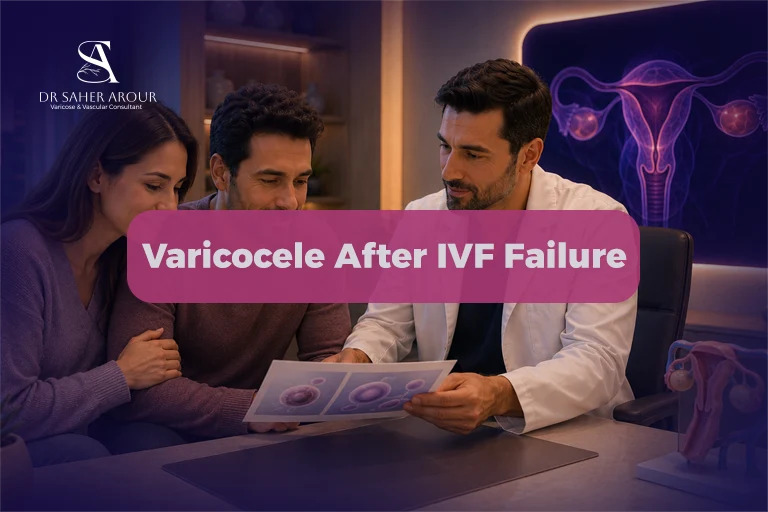
Should You Check for a Varicocele After IVF Failure Before the Next Cycle?
- Yes. Evaluating for a clinical varicocele is highly recommended after repeated IVF failure, as it frequently increases sperm DNA fragmentation despite normal semen analysis [4].
Finding out exactly why an IVF cycle didn’t succeed is key for your peace of mind and your future plans. When couples experience repeated in vitro fertilization or ICSI failures, combined oxidative stress and DNA fragmentation testing is recommended [4].
A varicocele creates a testicular environment that favors oxidative stress [4], which damages both nuclear and mitochondrial sperm DNA [5]. This damage may affect embryo development indirectly. When investigating recurrent IVF failure male factor issues, you might wonder if a varicocele and male infertility IVF connection is at play. Evaluating the scrotal veins helps us build the right personalized plan for you.
Normal Semen Analysis vs Hidden Varicocele Damage .. How to Tell Them Apart
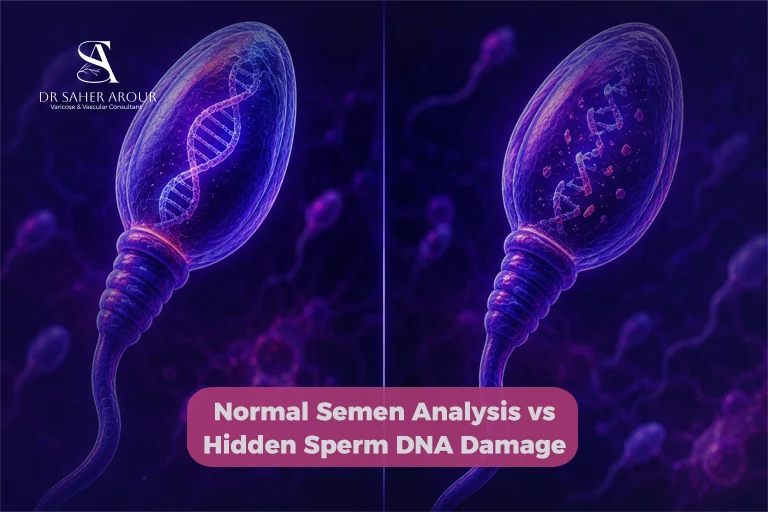
A standard semen test looks at how many sperm are present and how they move. But to be realistic, routine semen analysis provides limited information about a man’s reproductive potential and can miss sperm DNA defects [3].
In fact, abnormal DNA fragmentation levels are found in up to 20% of men with unexplained infertility who have normal routine semen parameters [6]. To make this easier to understand, here’s how the two approaches compare:
| Test Type | What We Look For | What You Should Know |
| Routine Semen Analysis | Basic sperm count, shape, and movement. | It provides limited information and can miss underlying sperm DNA defects [3]. |
| Advanced DNA Testing (SDF) | Hidden damage to nuclear and mitochondrial sperm DNA. | Abnormal levels are found in up to 20% of men with unexplained infertility despite normal routine semen parameters [6]. |
Signs That IVF Failure Is Likely Female-Factor (Normal Male Workup)
When the male partner has completely normal sperm DNA integrity and no signs of clinical varicocele, we know that male factors are less likely to blame. Please don’t feel discouraged if this happens, as narrowing down the exact cause is a normal and necessary part of your fertility journey. At this point, the focus naturally shifts to female-related factors.
Your fertility team will look into egg quality, the uterine environment, or hormonal balances to find out what’s wrong and adjust your treatment accordingly.
Signs That Suggest an Undiagnosed Varicocele Is Contributing to Recurrent Failure
If you’re dealing with repeated setbacks, a hidden varicocele might be involved. The presence of a varicocele is associated with increased sperm DNA fragmentation and impaired sperm DNA integrity [2].
The currently established clinical threshold is a DNA Fragmentation Index (DFI) above 25%, and men crossing this line fall into the statistical probability of encountering reproductive problems [2]. Also, higher clinical grades of varicocele are associated with higher reactive oxygen species (ROS) and DNA fragmentation [4]. For men with a grade 3 varicocele IVF success can be hindered, as grade III varicoceles are associated with significantly higher DFI than grades I and II [7].
The Varicocele–Fertility Link .. Why Heat, Oxidative Stress and DNA Fragmentation May Lower IVF Success
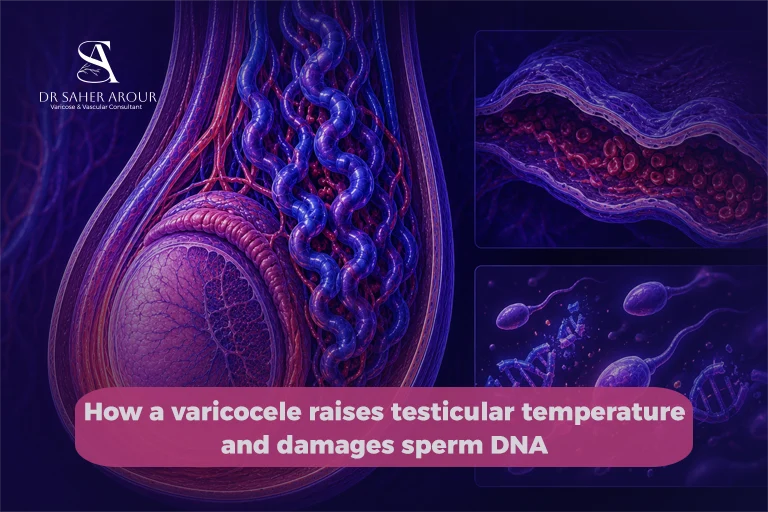
You might wonder how enlarged veins in the scrotum can affect a high-tech procedure like IVF. The connection comes down to temperature and cellular stress.
How Testicular Temperature Affects Sperm Quality
Spermatogenesis is a temperature-sensitive process, and the heat stress caused by a varicocele is considered the most plausible cause of impaired sperm production [8]. The enlarged veins cause small vessel obstruction and venous stasis, leading to raised scrotal temperature and tissue hypoxia, which can reduce spermatogenesis [2].
What Happens to Sperm DNA When Veins Stay Dilated
When veins stay enlarged, they create an environment that favors oxidative stress [4]. This means harmful molecules overwhelm the body’s natural antioxidants. Increased DNA fragmentation levels, commonly seen in men with clinical varicocele, are plausibly the endpoint of this oxidative-induced damage [9]. The sperm DNA fragmentation varicocele link is clear: research shows that varicocele is associated with one of the most significant increases in SDF, measuring a mean difference of 13.62% compared to healthy controls [10].
Three Scenarios After IVF Failure .. When to Consider Treating the Varicocele First
We always look at each couple uniquely to find the best path forward. Here’s how we evaluate the need for varicocele repair before retrying IVF.
Clinical Varicocele With Abnormal Semen Parameters
If a physical exam shows a clinical varicocele and the standard semen test is abnormal, treatment is a very strong option. Men with clinical varicocele and infertility who exhibit elevated SDF are reasonable candidates for repair, especially if they’ve prior ART failure [4]. To give you an idea of what this means for your actual chances, research shows that varicocelectomy improves sperm concentration by a mean of 9.59, progressive motility by 8.66, and morphology by 2.73 [2]. For men undergoing ICSI, prior varicocele repair is associated with an improved fertilization rate, a clinical pregnancy odds ratio of 1.38, and a live birth odds ratio of 2.07 [11].
Subclinical Varicocele With High DNA Fragmentation Index (DFI)
A subclinical varicocele is one we can’t feel during a physical exam but can see on an ultrasound. Even if DFI is high, the current medical evidence shows that varicocele repair doesn’t seem to improve SDF rates in men with subclinical varicocele [6]. In cases of subclinical varicocele IVF protocols may need to be adjusted instead of pursuing surgery, and we’ll guide you toward other ways to improve sperm health.
Recurrent Embryo Arrest or Repeated Implantation Failure
When embryos repeatedly stop growing or fail to implant, we must consider the sperm’s genetic health. DNA testing is recommended in repeated IVF or ICSI failure and poor embryo development [4]. If we find a clinical varicocele alongside high DNA damage, treating the varicocele may help. Looking at the varicocele repair before IVF success rate, we see that infertile men who received a varicocelectomy had a significantly higher clinical pregnancy rate (OR 1.38) and a significantly higher live birth rate (OR 2.18) compared to a control group [12].
Practical Steps to Work Up the Male Partner Before the Next IVF Cycle
Before moving forward with another cycle, we need to ensure the sperm is as healthy as possible. We’ll examine you thoroughly to understand your specific situation.
- Get a detailed physical exam: We check for a clinical varicocele, as this is the type that benefits most from treatment.
- Order advanced sperm testing: SDF testing is recommended in patients with clinical varicocele and borderline to normal semen parameters to better select varicocelectomy candidates [13].
- Discuss treatment types: Reduction in SDF is evident with both the microsurgical technique (SMD -1.014) and non-microsurgical inguinal approaches (SMD -1.495) [14]. As for varicocele embolization fertility outcomes, both surgery and embolization aim to block the faulty veins, and we’ll choose the safest route for you.
- Set realistic timelines: After a varicocelectomy, the mean SDF decrease is 6.74% at three months and reaches 12.39% after six months [15]. While DFI improves significantly within 3 and 6 months, no significant further improvement is observed when the follow-up period reaches 12 months [16].
When to See a Male Fertility / Andrology Specialist Before Retrying IVF
If you’ve faced a failed IVF cycle, consulting a male fertility specialist can provide clarity. We want to find out what’s wrong instead of rushing into another costly procedure. Although the overall evidence quality for SDF testing recommendations remains moderate to low [6], the clinical reality is that checking for a varicocele and high DFI can be highly useful. Evaluating a scrotal vein varicocele IVF outcome helps us understand what to expect.
While it’s important to know that out of 76 patients in a prospective study, 29% became fertile and 71% remained infertile after varicocelectomy [1], the procedure still significantly reduces seminal malondialdehyde [14] and improves live birth rates in fertility programs [17]. A specialist can help you weigh these odds honestly and safely.
FAQ Section .. People Also Ask
Can a varicocele cause IVF failure even if the semen analysis is normal?
Yes, a varicocele may contribute to poor outcomes because routine semen quality analyses fail to detect sperm DNA defects [3]. Elevated DNA fragmentation is common and may affect fertilization and development.
Should I treat the varicocele before the next IVF cycle?
Men with clinical varicocele and infertility who exhibit elevated SDF are reasonable candidates for repair, especially those with prior ART failure [4].
Does varicocele repair improve embryo quality or only sperm count?
Varicocelectomy significantly reduces sperm DNA fragmentation [14], which improves sperm genetic health and may indirectly support better embryo development.
Is varicocele embolization as effective as surgery before IVF?
Both embolization and microsurgical varicocelectomy are used to treat the veins. DFI is a reliable predictor of microsurgical varicocelectomy efficacy for semen improvement [18], and we’ll help you choose the best technique for your body.
How soon after varico repair can we retry IVF?
Sperm improvement occurs over time. Follow-up results show a significant improvement in sperm DFI at 3 months, with further improvement by 6 months [16], so many couples plan their next IVF cycle within this window.
References
- [1] https://pmc.ncbi.nlm.nih.gov/articles/PMC10879313/
- [2] https://bacandrology.biomedcentral.com/articles/10.1186/s12610-020-00117-6
- [3] https://www.nature.com/articles/s41598-023-29688-8
- [4] https://www.mdpi.com/2076-3921/15/3/250
- [5] https://www.frontiersin.org/articles/10.3389/fgene.2022.851108/full
- [6] https://onlinelibrary.wiley.com/doi/10.1111/and.13874
- [7] https://www.auajournals.org/doi/10.1097/JU.0000000000000967.021
- [8] https://onlinelibrary.wiley.com/doi/10.1111/andr.12510
- [9] https://onlinelibrary.wiley.com/doi/10.1111/andr.12776
- [10] https://rbej.biomedcentral.com/articles/10.1186/s12958-023-01017-2
- [11] https://wjmh.org/DOIx.php?id=10.5534/wjmh.240132
- [12] https://journals.sagepub.com/doi/10.1177/15579883251321387
- [13] https://tau.amegroups.org/article/view/16120/html
- [14] https://wjmh.org/DOIx.php?id=10.5534/wjmh.230034
- [15] https://www.nature.com/articles/s41598-025-91283-2
- [16] https://journals.sagepub.com/doi/10.1177/15579883241284813
- [17] https://www.cell.com/heliyon/fulltext/S2405-8440(20)32316-0
- [18] https://journals.lww.com/ajandrology/fulltext/2022/24040/predictors_of_microsurgical_varicocelectomy.3.aspx