
Many men spend years frustrated by an unexplained for Pelvic varicose veins in men. They see multiple doctors, take rounds of antibiotics, and still find no real relief. The truth is, male pelvic congestion syndrome, caused by pelvic varicose veins, is very real, even though it is widely thought to affect only women. It is a hidden vascular issue that perfectly mimics other common urological problems.
Medically Reviewed & Written by Dr. Saher Arour,
Board-Certified Vascular Surgeon
If you have been dealing with this persistent ache, you are certainly not alone, and it isn’t just in your head. In this guide, we will cover the exact reasons behind this condition, including:
- Why these deep veins remain invisible on routine clinical exams.
- How they closely mimic conditions like chronic prostatitis.
- The advanced imaging steps you actually need to get a clear answer.
- When it’s time to stop taking antibiotics and consult a vascular expert.
Table of Contents

Are Pelvic Varicose Veins in Men Real and Often Misdiagnosed as Varicocele or Prostatitis?
Pelvic varicose veins in men are a hidden, underdiagnosed vascular condition that causes chronic pelvic heaviness and is frequently misdiagnosed as a varicocele or prostatitis.
It is incredibly frustrating to be told your ultrasound is completely normal when you are in constant pain. In reality, pelvic and gonadal venous reflux syndromes are underdiagnosed and undertreated, yet they remain significant causes of morbidity in men and women [1]. Chronic pelvic pain in men may present without pampiniform plexus involvement, yet with symptoms overlapping those of varicocele [2].
This simply means you can have swollen, painful veins deep inside your pelvis even if your scrotum looks entirely normal from the outside. That is exactly why we have to look deeper to find the real source of your discomfort.
Symptoms That Look Like Other Conditions vs Signs of Pelvic Varicose Veins : How to Tell Them Apart
Symptoms That Suggest a Urological Cause (Prostatitis, Varicocele, Epididymitis)
When you experience pelvic discomfort, most doctors will naturally suspect a urological issue first. That is why you might undergo extensive testing. For instance, chronic testicular pain is a well-known symptom, affecting up to 2% to 10% of patients with varicocele [3].
If the issue seems prostate-related, doctors highly consider CP/CPPS (Chronic Prostatitis/Chronic Pelvic Pain Syndrome). By definition, this diagnosis is made when pain has been lasting for at least 3 of the previous 6 months [4]. While these are valid diagnoses, they don’t always explain the full picture of what your body is experiencing.
Symptoms That Suggest Pelvic Varicose Veins as the Real Cause
If you are wondering whether your discomfort is vascular, pay attention to how your body responds throughout the day. Your veins might be the actual problem if you notice these specific signs:
- Worsens with standing: The pain gets noticeably worse or heavier after you stand for long hours.
- Feels heavy: You experience a deep, dragging ache rather than a sharp, sudden sting.
- Relieved by lying down: Resting flat gives you significant relief by the end of the day, which is a strong clinical clue pointing toward internal iliac vein reflux.
Simply put, the hallmark of a venous issue is blood pooling because of gravity. When the valves in your veins struggle to pump blood upward, it leads to painful swelling deep inside.
The Anatomy and Mechanism : Why Pelvic Varicose Veins Develop in Men

How Gonadal and Internal Iliac Vein Reflux Creates Pelvic Varicosities
Your veins contain tiny one-way valves designed to push blood up to the heart. When these valves fail, blood flows backward, a process we call venous reflux. In men, varicose veins can cause varicocele [5]. This backward pressure stretches the vessels, creating the aching and swelling you feel. But the pressure isn’t just confined to the visible areas; it builds up inside the entire pelvic network.
Why These Veins Stay Hidden on Standard Scrotal and Abdominal Ultrasound
Standard transabdominal and transscrotal ultrasound tests are excellent for checking surface issues or solid organs. However, your internal iliac veins lie deep within the pelvic floor. A routine scan simply doesn’t capture the complex network of deep pelvic veins where the actual pooling happens.
That is why your tests keep coming back normal despite your pain. Specialized vascular imaging is necessary to visualize these hidden varicosities accurately.
Three Common Misdiagnoses and Why Pelvic Veins Get Overlooked in Men
Misdiagnosed as Chronic Prostatitis / Chronic Pelvic Pain Syndrome (CPPS)
Doctors frequently tell men they just have an inflamed prostate. Because the symptoms mimic each other so closely, many men end up on long, unhelpful courses of antibiotics for a prostate infection they don’t actually have. Here is a breakdown of what we often see in these cases:
| Condition Fact | Clinical Details |
| Primary Diagnosis | CP/CPPS (Chronic Prostatitis/Chronic Pelvic Pain Syndrome) |
| Target Age Group | It is the most frequent urologic diagnosis in men younger than 50 years [4]. |
| Prevalence Rate | It has a mean prevalence of 8–8.2% [4]. |
| The Real Culprit | Male pelvic congestion syndrome, hidden deep within the pelvic veins. |
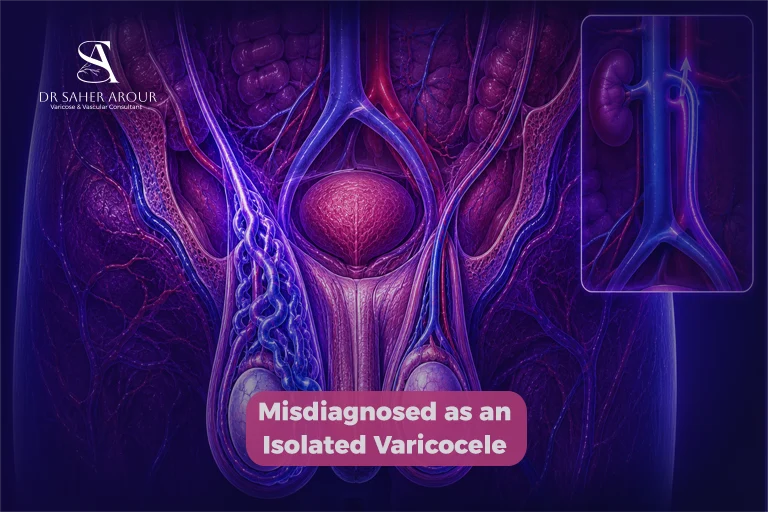
Misdiagnosed as an Isolated Varicocele
Sometimes, doctors find a surface varicocele and stop looking further. However, treating just the visible varicocele without addressing the deeper pelvic venous reflux won’t cure your underlying pain. Let me share some essential facts about this condition that help us see the bigger picture:
- General prevalence: Varicocele affects roughly 15 percent of males in the general population [6].
- Age progression: It occurs in 6% of children at age 10, 13% of adolescents, and 15 percent of adult males [6].
- Left-sided dominance: We know that approximately 90% of varicoceles are left-sided [7].
- The clinical red flag: If you present with an isolated right-sided varicocele, it is a strong indicator that a retroperitoneal abnormality should be excluded [8].
Misdiagnosed as Lumbar Spine or Musculoskeletal Pain
Because the internal pelvic veins rest closely against the back of the pelvis, swollen veins can press on nearby nerves. This referred pain is often mistaken for lower back issues or a pulled muscle. If physical therapy and painkillers aren’t helping your lower back or pelvic ache, we must consider a vascular origin.
Practical Steps to Get the Right Diagnosis for Pelvic Varicose Veins
To stop the guessing game and get you on the right path, we rely on highly specific diagnostic tools. Initially, noninvasive imaging modalities including ultrasound (US) and CT should be used for initial evaluation [9]. These tests give us a foundational view to rule out other severe abdominal conditions.
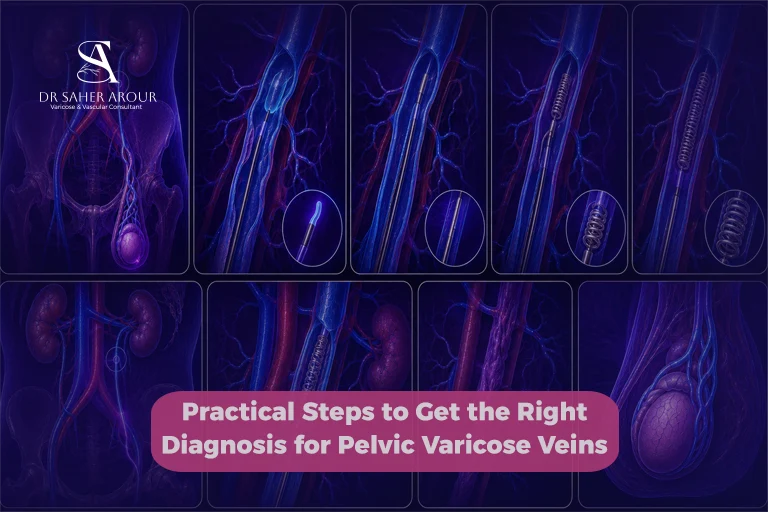
But to truly confirm the direction of blood flow and the extent of the venous reflux, we need to go a step further. Currently, catheter-directed venography remains the gold standard [9]. This allows us to see exactly where the valves are failing and map out a precise, targeted treatment plan.
When to See a Vascular Specialist for Pelvic Vein Symptoms
If you’ve been dealing with unexplained pelvic pain, or if your testicular pain isn’t improving with standard urological treatments, it’s time to see a vascular surgeon. You don’t have to live with a chronic ache indefinitely.
Modern vascular treatments are highly effective and minimally invasive. For example, a procedure like pelvic vein embolization in men yields excellent outcomes. Varicocele embolization has a success rate of between 70% and 100% [10]. While there is a recurrence rate of up to 16% [10], it is still an incredibly reliable option. Furthermore, for broader pelvic congestion syndrome, technical success is achieved in almost all cases (~100%) during embolization [10].
Here is a simple clinical breakdown to help you understand the core differences:
| Feature | Traditional Varicocele | Pelvic Varicose Veins |
| Primary Location | Scrotum (pampiniform plexus) | Deep Pelvis (internal iliac veins) |
| Visibility | Often visible or palpable during physical exam | Hidden from the surface |
| Common Symptoms | Testicular ache | Deep pelvic heaviness, radiating back pain |
| Gold Standard Diagnostic Test | Scrotal Ultrasound | Catheter-directed venography |
FAQ Section — People Also Ask
Can men get pelvic varicose veins?
Yes, but they are less common and often underdiagnosed; male pelvic venous disorders can occur independently of varicocele and may cause chronic pelvic pain.
Is pelvic congestion syndrome only a women’s condition?
No, it is more common in women but can also occur in men, although it is rarer and less frequently recognized.
How are pelvic varicose veins diagnosed in men?
Diagnosis typically requires imaging beyond standard ultrasound, such as CT/MR venography or venography, which is considered a reference standard for detecting venous reflux.
Can pelvic varicose veins cause testicular pain?
Yes, pelvic venous reflux can contribute to testicular or scrotal pain, sometimes mimicking or coexisting with varicocele.
What is the treatment for pelvic varicose veins in men?
Treatment may include minimally invasive procedures such as pelvic vein embolization, which can reduce symptoms in selected patients.
References
[1] Pelvic and Gonadal Venous Reflux Syndromes
[2] Chronic Pelvic Pain in Men
[3] Varicocele and Testicular Pain
[4] Chronic Prostatitis/Chronic Pelvic Pain Syndrome
[5] Varicocele Formation Mechanism
[6] Varicocele and its Treatment
[7] Left-Sided Varicocele Dominance