
Vascular leg pain typically worsens when you walk and improves when you rest. Orthopaedic pain usually flares up from joint movements, twisting, or bending.
Medically Reviewed & Written by Dr. Saher Arour,
Board-Certified Vascular Surgeon
And It’s normal to feel confused because these conditions often overlap.
That’s exactly why I wrote this guide which covers:
- Exact physical triggers separating vascular from musculoskeletal pain.
- Why issues like deep vein thrombosis are mistaken for muscle strains.
- Clear signs pointing to poor circulation vs nerve pain.
Table of Contents
How to Tell If Leg Pain Is Vascular or Orthopaedic?
To figure out where the discomfort is coming from, pay attention to your body’s triggers. Intermittent claudication from peripheral artery disease (PAD) usually causes aching, cramping, or heavy muscle fatigue during exertion that improves with rest [1]. Non-vascular causes for leg pain or claudication also exist, with hip arthritis being a common example [1].
However, symptom characteristics alone cannot reliably distinguish between vascular and neurogenic claudication [2]. A narrowed lumbar spinal canal, for instance, causes neurogenic claudication that closely mimics vascular claudication clinically [2].So that, a proper clinical assessment is necessary for an accurate diagnosis.
Symptoms That Look Like Other Conditions vs Signs of Vascular Pain : How to Tell Them Apart
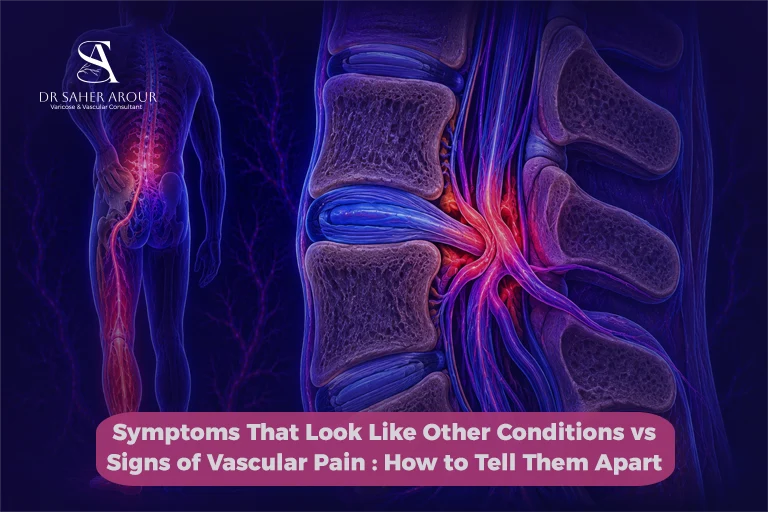
To make it easier for you, here is a quick breakdown of what triggers your pain based on its source:
| Pain Feature | Orthopaedic / Nerve Focus | Vascular Focus |
| Primary Triggers | Standing, bending, twisting the spine, or direct joint pressure. | Walking, exertion, or elevating the leg. |
| Relief Factors | Sitting down or changing posture. | Resting or hanging the foot off the bed (for severe blockages). |
| Sensation | Sharp, shooting, or localized joint aching. | Cramping, heaviness, tightness, or fatigue. |
Symptoms That Suggest an Orthopaedic Cause (Joint, Muscle, or Nerve Pain)
When looking at musculoskeletal leg pain vs vascular pain, physical movement triggers give us the biggest clues.
Certain symptom patterns strongly associate with neurogenic claudication, such as pain triggered simply by standing that improves when sitting, especially with symptoms above the knee [2].
If discomfort sharply worsens when bending, twisting, or pressing directly on a joint, orthopaedic leg pain causes are highly probable.
Symptoms That May Suggest Vascular Disease as a Possible Cause
Severely restricted arterial blood flow can cause ischemic rest pain, a distinctly different PAD symptom pattern compared to intermittent claudication [1]. This specific pain often wakes you at night, forcing you to hang your foot off the bed to find relief.
Venous claudication differs from arterial claudication in several noticeable ways:
- The pain feels like a tight, bursting sensation across the entire leg or calf [1].
- Discomfort improves gradually rather than fading immediately after stopping [1].
- Elevating the leg off the ground helps relieve the pressure and pain [1].
Additionally, venous claudication may associate with a history of iliofemoral deep vein thrombosis (DVT), edema (swelling), and clear signs of venous stasis [1].
The Anatomy and Mechanism :
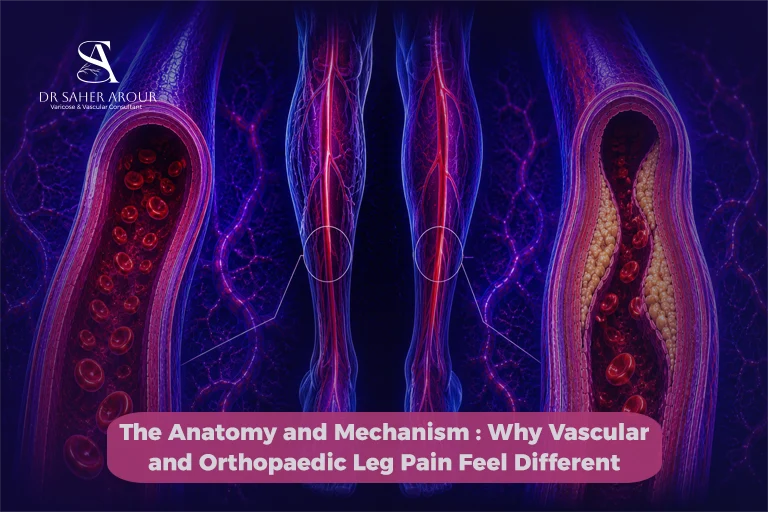
How Arterial Blockages and Venous Pooling Can Create Leg Discomfort
Your body relies on clear circulatory pathways to carry oxygen-rich blood down to your legs and return fluid back up to your heart. When trying to understand poor circulation vs nerve pain, keep in mind that PAD is a systemic vascular condition—meaning it affects your whole body—and not just a localized cause of leg pain; it’s heavily associated with significant cardiovascular and limb events [1].
Acute limb ischemia is a true medical emergency characterized by severe acute ischemia [1]. It typically presents with a sudden onset of symptoms:
- Severe, sharp leg pain and noticeable coldness in the limb [1].
- Pallor (pale skin) and loss of detectable pulses in the foot [1].
- Numbness, tingling, or full paralysis of the extremity [1].
Venous symptoms like leg pain, swelling, redness, and unusual warmth can indicate DVT, but being non-specific, they aren’t enough to confirm the diagnosis alone [3].
Why Nerve Compression and Joint Degeneration Create Musculoskeletal Pain
As your joints lose cartilage over time, or spinal discs bulge and compress nerve roots, the resulting mechanical friction creates a sharp, shooting sensation traveling down the leg. This feels quite different from the deep, heavy aching of oxygen-starved muscles typical of arterial blockages.
Three Common Misdiagnoses and Why Leg Pain Causes Get Confused
Misdiagnosed as Sciatica When It May Actually Be PAD (Peripheral Artery Disease)
I see many patients treat suspected sciatica for months before discovering their actual issue is poor circulation. Not all PAD symptoms follow the classic intermittent claudication pattern; other exertional leg symptoms may definitely appear [1].
Misdiagnosed as Arthritis When It May Actually Be Venous Insufficiency
Swollen, aching knees or ankles frequently take the blame for arthritis. But if that swelling comes with a heavy, bursting sensation that feels much better when you prop your legs up on a pillow, it might actually be venous insufficiency masking as an orthopaedic issue. Read more about these vein issues in our Varicose Veins Pillar.
Misdiagnosed as Muscle Strain When It May Be a Deep Vein Thrombosis (DVT)
A sudden, sharp cramp in your calf could just be a pulled muscle, but it could also be a serious blood clot. When DVT is suspected, the two-level Wells score should be used to estimate your clinical probability [4]. The medical approach depends heavily on this score:
- If your Wells score is >=2 (DVT likely), NICE recommends a proximal leg ultrasound, followed by a D-dimer blood test if the scan is negative [4].
- If your Wells score is <=1 (DVT unlikely), NICE recommends starting with a D-dimer test, followed by an ultrasound if the D-dimer is positive [4].
Fortunately, proximal compression ultrasound has a relatively high diagnostic accuracy for lower extremity DVT [3]. For deeper insights into clot management, explore our DVT article.
Practical Steps to Get the Right Diagnosis for Your Leg Pain
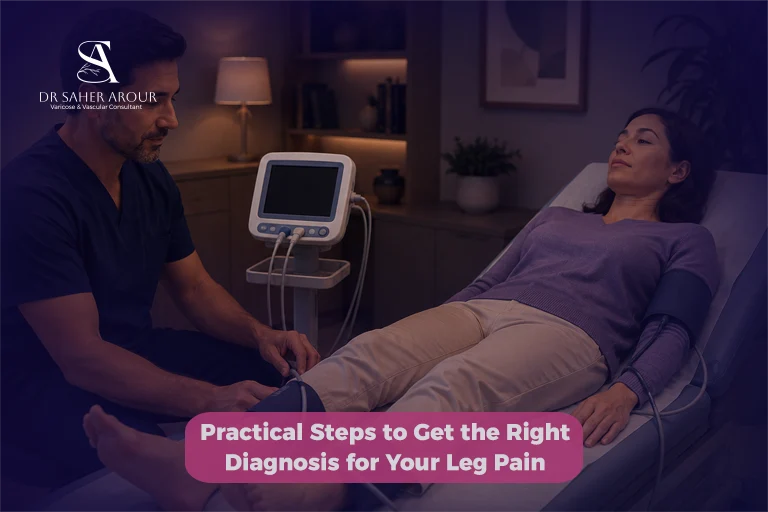
To safely pinpoint what’s happening in your body, we rely on a very structured medical approach. The evaluation of PAD begins with a detailed medical history and clinical examination, followed by appropriate vascular tests [1]. The ankle-brachial index (ABI) is the primary method used for the initial diagnosis of PAD [1].
| Diagnostic Tool | Clinical Usefulness |
| Resting ABI | In symptomatic patients, resting ABI has a sensitivity of 69%–79% and specificity of 83%–99% compared to imaging that shows significant arterial stenosis [1]. |
| Additional Physiological Tests | ABI can be used alongside Doppler waveforms or other physiological tests when further evaluation is needed [1]. |
| Advanced Imaging (Duplex, CTA, MRA) | These can be used to determine the exact location and severity of the stenosis in symptomatic PAD patients when revascularization is being considered [1]. |
If you suspect you might be dealing with arterial blockages, you’ll find more details in our comprehensive PAD/Atherosclerosis article.
When to See a Vascular Specialist vs an Orthopaedic Specialist for Leg Pain
Timing matters a lot when it comes to your circulation. My goal here isn’t to alarm you, but to give you the clear facts to protect your health: PAD is associated with increased risks of amputation, myocardial infarction (heart attack), stroke, and overall death [1]. If your pain reliably disappears when you sit down but flares up predictably the moment you walk, getting a vascular assessment is a smart, necessary step.
If vascular disease is confirmed, you aren’t automatically headed for surgery. We have excellent conservative options. Supervised exercise therapy is highly recommended for PAD patients with claudication to improve their function, quality of life, and reduce leg symptoms [1]. Structured exercise programs typically follow specific clinical guidelines:
- Sessions take place >=3 times per week for at least >=12 weeks [1].
- Each 60-minute session includes 30–45 minutes of active, supervised treadmill training [1].
Conversely, if your pain only triggers when twisting your spine or lifting heavy objects, consulting an orthopaedic doctor is your safest route.
FAQ Section : People Also Ask
What is the difference between vascular and orthopaedic leg pain?
Vascular leg pain may be related to impaired arterial blood flow or venous disease, while orthopaedic pain may arise from muscles, joints, bones, or nerves. In PAD, classic claudication is reproducible leg discomfort with exertion that is relieved by rest.
How do I know if my leg pain is poor circulation?
Pain that repeatedly occurs with walking or exertion and improves with rest can be a symptom of PAD, but symptoms alone do not establish the diagnosis; clinical assessment and appropriate vascular testing are used.
Does vascular leg pain hurt when walking?
It can: intermittent claudication classically causes reproducible aching, cramping, or pain in the calf, thigh, or buttock during exertion and is relieved by rest.
Can vascular problems cause nerve pain in the legs?
Vascular disease and nerve-related leg pain can overlap in presentation, so persistent or unexplained symptoms should not be attributed to a nerve disorder or vascular disease without appropriate clinical evaluation.
When should I see a doctor for leg pain?
New or unexplained leg pain with signs suggesting PAD, venous disease, or DVT warrants medical assessment; suspected DVT requires an appropriate diagnostic strategy rather than diagnosis from symptoms alone.
References
- [1] 2016 AHA/ACC Guideline on the Management of Patients With Lower Extremity Peripheral Artery Disease: A Report of the American College of Cardiology/American Heart Association Task Force on Clinical Practice Guidelines
- [2] Symptoms of Lumbar Spinal Stenosis and Peripheral Arterial Disease: A Clinical Study
- [3] Diagnosis of Deep Vein Thrombosis: A Clinical Review
- [4] Venous thromboembolic diseases: diagnosis, management and thrombophilia testing – NICE guidelines