How Smoking Damages Veins and Arteries. When people talk about tobacco, they almost always focus on what it does to their lungs, but they rarely consider the full effect of smoking on veins and arteries: vascular damage. Your vascular network is a 60,000-mile system of blood vessels delivering oxygen and nutrients to every organ and limb. The moment toxic chemicals enter your bloodstream, your vessels absorb that hit directly.
Medically Reviewed & Written by Dr. Saher Arour,
Board-Certified Vascular Surgeon
In clinic, I always remind patients that understanding how smoke alters blood vessel tissue is essential for their overall health, as it provides the clarity needed to protect long-term circulation:
- Vascular injury starts in the delicate inner lining of your blood vessels.
- Smoking speeds up arterial plaque buildup while increasing blood clot risks in your veins.
- Conditions like peripheral artery disease and aortic aneurysms are directly linked to tobacco exposure.
- Quitting smoking triggers vascular recovery, though reducing long-term disease risk takes time.
Table of Contents

How Does Smoking Damage Veins and Arteries?
Smoking damages veins and arteries by causing endothelial injury, oxidative stress, chronic inflammation, and thrombosis, which accelerates plaque formation and arterial narrowing [1].
Every single puff sends thousands of reactive chemicals straight into your blood. These compounds do not just pass through; they irritate vessel walls and alter blood chemistry.
Over time, this constant chemical irritation strips vessel walls of their natural flexibility, causing them to stiffen and accumulate fatty deposits. That breakdown impairs oxygen delivery throughout your entire body.
How Your Vascular System Works: A Quick Baseline
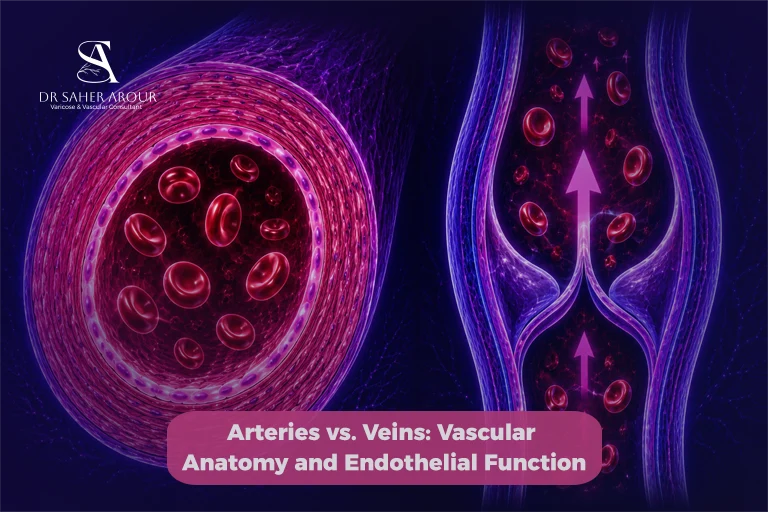
To understand how tobacco causes harm, it helps to review how blood flows through your body under healthy conditions. Your circulatory system relies on two main vessel networks working together, supported by a specialized cellular inner lining.
Arteries vs Veins: Different Anatomy, Different Vulnerabilities
Arteries carry oxygen-rich blood away from your heart under high pressure. Their thick, elastic muscular walls expand and contract to regulate blood flow.
Veins, by contrast, return oxygen-depleted blood back to your heart under low pressure using thinner walls and one-way valves. Because of these structural differences, smoking attacks each vessel type through distinct mechanisms.
| Vessel Feature | Arteries | Veins |
| Function | Carry oxygenated blood away from the heart | Return deoxygenated blood back to the heart |
| Wall Structure | Thick, muscular, elastic walls under high pressure | Thinner walls with one-way valves under low pressure |
| Primary Tobacco Impact | Accelerated plaque buildup, narrowing, and aneurysms | Increased tendency for deep vein blood clot formation (VTE) |
The Endothelium: Where Smoking Strikes First
The endothelium is the delicate inner cell lining of your blood vessels. It acts like an active shield, releasing nitric oxide (a natural vessel-relaxing compound) to keep your blood flowing smoothly and prevent clots. Smoking damages this protective system directly:
- Cellular Damage & Inflammation: Toxic smoke triggers oxidative stress and systemic inflammation, reducing nitric oxide availability and injuring vessel cells [1].
- Loss of Vessel Flexibility: A meta-analysis of 14 studies showed smoking significantly impairs flow-mediated dilation (FMD, a standard test of vessel flexibility), yielding a pooled effect size of -3.15 (95% CI -3.84 to -2.46) [2].
- Restricted Blood Flow Expansion: Lab tests on human arterial tissue confirm that smoke stops vessels from relaxing normally and lowers nitric oxide production [3].
When nitric oxide drops, your vessels lose their natural ability to dilate, making it harder for your body to deliver essential oxygen when your limbs or organs need it most.
The Chemistry of Damage: What’s in a Cigarette Reaches Your Vessels
Cigarette smoke contains thousands of chemical agents that enter your lungs and pass directly into your cardiovascular system. These toxins attack vessel walls through multiple pathways at the same time.
Nicotine: Vasoconstriction and Endothelial Dysfunction
Nicotine triggers an instant release of adrenaline and catecholamines, causing immediate vascular constriction and elevating blood pressure. While nicotine drives arterial spasms and vascular stress, it isn’t acting alone. Cigarette smoke contains numerous vasoactive toxins that work alongside nicotine to injure endothelial cells and block normal blood vessel relaxation.
Carbon Monoxide and Oxidative Stress
Carbon monoxide binds tightly to hemoglobin, displacing oxygen and cutting down your blood’s oxygen-carrying capacity. At the same time, high concentrations of free radicals in tobacco smoke deplete your body’s natural vascular antioxidants. This chronic oxidative stress damages cell membranes and promotes low-density lipoprotein (LDL) oxidation, laying the foundation for arterial disease.
Three Ways Smoking Damages Arteries and Veins
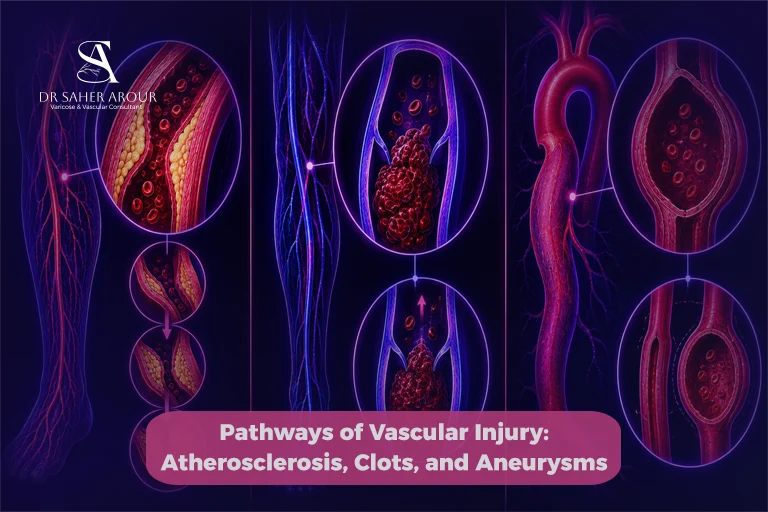
The cellular damage caused by smoking appears in three distinct vascular pathologies: arterial blockage, venous clotting, and wall expansion.
Accelerated Atherosclerosis and Plaque Rupture
Smoking speeds up atherosclerosis (the process where fatty deposits, cholesterol, and inflammatory cells form hard plaques inside arterial walls). Smoke exposure makes these plaques unstable and prone to rupture, which can suddenly block arterial flow. Large-scale global evidence confirms that cigarette smoking is a strong, dose-responsive risk factor for developing peripheral artery disease [5].
In a comprehensive meta-analysis of 55 studies, current smokers exhibited a pooled odds ratio (OR) of 2.71 (95% CI 2.28 to 3.21) for developing peripheral artery disease compared to non-smokers [4]. Former smokers also retain an elevated risk, with a pooled odds ratio of 1.67 (95% CI 1.54 to 1.81) versus those who never smoked [4].
Venous Thromboembolism and Deep Vein Thrombosis (DVT)
While smoking inflicts its heaviest damage on arteries, clinical evidence shows it increases venous risk too. A meta-analysis of 32 observational studies including over 3.9 million participants and 35,151 clot events found that current smokers have a relative risk (RR) of 1.23 (95% CI 1.14 to 1.33) for venous thromboembolism (VTE) compared with never smokers [6]. Former smokers maintain a relative risk of 1.10 (95% CI 1.03 to 1.17) [6].
This venous clot risk rises with heavier tobacco exposure. Specifically, VTE risk increases by 10.2% (95% CI 8.6% to 11.8%) for every additional 10 cigarettes smoked per day, and by 6.1% (95% CI 3.8% to 8.5%) for every additional 10 pack-years [6].
Aneurysm Formation: The Silent Risk
Smoking degrades structural proteins like elastin and collagen within arterial walls, causing them to weaken and balloon outward. Smoking is an independent, major risk factor for abdominal aortic aneurysm (AAA) development, growth, expansion, and rupture [7]. Clinical guidelines also identify smoking as a key risk factor for thoracic aortic aneurysm (TAA) expansion [7].
A systematic review and meta-analysis of 23 prospective studies revealed that current smokers face a summary relative risk of 4.87 (95% CI 3.93 to 6.02) for developing AAA compared to never smokers [8]. Former smokers retain a summary relative risk of 2.10 (95% CI 1.76 to 2.50) [8].
Specific Vascular Conditions Associated With Smoking (PAD, AAA, Buerger’s Disease)
Chronic tobacco exposure directly drives several vascular disorders that require careful clinical management. Maintaining your overall vascular health starts with recognizing how these conditions appear in daily life.
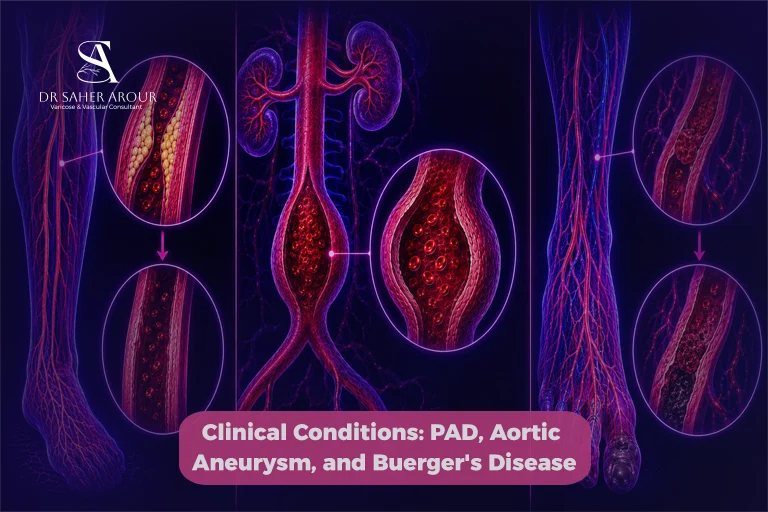
The 2024 ACC/AHA lower extremity guideline outlines four distinct clinical subsets of peripheral artery disease [5]:
- Asymptomatic PAD: Individuals have reduced arterial blood flow that may cause subtle functional impairment without classic symptoms [5].
- Chronic Symptomatic PAD: Presents as typical intermittent claudication, causing exertional pain, aching, or cramping in the calves, thighs, or buttocks that usually disappears within about 10 minutes of rest [5].
- Chronic Limb-Threatening Ischemia (CLTI): Advanced disease presenting with ischemic rest pain, nonhealing sores or ulcers, or gangrene lasting more than 2 weeks [5].
- Acute Limb Ischemia (ALI): A sudden loss of arterial blood flow occurring within less than 2 weeks, characterized by pain, pallor, pulselessness, coolness (poikilothermia), numbness (paresthesias), or paralysis [5].
Another condition uniquely linked to tobacco is Buerger’s disease (thromboangiitis obliterans). It is a non-atherosclerotic inflammatory occlusive disease affecting small and medium arteries and veins in the hands and feet [9]. Tobacco exposure is central to both the trigger and progression of Buerger’s disease [9]. Quitting tobacco completely is the only definitive treatment to stop disease progression—even smoking 1 or 2 cigarettes daily or using smokeless tobacco keeps active inflammation alive [9].
Practical Steps: When to See a Vascular Surgeon and How to Protect Your Vessels
If you smoke or have a history of smoking, paying attention to early vascular signals can prevent severe complications. A vascular evaluation allows us to perform non-invasive testing—like the ankle-brachial index (ABI) or vascular ultrasound—to assess your circulation.
I encourage patients to seek a vascular assessment if they experience any of the following symptoms:
- Leg cramping or aching during routine walking that disappears shortly after resting.
- Coldness, numbness, or skin color changes in one foot or lower leg.
- Slow-healing sores or nonhealing ulcers on your toes, feet, or ankles.
- A pulsating sensation in your abdomen, which warrants evaluation for an aortic aneurysm.
Major clinical practice guidelines strongly mandate smoking cessation across vascular disorders. The ACC/AHA guidelines give a Class 1, Level A recommendation that patients with PAD who smoke should be advised at every single visit to quit or maintain cessation [5]. Likewise, smoking cessation efforts are strongly recommended for patients with abdominal aortic aneurysms (Class 1, Level C-LD) and thoracic aortic aneurysms (Class 1, Level C-LD) who smoke [7].
Recovery Timeline: What Happens to Your Vessels After You Quit
Quitting tobacco is the single most impactful step you can take for your circulation. If you are exploring steps toward smoking cessation recovery, structured clinical support makes a dramatic difference in helping your blood vessels heal over time.
| Timeframe / Intervention | Vascular Impact & Clinical Evidence |
| Structured Cessation Programs | Combining behavioral counseling with medications increases quit success by 2 to 3 times compared to going cold turkey [5]. In PAD patients, comprehensive programs achieved a 21% quit rate versus 7% with standard advice alone [5]. |
| 10 to 20 Years Post-Quitting | Vascular risk reduction progresses gradually. The risk of developing peripheral artery disease (PAD) remains more than 2 times higher than never-smokers during this period [5]. |
| Every 10 Years of Cessation | Each additional decade of smoking cessation is associated with a summary relative risk of 0.45 (95% CI 0.32 to 0.63) for abdominal aortic aneurysm (AAA) [8]. Clinical guidelines strongly urge cessation to preserve vessel wall stability [7]. |
| 30 Years Post-Quitting | The risk of developing peripheral artery disease fully returns to a non-smoker’s baseline level [5]. |
Although structural vascular recovery takes time, cellular healing begins early. Starting your cessation journey today is the most effective way to protect your arteries and prevent progressive disease.
FAQ Section: People Also Ask
How does smoking damage blood vessels?
Smoking causes endothelial injury, oxidative stress, chronic inflammation, blood clot formation, and plaque buildup, significantly raising your overall vascular disease risk [1].
Can the vascular damage from smoking be reversed?
Some vascular functions like endothelial responsiveness start improving shortly after quitting, but established atherosclerotic plaque or structural aneurysms shouldn’t be expected to fully disappear [5].
How long after quitting smoking does circulation improve?
Vascular healing starts within days of quitting, but substantial risk reduction takes time; elevated PAD risk declines progressively over 10 to 30 years [5].
What are the warning signs of smoking-related vascular disease?
Key signs include leg pain during walking that resolves with rest, nonhealing foot sores, cold or pale feet, or sudden numbness and loss of lower limb pulses [5].
Does smoking affect veins as well as arteries?
Yes. While smoking inflicts its most severe damage on arteries, clinical evidence proves it also elevates the risk of deep vein blood clots and venous thromboembolism [6].
References
- [1] Endothelial dysfunction and cigarette smoking: Mechanisms and clinical implications
- [2] Effect of cigarette smoking on flow-mediated dilation: A systematic review and meta-analysis
- [3] Cigarette smoking impairs endothelium-dependent vascular relaxation in human arteries
- [4] Comparison of global estimates of prevalence and risk factors for peripheral artery disease in 2000 and 2010: a systematic review and analysis
- [5] 2024 ACC/AHA/AACVPR/APMA/ABC/SCAI/SVM/SVN/SVS/VQI Guideline for the Management of Lower Extremity Peripheral Artery Disease
- [6] Cigarette smoking and risk of venous thromboembolism: a systematic review and meta-analysis
- [7] 2022 ACC/AHA Guideline for the Diagnosis and Management of Aortic Disease
- [8] Tobacco smoking and the risk of abdominal aortic aneurysm: a systematic review and meta-analysis of prospective studies
- [9] Thromboangiitis obliterans (Buerger’s disease)