
Deep vein thrombosis (DVT) after COVID-19 is simply a blood clot condition triggered by viral inflammation, primarily affecting patients recovering from severe infections.
Everyone worries about developing a clot after having the virus.. And that’s exactly why I understand your concerns about your vascular health after recovery.
We now know this virus affects more than just the lungs; it impacts the blood vessels too. Here is what the actual research shows, so you know exactly where you stand and when to seek help.
Medically Reviewed & Written by Dr. Saher Arour,
Board-Certified Vascular Surgeon
Just keep these key facts in mind, which I’ll discuss in detail throughout the article:
- Clot risk is highest in the first few weeks following a severe infection.
- Mild cases treated at home carry a significantly lower vascular risk.
- Recognizing early leg swelling or pain allows for prompt, life-saving evaluation.
- Authorized vaccines haven’t shown an increased risk of ordinary acute deep vein thrombosis.
Table of Contents
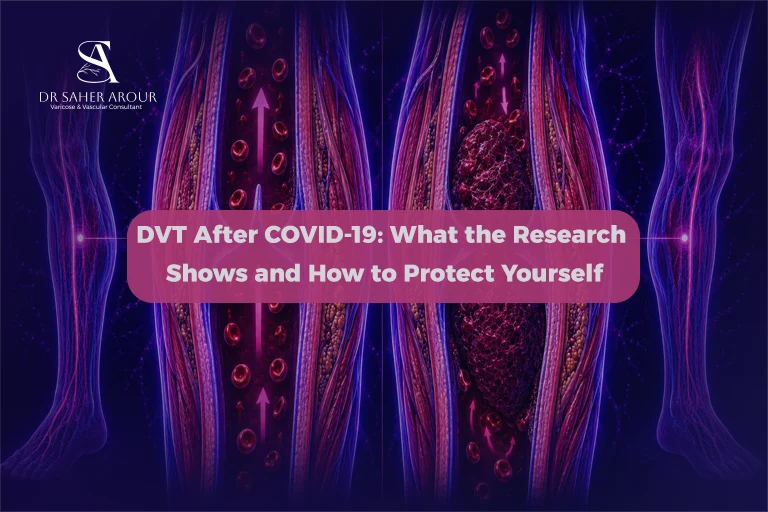
What Does the Research Show About DVT After COVID-19?
The connection between the virus and your vascular system is clear. Acute and critical COVID-19 cases are associated with an increased VTE risk [1]. While this might sound alarming, looking at the actual research helps put things into a calmer perspective. Here is what large-scale studies tell us about your real risk:
- Your overall risk is higher, but the actual occurrence is low: Recovered COVID-19 patients do face a higher relative risk, showing a DVT hazard ratio of 2.55 and a PE (pulmonary embolism) hazard ratio of 3.16 compared to non-infected individuals [2]. However, the actual number of people who develop clots remains quite small. Over a mean follow-up of 8.5 months, the actual cumulative incidence was only 1.2% for PE and 2.3% for DVT [2].
- The risk drops over time: Even in the modern Omicron era, your risk of a clot is highest early on. The standardized incidence ratio for VTE is elevated at 3.61 within the first 30 days, but it successfully attenuates (decreases) to 1.88 at 180 days [3]. The risk is real, but thankfully, your body naturally lowers that risk as more time passes.
Why COVID-19 Causes Blood Clots : The Viral Mechanism Explained
To understand why a respiratory virus causes clots in the legs, we have to look at how your body fights the infection. The immune response is intense and sometimes overactive, leading to direct changes in your blood vessels.
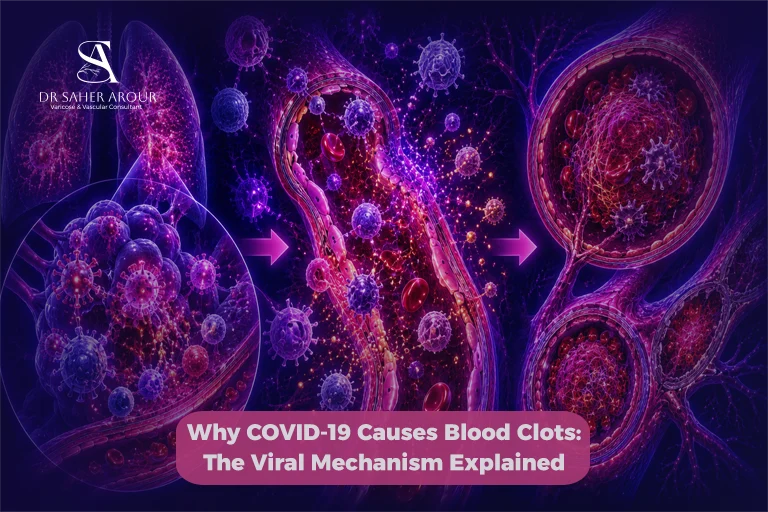
Endothelial Damage : How SARS-CoV-2 Affects the Blood Vessel Lining
Your blood vessels have a delicate inner lining called the endothelium. When you get sick, the virus triggers a response involving endothelial dysfunction, platelet activation, and immune hyperactivation [4].
This dysfunction, along with hypercoagulation (blood thickening) and impaired fibrinolysis (the body’s inability to break down clots naturally), contributes directly to thrombosis [5].
Cytokine Storm and Systemic Inflammation
When your immune system fights hard, it releases inflammatory signals. These blood vessel changes are driven by inflammatory signaling, complement activation, NETosis (a process where immune cells cast webs that can trap blood cells), and a cytokine storm [5]. It’s this complex inflammatory environment that tips the balance toward clotting.
Three Stages of DVT Risk After COVID-19 Infection
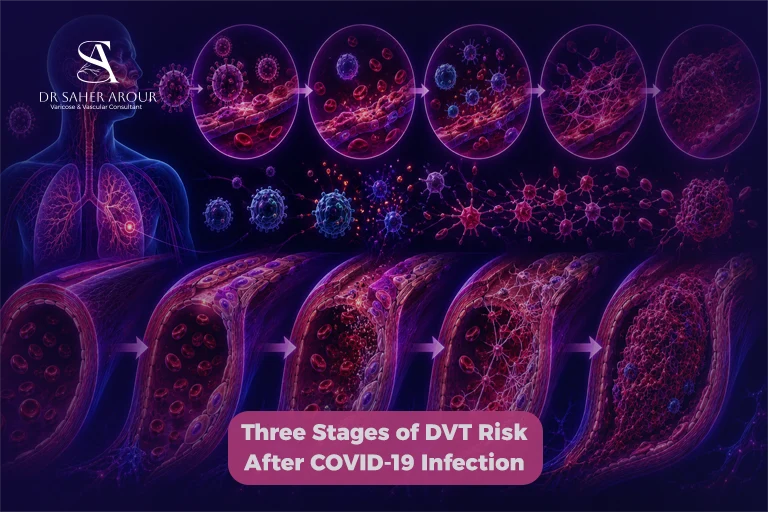
Your risk of developing a clot isn’t the same every day after you test positive. Generally, the risk is highest early on and attenuates over subsequent months [6]. Let’s break down these evidence-based time windows.
Acute Phase (0 to 14 days) : Highest Clot Risk in Severe Cases
The first two weeks are when your body is under the most extreme stress. Based on the research, this is exactly when the risk peaks [7]:
- First week: The incidence rate ratio for a first DVT is 5.59 times higher than normal.
- Second week: This incidence rate ratio rises slightly to 7.44.
- Lung clots (Pulmonary Embolism): The risk here is even more pronounced, with an incidence rate ratio jumping to 36.17 in week one and 46.40 in week two.
Subacute Phase (2 to 12 weeks) : Persistent Risk Even After Recovery
Even as you start feeling better and the acute symptoms fade, your vascular system is still recovering.
The risk remains significantly increased up to 70 days [7]. That’s exactly why staying vigilant and keeping mobile during your recovery weeks is crucial.
Long COVID Phase (3+ months) : Is the Risk Still Elevated?
A common concern is whether you need to worry about blood clots forever. Honestly, the answer depends heavily on how sick you were. Persistent long-term excess risk is strongest in previously hospitalized patients, while non-hospitalized patients generally show much less persistent excess risk [8].
Who Is Most at Risk of DVT After COVID-19?
Not everyone who catches the virus has the same chance of developing a clot. Your individual health factors and the severity of the infection play massive roles.
Risk Factors : Hospitalization, Immobility, Obesity, and Pre-existing Conditions
Background VTE risk factors like immobility, advanced age, and obesity definitely play a role [9].
However, it’s important to be clinically precise here. We view obesity as a general background risk rather than a uniformly proven independent predictor specifically for COVID-associated VTE [10].
Mild vs Severe COVID : Does the Risk Differ?
Yes, the difference is substantial. Being treated in a hospital versus recovering at home changes your risk profile entirely.
| Infection Severity | Hazard Ratio for PE (60 to <180 days) | Hazard Ratio for DVT (60 to <180 days) |
| Hospitalized for COVID-19 | 6.05 [8] | 3.97 [8] |
| COVID-19 without hospitalization | 1.17 [8] | 0.99 [8] |
Recognizing DVT Symptoms After COVID-19 : When to Act
Knowing what to look for is your best defense. A swollen leg and a painful leg are recognized in DVT presentations [11].. If a clot travels to the lungs, it becomes a pulmonary embolism (PE). Chest pain, sudden shortness of breath, and coughing up blood are PE warning symptoms [11].
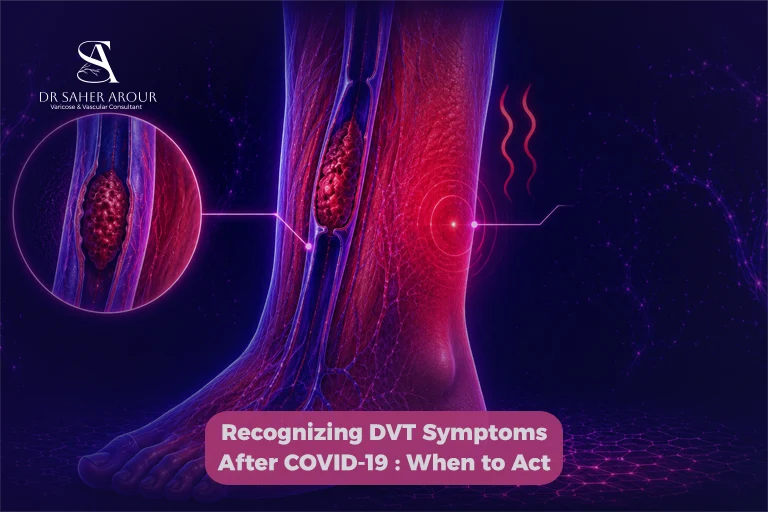
Please don’t ignore these signs hoping they’ll just go away.. If you experience these symptoms, please don’t try to self-diagnose at home. Suspected DVT requires a proper clinical probability assessment (using the 2-level DVT Wells score); symptoms alone don’t confirm it [11].
If the assessment indicates a likely DVT (a Wells score of 2 or more), you should have a proximal leg vein ultrasound scan within 4 hours if possible [12]. For those over 50, an age-adjusted D-dimer blood test threshold might also be considered as part of the diagnostic pathway [11].
Prevention and Protection : Practical Steps After COVID-19
The usual question is whether you should automatically take blood thinners after recovering. Current guidelines actually recommend against using routine post-discharge outpatient anticoagulant thromboprophylaxis (blood thinners) for patients with COVID-19 who do not have a confirmed VTE or another specific indication [13].
Instead, medical professionals handle this carefully based on what your body actually needs. Here is the standard approach:
- You and your doctor must conduct an individualized assessment of your thrombosis and bleeding risks [13].
- Prophylaxis (preventative treatment) may only be reasonable for selected patients judged to be at high thrombotic risk and low bleeding risk [13].
- Staying mobile and hydrated remains a safe, foundational step for everyone during recovery.
COVID Vaccines and DVT : Separating Fact from Misinformation
There’s a lot of fear circulating about vaccines and blood clots. To give you peace of mind, let’s look at the actual population data. Overall, the post-vaccination VTE incidence was found to be 4.1 per 1000 person-years, which very closely matches the 4.0 per 1000 person-years seen before the vaccines were even introduced [14].
To separate fact from misinformation, here is what you need to know about the actual risks:
- The rare vaccine syndrome is distinctly different: It is crucial to distinguish ordinary DVT from thrombosis with thrombocytopenia syndrome (TTS), a very rare condition involving low platelets linked to the Janssen vaccine [15]. This rare TTS occurred in only about 4 people per one million doses overall, and roughly 9 to 10 per million among women aged 30 to 49 [15].
- The virus itself is far more dangerous: When comparing the two, the infection-associated vascular risk was massively higher than the vaccine-associated signal. To put it clearly, the SARS-CoV-2 positive incidence rate ratio was 13.86, compared to just 1.10 for the ChAdOx1 vaccine during days 8 to 14 [16].
FAQ Section : People Also Ask
How long after COVID-19 am I at risk of blood clots?
The risk is highest around the acute illness and can remain elevated for weeks or longer after severe or hospitalized COVID-19, while long-term risk after non-hospitalized infection may return toward baseline sooner.
Can mild COVID-19 cause DVT?
DVT can occur after COVID-19, but the risk is generally lower than after severe or hospitalized infection and varies according to individual risk factors.
Should I take a blood thinner after COVID-19?
Routine anticoagulation isn’t appropriate for everyone after COVID-19; the decision depends on hospitalization status, clotting risk, bleeding risk, and individual clinical circumstances.
Are COVID vaccines linked to blood clots?
A rare thrombosis with thrombocytopenia syndrome (TTS) was causally associated with adenoviral-vector vaccines such as Janssen, whereas large studies haven’t shown an increased risk of acute venous thromboembolism after the authorized COVID-19 vaccines overall.
What are the early signs of DVT after COVID recovery?
Common warning signs include new swelling, pain or tenderness, warmth, and skin discoloration in one leg; sudden shortness of breath or chest pain may indicate pulmonary embolism and requires emergency evaluation.
References
- [1] American Society of Hematology living guidelines
- [2] Cumulative incidence of PE and DVT in COVID-19 recovered patients
- [3] Elevated SIRs for VTE and ATE following SARS-CoV-2 infection
- [4] Pathophysiological mechanisms triggered by SARS-CoV-2
- [5] Endothelial dysfunction and inflammatory pathways in COVID-19
- [6] VTE risk attenuation over time post-infection
- [7] Incidence rate ratios of first DVT and PE after COVID-19
- [8] VTE risk in hospitalized vs non-hospitalized COVID-19 patients
- [9] Background VTE risk factors in critical COVID-19 illness
- [10] Obesity and the risk of VTE in COVID-19
- [11] NICE Recommendations for DVT and PE signs and assessment
- [12] NICE Recommendations for DVT ultrasound
- [13] ASH guidelines on post-discharge outpatient anticoagulant thromboprophylaxis
- [14] Overall incidence rates of VTE post-vaccination
- [15] CDC Vaccine Safety for COVID-19
- [16] Comparative population data of thrombotic signal from infection vs vaccination