
How Diabetes Damages Arteries? One of the most common concerns I notice among diabetic patients is the fear of long-term foot complications and artery damage. Focusing on your daily blood sugar readings is an excellent habit, but truly understanding what those numbers mean for the blood vessels in your legs is what makes the real difference in protecting them..
The peripheral artery disease diabetes connection is a physical reality; high blood sugar doesn’t just drain your energy, it actively changes the structure of your arteries over time.
My goal today isn’t just to review lab results with you; it’s to help you take the right clinical steps to keep walking comfortably and safely for years to come.
Medically Reviewed & Written by Dr. Saher Arour,
Board-Certified Vascular Surgeon
Let’s look at what is actually happening inside your arteries and what you can do about it right now:
- How the peripheral artery disease diabetes connection physically works.
- Why some people don’t feel the typical warning signs early on.
- Three specific ways your arteries change under high blood sugar.
- Clear, clinical steps you can take today to protect your circulation.
Table of Contents

How Diabetes Damages Arteries and What Is the Connection Between Diabetes and Peripheral Artery Disease?
Diabetes causes high blood sugar that directly damages your artery lining, making you nearly twice as likely to develop severe leg blockages [1].
When we look at the clinical data, the reality is clear. Diabetes is a recognized, independent risk factor for increased PAD risk [2]. Research shows the relative risk for developing incident PAD is 1.96 in women and 1.84 in men compared to people without diabetes [3]. Simply put, if you have diabetes, your vascular system needs much closer attention to prevent future complications.
How High Blood Sugar Physically Alters Your Arteries
This physical link explains why vascular surgeons monitor diabetic patients so carefully. For patients who already have PAD, diabetes brings higher risks of adverse limb issues and mortality [4].

In fact, a massive review of over 15,000 patients found that diabetes nearly doubles the risk of all-cause mortality (an odds ratio of 1.89) [5]..
When I share these medical numbers I don’t want to cause alarm, but to help takeing proactive steps together to protect your arteries starting today. Managing your blood sugar and circulation together is your safest strategy.
How Hyperglycemia Damages the Endothelium (Inner Artery Lining)
Your arteries are lined with a thin, smooth protective layer called the endothelium. Chronic high blood sugar (hyperglycemia) contributes to vascular injury through inflammatory signaling and advanced glycation end products (harmful coated proteins) [6]. Essentially, high blood sugar continuously irritates this delicate inner wall.
Specifically, it impairs your body’s natural nitric oxide signaling (which helps vessels relax) and increases reactive oxygen species (molecules that cause cell damage) [6]. When this normal signaling breaks down, your blood vessels can’t open up properly, setting the stage for poor circulation.
Why People With Diabetes May Have Less Typical or Unrecognized PAD Symptoms
You might expect leg pain while walking to be the first obvious sign of trouble. However, classic claudication (cramping pain when walking) is uncommon. Almost half of newly diagnosed PAD cases in a major study were completely asymptomatic [2]. Why does this happen? Let’s break it down:
- Nerve Damage: Up to 50% of diabetic peripheral neuropathy (nerve damage) may be asymptomatic [7]. This large-fiber neuropathy causes numbness and a loss of protective sensation [7]. Because your legs are numb, you simply won’t feel the cramping that normally warns us about blocked arteries.
- Limited Physical Activity: Asymptomatic PAD isn’t explained by neuropathy alone. Limited activity and other health conditions often prevent typical symptoms from being provoked [2]. If joint pain keeps you from walking far, your leg muscles won’t demand the extra blood flow needed to trigger that warning pain.
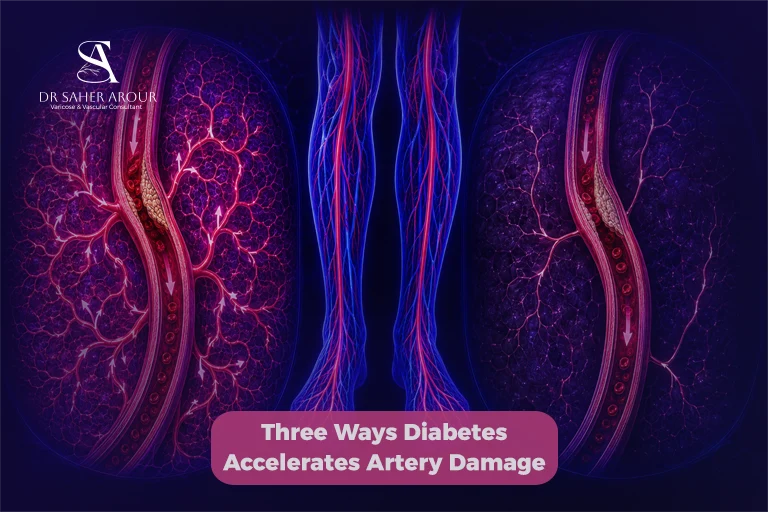
Three Ways Diabetes Accelerates Artery Damage
When diabetes and peripheral artery disease interact, the physical changes in your artery walls look quite different from those of normal aging. Here is what actually happens.
Inflammation and Plaque Instability
Diabetes triggers multiple interacting mechanisms that contribute to atherosclerotic disease (plaque buildup) and PAD [6]. My main clinical concern here is the stability of the plaque inside your arteries. Diabetes-associated mechanisms can increase plaque instability, rupture, and thrombosis (blood clots) [8]. While this isnt inevitable for every patient, it remains a known clinical risk that we track carefully, because unstable plaque can suddenly restrict blood flow.
Medial Arterial Calcification (MAC) in Diabetics
In many patients with diabetes, the arteries harden in a very specific way. MAC is the calcification of the middle layer of the arterial wall, which is entirely distinct from normal plaque buildup [9]. It is incredibly common. In one study of 185 adults with type 1 diabetes, x-ray MAC was present in 57% of them [9].
This stiffening creates a real diagnostic challenge for us in the clinic. Because the arteries become noncompressible (too stiff to squeeze), standard Ankle-Brachial Index (ABI) tests become less reliable [7]. To help you understand what we look for during your vascular exam, here is exactly how we interpret your ABI scores:
| ABI Score Range | Clinical Interpretation | What It Means For You |
| 1.00 to 1.40 | Normal | Good circulation; continue routine diabetic foot care. |
| 0.91 to 0.99 | Borderline | Requires closer observation and proactive risk management. |
| 0.90 or lower | Abnormal | Indicates poor blood flow and confirms PAD [10]. |
| Over 1.40 | Noncompressible (Uninterpretable) | Arteries are too stiff to compress. We must use the Toe-Brachial Index (TBI) instead to measure your actual blood flow [10]. |
Impaired Collateral Blood Vessel Formation
Normally, your body tries to build its own natural bypass routes—called collateral vessels—around blocked arteries. Unfortunately, diabetes limits this adaptive collateral blood flow development [8]..
Type 2 diabetes is specifically associated with reduced collateral development, a fact supported by both clinical and experimental evidence [11]. Because we can’t always rely on your body to build these detours on its own, catching blockages early is critical.
Practical Steps for Diabetics to Slow Artery Damage
A vascular diagnosis is a warning, not a dead end. Your management plan should be highly individualized and include strict glycemic control, diet and weight control, cardiovascular risk-factor management, and aggressive foot care to prevent ulcers [4]. However, blood sugar control is just one piece of your treatment puzzle.

Physical movement is one of the strongest medicines we have. A structured community-based exercise program with behavioral support carries a Class 1, Level A recommendation for chronic symptomatic PAD [10]. This structured training safely forces your blood vessels to adapt over time.
Here is the practical difference between general advice and structured clinical care:
| General Advice | Structured Diabetic PAD Care |
| “Go out and walk more.” | Supervised treadmill exercise for 30–45 min, 3x/week for 12 weeks. |
| Checking blood sugar occasionally. | Consistent glycemic management linked directly with cardiovascular risk-factor treatment. |
| Looking at feet only when they hurt. | Annual comprehensive foot exams to specifically check for loss of protective sensation. |
| Assuming symptoms are just aging. | Reporting any numbness, tingling, or limited walking distance to your vascular doctor immediately. |
As the data shows, for chronic symptomatic PAD, structured exercise should not be equated with unstructured walking advice [10]. To see real improvement in your walking distance, you need a dedicated, safe program.
When to See a Vascular Specialist for PAD Symptoms
Because PAD easily hides behind diabetic nerve damage, you shouldn’t wait for severe leg pain before getting checked. Even if your legs feel perfectly fine today, proactive screening is your best defense. Here is exactly when you need a proper vascular evaluation:
- Annual Check-ups: If you have diabetes, you must receive a comprehensive foot examination at least once a year. If you are at a higher risk, you will require even more frequent assessments [7].
- Age and Duration of Diabetes: The American Diabetes Association (ADA) highly recommends ABI screening if you are 50 or older. You should also be screened if you have specific high-risk features, such as having diabetes for 10 years or more [12].
- Abnormal Clinical Signs: Your initial assessment starts with a simple physical exam of your legs and feet. If we find abnormal pulses during this check, we immediately move on to an ABI test with toe pressures to see exactly what’s happening with your blood flow [7].
- Warning Signs of Foot Complications: Poor blood sugar management, loss of protective sensation (numbness), and existing PAD are universally recognized risk factors for serious diabetic foot complications that require a specialist’s care [7].
If you fall into any of these categories, please don’t ignore it. Ask your physician for a referral to a vascular specialist to protect your health and mobility.
FAQ Section: People Also Ask
- What is the connection between diabetes and peripheral artery disease?
Diabetes causes high blood sugar that directly damages your artery lining. This inflammatory change increases your risk of blockages and poor leg circulation compared to someone without diabetes [3]. - Why do diabetics get poor circulation?
Elevated blood glucose promotes vascular inflammation, damages the inner artery lining, and leads to a specific stiffening of the artery walls called medial arterial calcification [6]. It also limits your body’s ability to build new bypass blood vessels [11]. - What are the silent symptoms of PAD in diabetics?
Because diabetic nerve damage causes numbness and a loss of protective sensation, up to half of newly diagnosed patients simply don’t feel the typical leg pain while walking [7]. The disease progresses silently until the blockages become severe. - How can diabetics prevent artery damage?
A comprehensive plan works best. This includes strict glycemic management, controlling blood pressure and cholesterol, starting a structured supervised exercise therapy program, and receiving a comprehensive foot examination at least annually [4]. - Is PAD in diabetics harder to treat?
It does present unique challenges. For example, calcified arteries make standard ABI tests less reliable. However, vascular specialists use alternative measures like the Toe-Brachial Index (TBI) and tailor your care plan to manage this complexity effectively [10].
References
[1] Diabetes is an established independent risk factor for PAD. https://pubmed.ncbi.nlm.nih.gov/32979922/
[2] Classical claudication is uncommon; almost half of newly diagnosed PAD cases in the cited PARTNERS population were asymptomatic. https://diabetesjournals.org/care/article/49/Supplement_1/S216/163933/10-Cardiovascular-Disease-and-Risk-Management
[3] Adjusted RR for incident PAD: 1.96 (95% CI 1.29–2.63) in women and 1.84 (95% CI 1.29–2.86) in men. https://pmc.ncbi.nlm.nih.gov/articles/PMC7520021/
[4] Diabetes is associated with higher risks of adverse limb and mortality outcomes among patients with PAD. https://pmc.ncbi.nlm.nih.gov/articles/PMC5477786/
[5] Meta-analysis of 21 studies and 15,857 patients: diabetes was associated with OR 1.89 (95% CI 1.51–2.35) for all-cause mortality. https://pubmed.ncbi.nlm.nih.gov/28026025/
[6] Hyperglycemia contributes to vascular injury through advanced glycation end products and inflammatory signaling. https://pmc.ncbi.nlm.nih.gov/articles/PMC8192257/
[7] Up to 50% of diabetic peripheral neuropathy may be asymptomatic. https://diabetesjournals.org/care/article/47/Supplement_1/S231/153941/12-Retinopathy-Neuropathy-and-Foot-Care-Standards
[8] Diabetes-associated mechanisms can increase plaque instability, rupture and thrombosis; this should not be presented as inevitable in every patient. https://pmc.ncbi.nlm.nih.gov/articles/PMC4499529/
[9] MAC is calcification of the medial arterial wall and is distinct from intimal atherosclerotic plaque. https://pmc.ncbi.nlm.nih.gov/articles/PMC3415559/
[10] ABI <=0.90 is abnormal; 0.91–0.99 borderline; 1.00–1.40 normal; >1.40 noncompressible/uninterpretable. https://pmc.ncbi.nlm.nih.gov/articles/PMC12782132/
[11] Type 2 diabetes is associated with reduced collateral development; this is supported by clinical and experimental evidence. https://academic.oup.com/cardiovascres/article/120/10/1218/7667836
[12] ADA 2024 recommends ABI screening in asymptomatic people with diabetes aged >=50 years or with specified high-risk features. https://diabetesjournals.org/care/article/47/Supplement_1/S179/153957/10-Cardiovascular-Disease-and-Risk-Management