There may be plaque building inside your neck arteries right now without you feeling it. In fact, the symptoms of carotid artery narrowing before a stroke occur are often completely silent. Because this condition accounts for approximately 15% to 20% of ischemic strokes [3], knowing the warning signs is vital for your vascular health.
When symptoms finally appear, they require immediate medical attention and typically include:
- Sudden weakness or numbness on one side of the body [8].
- Temporary trouble speaking or understanding speech [8]
- Unexplained blurred vision or temporary vision loss in one eye [10].
- A Transient Ischemic Attack (TIA) is a critical warning sign [4].
Table of Contents
Understanding these signs allows us to safely detect and treat the problem long before a permanent stroke happens.
What Is Carotid Artery Stenosis?
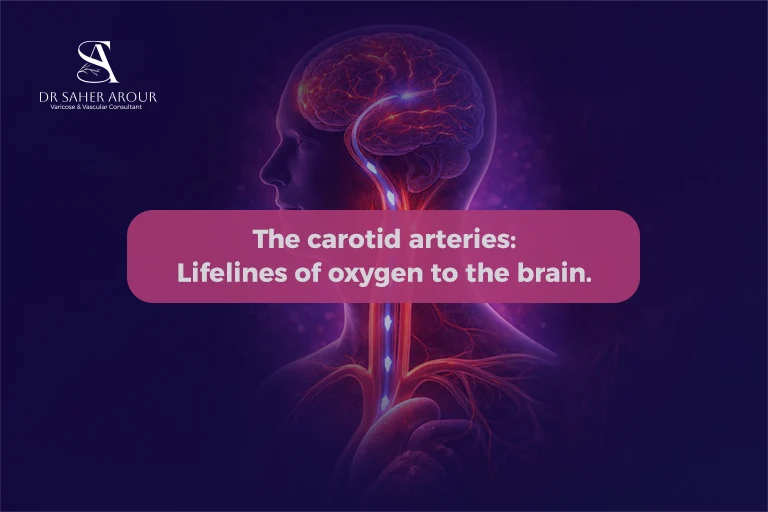
Carotid artery stenosis refers to the narrowing or blockage of the carotid arteries, which are the two large blood vessels located on each side of the neck. These arteries deliver oxygen-rich blood to the front part of the brain, which controls thought, speech, personality, and sensory and motor functions. When these vessels narrow, blood flow to the brain can be severely restricted, or plaque can break off and travel to smaller vessels, causing a stroke.
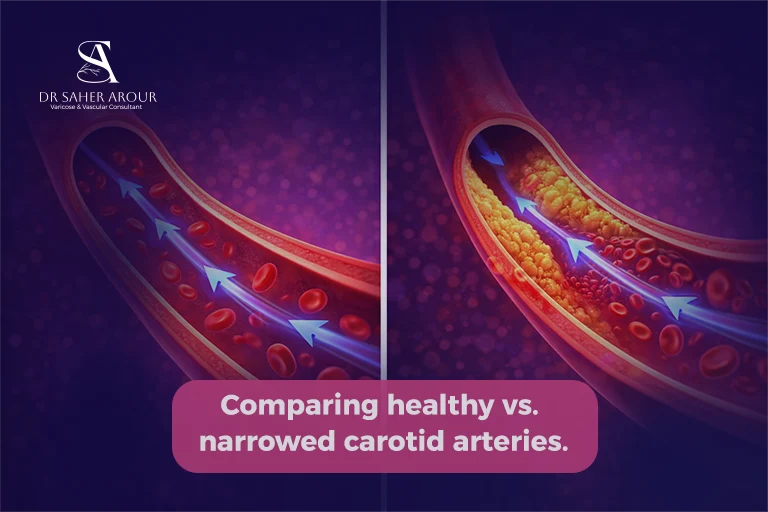
This condition is primarily caused by atherosclerosis, a biological process where fatty deposits, known as plaques, clog the blood vessels [1]. As these plaques grow and calcify over time, they stiffen and narrow the artery, reducing the internal diameter through which your blood can flow. This narrowing is measured as a percentage of the artery that is blocked, which helps the medical team determine the severity of your condition and map out the safest and most appropriate course of treatment.
How Plaque Builds Up in the Carotid Artery. The Silent Process
The development of carotid artery stenosis is rarely a sudden event. It is a chronic, progressive process that takes place over many years. Plaque is not merely a collection of fat: it is a complex mixture of cholesterol, calcium, and cellular waste products that accumulates on the inner lining of the artery walls. As this buildup continues, it alters the vessel’s structure, making it less flexible and more prone to damage.
The Atherosclerosis Timeline
Atherosclerosis typically begins in early adulthood and progresses slowly. In the initial stages, the body may attempt to compensate for the narrowing, and the patient feels completely normal. Over time, however, the plaque can become “unstable” or prone to rupture. If the plaque ruptures, the body reacts by forming a blood clot at the site, which can instantly block the artery or break loose and travel to the brain. This is why the condition is often called a “silent” threat: the biological process is active long before a patient experiences any physical distress.
Why the Carotid Bifurcation Is a Common Site for Plaque
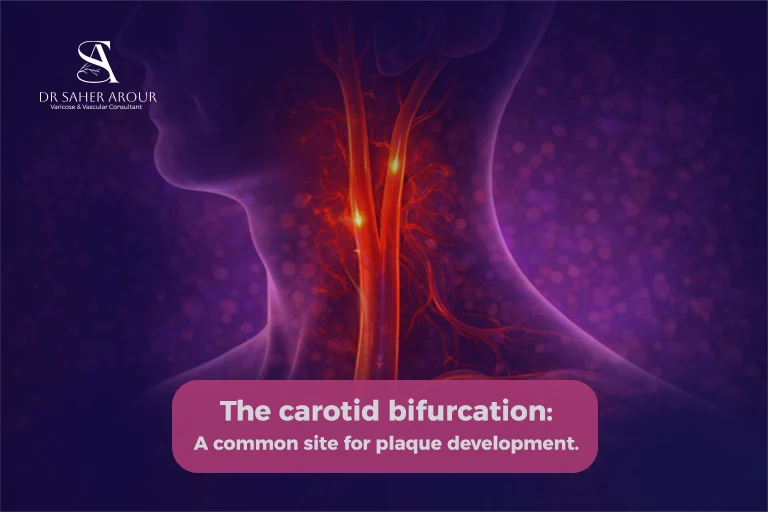
The carotid bifurcation is the specific anatomical point in your neck where the common carotid artery splits into the internal and external carotid arteries. This location is the most common site of atherosclerotic plaque buildup [5]. The reason for this is largely mechanical: at the bifurcation, the blood flow becomes turbulent rather than smooth. This turbulence can stress the inner lining of the artery (the endothelium), making it easier for cholesterol and other substances to penetrate the vessel wall and initiate plaque formation.
Symptoms of Carotid Artery Narrowing Before a Stroke Occurs
One of the most challenging aspects of carotid artery disease is that early carotid artery disease often has no symptoms [2]. A person can have a significant narrowing without ever feeling any sensation in their neck or noticing any change in their health. However, as the narrowing becomes severe, certain warning signs may appear, particularly if blood flow to the brain is momentarily interrupted.
Asymptomatic Stenosis
Clinically speaking, a patient is considered to have asymptomatic carotid stenosis if they have not experienced a stroke, a transient ischemic attack, or any other focal neurological symptoms in the distribution of the carotid artery within the previous six months [6]. Many cases are discovered incidentally during a physical examination or while testing for other conditions. For example, a doctor might hear an abnormal sound (a bruit) with a stethoscope placed over the neck, suggesting turbulent blood flow.
Symptomatic Stenosis: Warning Signs Before a Stroke
When a patient has “symptomatic” carotid stenosis, it means they have experienced focal neurological symptoms in the carotid distribution within the last six months [7]. Because these warning signs often precede a major stroke, recognizing them is critical. While experiencing such symptoms can naturally be frightening, this early warning gives us the exact window we need to intervene safely and prevent permanent damage. If you notice any of these signs, seek medical attention right away, even if they completely resolve [11].
The common warning symptoms may include:
- Sudden Weakness or Numbness: This typically occurs on one side of the body, suddenly affecting the face, an arm, or a leg [8].
- Speech Difficulties: You may suddenly have trouble speaking clearly, finding the right words, or understanding what others around you are saying [8].
- Visual Disturbances: Sudden loss or blurred vision in one or both eyes is a frequent and serious warning sign [8].
- Amaurosis Fugax: This is a specific medical term for temporary vision loss in one eye, often described by patients as a dark “shade” or “curtain” coming down over their field of vision, and it should be treated as a vascular warning symptom [10].
- Loss of Balance: Sudden dizziness or loss of balance can also signal a TIA or stroke [9].
For more detailed information on identifying these red flags, you may read our complete guide to stroke causes, warning signs, and catheter treatment..
Diagnosis: How Carotid Artery Stenosis Is Detected and Graded
Diagnosing the severity of carotid narrowing is the first step in creating a prevention plan. Modern imaging allows us to see exactly how much plaque is present and how it is affecting blood flow to the brain.
Carotid Duplex Ultrasound. The First-Line Test
Carotid duplex ultrasound is the first-line imaging test for carotid stenosis [12]. What you care about as a patient is that this test is a painless, completely radiation-free scan that we can perform quickly and safely in the clinic. It uses high-frequency sound waves to create clear images of the carotid arteries and to measure the speed of your blood flow. By carefully measuring the velocity of blood as it passes through a narrowed section, we can estimate the degree of stenosis with high clinical accuracy.
CT Angiography (CTA). For Detailed Anatomy
CT Angiography (CTA) provides a more detailed, three-dimensional view of blood vessels and surrounding structures. It is often used for further evaluation after an ultrasound, especially when planning for a surgical or catheter-based procedure [13]. This test involves injecting a contrast dye to make the arteries clearly visible on X-ray images.
MR Angiography (MRA)
Similar to CTA, MR Angiography (MRA) provides a detailed vascular assessment without X-rays [13].. It uses a strong magnetic field and radio waves to generate images of the arteries and brain tissue, helping determine whether any “silent” strokes have already occurred.
Treatment .. When Is Intervention Necessary?
You might have a common concern about whether every blockage requires surgery. The truth is, not every patient needs surgery. The necessity of intervention is determined based entirely on your symptoms, your stenosis severity, and the specific procedural risk for your individual case [14]. Therefore, we tailor a customized treatment plan specifically for you. whether that involves simple lifestyle adjustments, targeted medications, or, when truly needed, a surgical procedure [15].
Medical Management .. For All Patients
All patients with carotid stenosis, regardless of whether they have surgery, require aggressive medical management to control risk factors. This includes the treatment of hypertension (high blood pressure), hypercholesterolemia (high cholesterol), and dedicated efforts at smoking cessation [16]. Medications like aspirin or other blood thinners are also commonly prescribed to prevent clots from forming.
Carotid Endarterectomy (CEA). Surgical Plaque Removal
Carotid endarterectomy is a surgical procedure in which the surgeon opens the carotid artery and physically removes the plaque [17]. This has long been the standard treatment for patients with severe narrowing, particularly those who have already experienced a TIA or a minor stroke.
Carotid Artery Stenting (CAS) .. Catheter-Based Alternative
Carotid artery stenting is a less invasive procedure where a catheter is used to place a small mesh tube (a stent) inside the artery. A balloon is inflated to open the vessel, and the stent is left in place to maintain the opening [18]. This option is often considered for patients who may be at a higher risk for traditional surgery.
Who Should Be Screened for Carotid Artery Stenosis?
While carotid stenosis is a significant risk factor for stroke, routine screening is not recommended for asymptomatic adults in the general population [19]. Screening the entire population would lead to many unnecessary tests and potentially harmful procedures for people who were never at a high risk of stroke.
However, selective screening may be considered for certain patients with increased risk, such as those with a history of vascular disease elsewhere or multiple uncontrolled risk factors, provided they would be candidates for intervention if a blockage were found [20]. If you are concerned about your risk, the best approach is to discuss your vascular health and risk factors with a specialist.
Frequently Asked Questions
What are the symptoms of carotid artery narrowing before a stroke occurs?
Many people have no symptoms. Warning signs can include sudden weakness or numbness on one side, trouble speaking, sudden vision loss or blurred vision, dizziness, or a TIA.
Can carotid artery stenosis cause temporary vision loss?
Yes. Temporary vision loss or blurred vision in one eye can be a warning sign of TIA or stroke and needs urgent medical attention.
How is carotid artery stenosis diagnosed?
Carotid duplex ultrasound is usually the first-line test. CTA or MRA may be added when more detail is needed.
Does carotid artery stenosis always need surgery?
No. Treatment depends on the severity of the blockage, whether it is causing symptoms, and the patient’s overall risk. Many patients also need medical management and risk-factor control.
What is the difference between carotid endarterectomy and carotid artery stenting?
Carotid endarterectomy removes plaque through surgery. Carotid artery stenting uses a catheter and stent to open the artery in selected patients.
Should people without symptoms be screened for carotid artery stenosis?
Routine screening is not recommended for asymptomatic adults in the general population. Screening may be considered selectively in some higher-risk situations.
References
[1] Carotid artery disease/stenosis is caused by atherosclerotic plaque buildup
[2] Early carotid artery disease often has no symptoms
[3] Carotid stenosis accounts for approximately 15% to 20% of ischemic strokes
[4] A stroke or TIA may be the first sign of carotid artery disease
[5] The carotid bifurcation is the most common site of carotid plaque buildup
[6] Definition of asymptomatic carotid stenosis
[7] Definition of symptomatic carotid stenosis
[9] Dizziness or loss of balance can occur as a TIA/stroke-type warning symptom
[11] Stroke/TIA symptoms need urgent medical attention even if they go away
[12] Carotid duplex ultrasound is the first-line imaging test for carotid stenosis
[13] CTA and MRA are used for further evaluation and more detailed vascular assessment
[14] Whether intervention is needed depends on symptoms, stenosis severity, and procedural risk
[17] Carotid endarterectomy is a surgical plaque-removal procedure
[18] Carotid artery stenting is a catheter-based procedure that opens the artery and places a stent
[19] Routine screening is not recommended for asymptomatic adults in the general population