
If you’re dealing with persistent knee osteoarthritis pain and considering genicular artery embolization, knowing what your knee embolization recovery actually looks like can give you real peace of mind. Recovery isn’t an overnight transformation; it’s a gradual, natural healing process where joint pain settles progressively across key milestones at 1, 3, 6, and 12 months. Because GAE is a minimally invasive catheter procedure, it directly targets inflamed joint tissue without open surgery or lengthy hospital stays.
Educational Disclaimer: This content is for informational purposes only and is not a substitute for professional medical advice, diagnosis, or treatment.
- Procedure nature: Outpatient catheter procedure targeting abnormal blood vessels in the knee joint lining.
- Immediate aftermath: Minor access-site tenderness and localized knee soreness for a few days.
- Pain relief onset: Observed progressively across standard post-procedure clinical follow-up intervals.
- Long-term durability: Outcome studies track symptom relief through 12 to 24 months.
Table of Contents

What Is Knee Embolization Recovery Like After GAE?
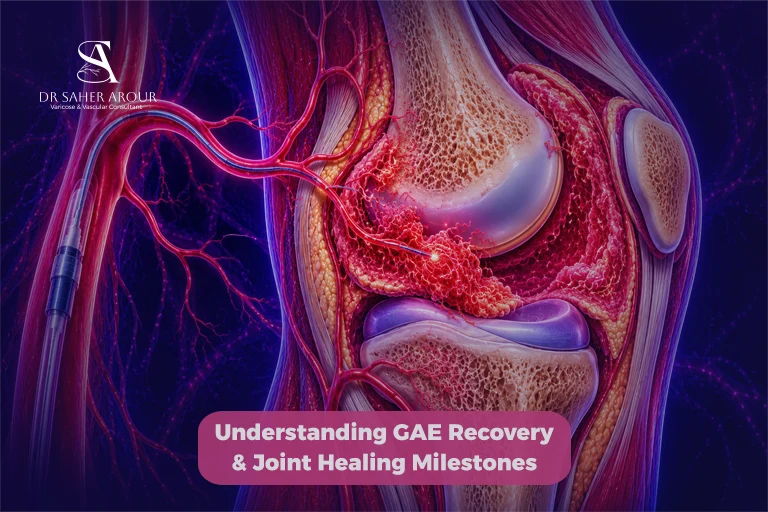
Genicular artery embolization (GAE) recovery is generally smooth and outpatient-based, focusing on natural joint healing without open knee surgery or cartilage alteration [1]. Instead of major surgical cutting, an interventional radiologist guides a micro-catheter through a tiny groin or thigh puncture to calm the inflamed blood vessels feeding your knee lining.
Because there’s no major surgical incision, your body’s recovery focuses on two straightforward priorities:
- Vascular site sealing: Allowing the tiny upper thigh or groin puncture site to close safely within a few hours.
- Inflammation reduction: Giving your knee joint time to settle as overactive inflammatory signals gradually fade.
Most patients rest comfortably in a recovery bay for just a few hours before heading home the same afternoon. If you’d like to understand the procedure details before learning about recovery, explore our comprehensive genicular artery embolization guide.
The First 48 Hours After GAE
The first two days focus on protecting your vascular access site and keeping you comfortable at home. Here is what your immediate post-procedure routine looks like:
- Initial rest: Right after the procedure, you’ll lie flat for a specified period so the puncture site in your groin or leg seals securely.
- Gentle mobility: Once your clinical team checks that your puncture site is stable, you’re cleared to stand and take light, short walks around your home.
- Managing mild ache: It’s completely normal to feel a mild or moderate dull ache inside your knee or around the puncture site as local blood flow decreases in inflamed joint tissues.
- Home care: Expect to rest quietly, keep your leg elevated when seated, avoid heavy lifting or straining, and manage early discomfort with simple over-the-counter pain medications recommended by your care team.

GAE Side Effects: What Is Normal and What Is Not
Understanding expected post-procedure changes keeps you calm and helps you recognize when medical attention is actually needed. Reported adverse events in medical literature are generally minor and short-lived [5].
Common, Temporary Side Effects (Bruising, Pain Flare, Puncture-Site Soreness)
Clinical studies evaluating post-GAE safety report that temporary, minor side effects resolve naturally as tissues recover [5]. The most frequently documented events include:
- Transient skin discoloration: Observed in approximately 11% of patients [5]. Mild purplish or reddish discoloration can appear over the targeted knee skin and fades over a few weeks.
- Access-site hematoma: Reported in about 3% of patients [5]. Small bruising or tenderness near the groin puncture site typically settles on its own.
- Temporary pain flare: Some individuals notice a temporary increase in knee ache during the first week as local inflammatory tissues adjust.
In clinical trials, these events haven’t caused long-term issues and were categorized as mild, self-limited occurrences [6].
Warning Signs: When to Call Your Doctor
While serious complications are uncommon, you should contact your medical team promptly if you notice any of these warning signals:
- Active bleeding, rapid swelling, or a growing firm lump at your groin puncture site.
- Sudden coldness, numbness, or pale skin in your foot or toes.
- Fever, worsening redness, or warm discharge around the access puncture.
- Severe leg or knee pain that doesn’t respond to prescribed pain medication.
- Sudden calf swelling, tenderness, or difficulty breathing.
Knee Embolization Recovery Timeline: Week by Week
Recovery after knee embolization unfolds gradually over several months. Instead of an immediate post-procedure transformation, clinical studies track patient progress at specific follow-up intervals [2]. The table below outlines what you can typically expect alongside clinical study follow-up markers.
| Timeframe | Typical Physical Experience & Activity | Clinical Research Observations |
| Days 1–3 | Rest at home, light walking, mild puncture soreness, potential skin bruising around the knee. | Immediate post-procedure period focused on vascular closure and early tissue healing [5]. |
| Weeks 1–2 | Gradual return to routine daily movements; swelling and skin discoloration begin to fade. | Early healing phase; physical activity increases as localized knee ache stabilizes. |
| Month 1 | Most people comfortably resume normal walking and light recreational activities. | Updated meta-analyses demonstrate a mean VAS pain score reduction of -38.5 points [2]. |
| Month 3 | Sustained joint comfort during daily walking, stair climbing, and prolonged standing. | Meta-analysis data show a sustained mean VAS pain score reduction of -36.2 points [2]. |
| Months 6–12 | Full stabilization of knee functional improvement and daily joint mobility. | Mean VAS score reductions remain stable at -40.3 points at 6 months and -40.5 points at 12 months [2]. |
To put those research numbers into everyday terms, joint pain is measured on a standard 100-point Pain Scale (VAS score). On average, observational studies report meaningful, progressive pain reduction at each key check-in [2]:
- Month 1: Average pain score drops by -38.5 points (meaning early, noticeable daily relief) [2].
- Month 3: Pain reduction remains steady at -36.2 points [2].
- Month 6: Comfort deepens with an average pain drop of -40.3 points [2].
- Month 12: Relief stabilizes with an average reduction of -40.5 points (cutting baseline joint pain by roughly half for many individuals) [2].
These figures represent average group trends across observational research, so individual healing speeds naturally vary.
How Long Does GAE Last? What Studies Show
When you ask how long your results will last, it helps to understand the difference between technical procedural success and long-term joint comfort.
GAE Success Rate and Duration of Pain Relief
Technical success in published literature reaches 99.7% [4]. However, technical success simply means the interventional radiologist successfully navigated the catheter and delivered microparticles into the target genicular branches. It isn’t a guarantee of total pain removal for every single person.
Long-term pain relief durability has been tracked in two-year clinical observation studies [3]:
- Overall 24-month response: At 24 months, 18 out of 38 patients (47.4%) maintained a reduction in WOMAC knee osteoarthritis pain and function scores of at least 50% [3].
- Sustained responder rate: Among 25 patients who initially achieved good clinical success at 12 months, 18 patients (72.0%) maintained that clinical response through 24 months [3].
- Symptom recurrence: In that same group of initial responders, 28.0% experienced some degree of pain returning between 12 and 24 months [3].
If you’re evaluating treatment options, checking our guide on knee embolization cost breakdown offers helpful financial perspective alongside clinical durability data.
Is Genicular Artery Embolization Safe? Risks and Complications
Available evidence suggests GAE carries a favorable short-term safety profile [1]. In a rigorous 58-patient sham-controlled trial (a clinical study comparing real GAE against a placebo procedure), no serious adverse events occurred in either group [6]. The trial noted 23 mild adverse events in the GAE group compared to 5 in the sham control group [6].
To keep expectations honest and transparent, high-quality sham trials remind us that joint pain is complex. The 58-patient sham trial recorded a 4-month between-group pain difference of 3.0 points (95% CI -7.1 to 13.0, p=.31), which did not reach statistical significance over sham intervention at 4 months [7].
Medical consensus indicates that while early research confirms short-term safety and symptom improvements in observational registries, ongoing high-quality trials are still validating long-term durability and comparative effectiveness [1]. To understand how GAE fits into broader knee care, review other non-surgical arthritis knee pain options.
Aftercare Tips to Protect Your Result
Proper post-procedure aftercare protects your puncture site and supports comfortable joint healing during your knee embolization recovery:
- Puncture site care: Keep your groin or leg access site clean and dry for the first 24 to 48 hours. Avoid soaking in baths or hot tubs until your doctor clears it.
- Gradual activity progression: Stick to gentle walking around the house initially. Avoid high-impact running, heavy weightlifting, or vigorous leg exercises for 1 to 2 weeks.
- Listen to your knee: If walking causes a mild ache, rest and elevate your leg. Don’t push through sharp discomfort during early recovery.
- Follow medical guidance: Take any recommended anti-inflammatory or pain relief medications as directed by your physician.
- Attend follow-up visits: Keep all scheduled appointments with your interventional radiologist to monitor puncture healing and track knee pain scores.
Frequently Asked Questions
How long does it take to recover from knee embolization?
Recovery varies by individual, but many studies report progressive improvement during the first weeks to months rather than a single fixed recovery time [2]. Most people return to light daily walking within 24 to 48 hours.
What are the side effects of GAE?
Common reported adverse effects include temporary knee pain, bruising or soreness at the access site, and mild skin discoloration; most reported events have been minor and self-limited [5], [6].
How long does GAE pain relief last?
Studies have reported pain and functional improvement through 12 months and, in some patients, sustained benefit through 24 months, though durability varies between individuals and trials [2], [3].
Is genicular artery embolization safe?
Current evidence suggests GAE is generally associated with a favorable short-term safety profile, though long-term durability and effectiveness still require further high-quality study [1], [6], [7].
Can I walk right after the GAE procedure?
Walking instructions depend on your specific vascular access site, individual recovery, and your medical team’s protocol, so you should follow your personalized post-procedure plan.
When can I return to work after knee embolization?
Return to work depends on your job type, symptoms, puncture site healing, and personal recovery pace rather than a single universal timeline.
References
[1] Genicular Artery Embolization for Knee Osteoarthritis: Clinical and Technical Aspects. https://pubmed.ncbi.nlm.nih.gov/38685470/
[2] Pain and Functional Outcomes Following Genicular Artery Embolization for Knee Osteoarthritis: A Meta-Analysis. https://pubmed.ncbi.nlm.nih.gov/39527285/
[3] Two-Year Outcomes and Durability of Genicular Artery Embolization for Symptomatic Knee Osteoarthritis. https://pubmed.ncbi.nlm.nih.gov/39322180/
[4] Technical Success and Safety Profile of Genicular Artery Embolization: A Systematic Review. https://pubmed.ncbi.nlm.nih.gov/36865988/
[5] Adverse Events and Side Effect Profiles in Genicular Artery Embolization for Knee Pain. https://pubmed.ncbi.nlm.nih.gov/42303879/
[6] Safety and Adverse Events in a Sham-Controlled Trial of Genicular Artery Embolization. https://pubmed.ncbi.nlm.nih.gov/39353688/
[7] Genicular Artery Embolization Versus Sham Intervention for Knee Osteoarthritis: A Randomized Controlled Trial. https://pmc.ncbi.nlm.nih.gov/articles/PMC11448342/