A single abdominal aortic aneurysm screening is explicitly recommended for men aged 65 to 75 with a smoking history to detect dangerous vessel swelling [1].
If you’re worried about your vascular health as you get older, you’re not alone, because the abdominal aorta is the main blood vessel supplying your lower body, and sometimes its walls can silently weaken and bulge. Finding this bulge early through a simple, painless check gives us a clear path to monitor and protect your health, ensuring it never turns into a medical emergency.
Medically Reviewed & Written by Dr. Saher Arour,
Board-Certified Vascular Surgeon
Here is what this article will walk you through, to know how to protect yourself :
- An ultrasound easily detects the swelling while it’s still small and manageable.
- A history of smoking is the strongest single reason to get your aorta checked.
- Most aneurysms stay completely silent until they reach a dangerous size, making early screening vital.
Table of Contents

Who Needs Abdominal Aortic Aneurysm Screening?
Medical guidelines are precise about who benefits the most from getting checked. We look closely at your age and smoking history to make the safest choice for your body. Here is a clear breakdown of the aaa screening age guidelines:
| Patient Profile | Screening Recommendation |
| Men aged 65 to 75 who have ever smoked | One-time abdominal ultrasonography is strongly recommended [1]. |
| Men aged 65 to 75 who have never smoked | You should be considered selectively for screening rather than screened routinely, based on your personal health picture [1]. |
You might wonder why we rely so heavily on these guidelines. The reason is simple: catching the problem early saves lives. The MASS randomized trial demonstrated that a one-time screening invitation reduced the AAA-related mortality rate to 0.66% compared to 1.12% in the unscreened control group, achieving a relative risk reduction of 42% [2]. Systematic reviews confirm that screening reduces AAA rupture and AAA-related mortality, though no statistically significant all-cause mortality reduction has been demonstrated through 15 years [3].
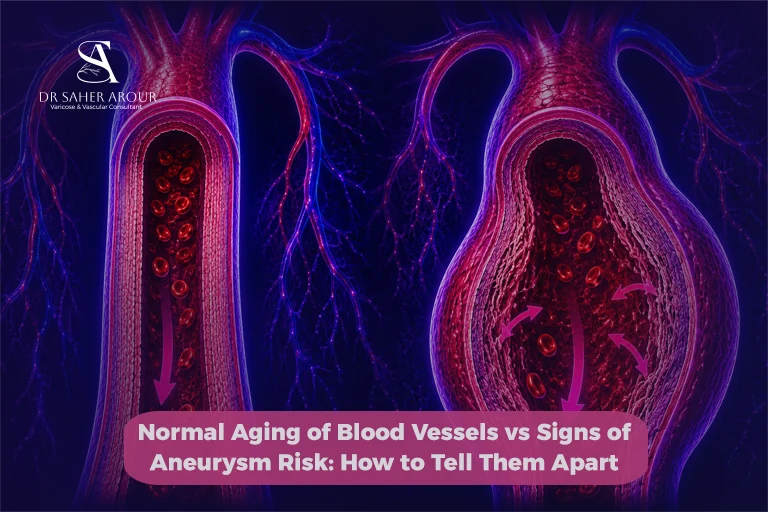
Normal Aging of Blood Vessels vs Signs of Aneurysm Risk: How to Tell Them Apart
It’s reasonable to wonder if a bulging blood vessel is just a standard part of getting older. Well.. While arteries do stiffen as we age, an aneurysm is an entirely different structural problem that requires specific attention.
Changes Associated With Normal Cardiovascular Aging
Many people assume aneurysms are just severe plaque buildup, much like what causes blockages in the heart. While AAA is associated with atherosclerotic risk factors, it actually has a distinct pathology characterized by medial degeneration of the aortic wall [4]. To put it simply, the actual structural tissue supporting the vessel breaks down, allowing the aorta to balloon outward like a weak spot on a tire.
Risk Factors That Suggest You May Need an Abdominal Aortic Aneurysm Screening
We look closely at specific aortic aneurysm risk factors men often face. The core risk factors include older age, male sex, smoking, and having a first-degree family history [1]. Having a father or brother with the condition greatly elevates your risk. We also know that hypertension is associated with AAA risk [5]. This is why treating High Blood Pressure early is so crucial: it protects your vessel walls from constant, daily stress.
The Anatomy and Mechanism: Why the Aorta Weakens and Bulges
Your aorta is built to handle high pressure, but when the middle layer of the wall degenerates, it gives way. Once an aneurysm starts forming, we track its size precisely to keep you safe.
How Atherosclerosis and High Blood Pressure Are Associated With Abdominal Aortic Aneurysm Risk
Medically, an aneurysm is typically defined as an aortic enlargement reaching a diameter of 3.0 cm or larger [1]. As that diameter gets wider, the wall stretches thinner and becomes weaker. Research shows the growth rate actually increases as the AAA diameter increases [6]. In small aneurysms, the mean growth rate is roughly 2.3 mm per year [6]. That’s why regular ultrasound monitoring becomes your best defense against unexpected growth.
Why Aneurysms Can Stay Hidden Until They Rupture or Are Accidentally Found
This condition is dangerously quiet. Most AAAs are asymptomatic, meaning they stay clinically silent and are often detected incidentally through imaging before a rupture occurs [1]. You simply can’t wait for your body to give you a warning sign: we have to look for it proactively to keep you safe.
Three Common Misconceptions and Why AAA Screenings Get Overlooked
Over the years, I’ve seen many men skip their vascular appointments based on common misunderstandings. Clearing up these myths is a vital part of protecting your health. Here is why you shouldn’t ignore the screening:
- Missed Because the Patient Has No Abdominal Pain: Many people believe they’ll feel pain if something inside is stretching. But the absence of classic symptoms absolutely does not rule out a ruptured AAA [7]. In fact, research shows the pooled sensitivity of abdominal pain for detecting a rupture is only 61.7% [7]. Waiting for pain means waiting until the situation is critical.
- Missed Because the Patient Quit Smoking Decades Ago: When considering aneurysm screening for smokers, some men feel safe because they quit 20 or 30 years ago. However, the epidemiologic literature defines an “ever smoker” as someone who has smoked at least 100 cigarettes over a lifetime [1]. That past exposure causes lasting structural damage. Average AAA growth was found to be 0.35 mm/year higher in smokers [6].
- Missed Because Normal Cholesterol Gave a False Sense of Security: A normal cholesterol panel is wonderful for your heart, but it doesn’t clear you for an AAA. Because the condition is pathologically distinct and driven by medial degeneration rather than typical atherosclerosis [4], good lipid numbers won’t stop a weakened aortic wall from expanding.
Practical Steps to Prepare for Your AAA Screening and Understand the Results
If you’re scheduled for a Vascular Screening, the standard approach we use is abdominal duplex ultrasonography [1]. It’s fast, painless, and highly accurate. This ultrasound has a pooled sensitivity of 97.5% and a specificity of 98.9% for detecting the condition [3]. If the ultrasound inadequately defines the AAA, surveillance CT is recommended for further evaluation and pre-surgical planning [5].
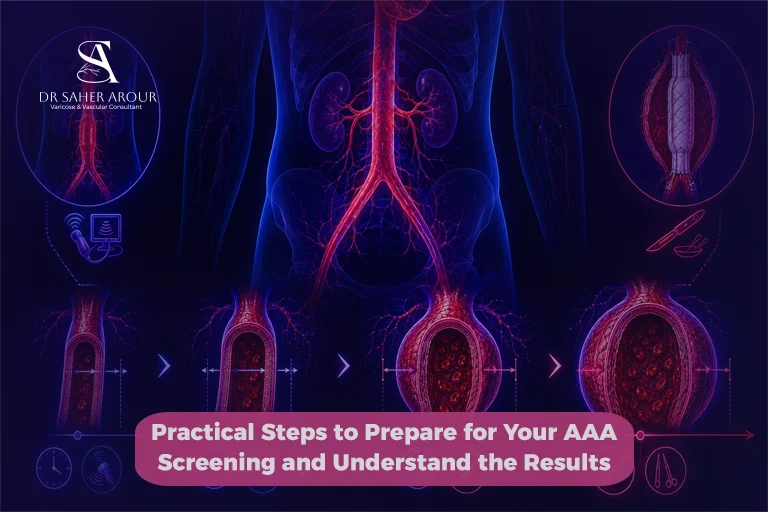
When we get your results, we rely on a specific size chart to plan your care safely and effectively:
| Aortic Diameter Finding | Recommended Medical Follow-up |
| Under 3.0 cm (Normal) | No active surveillance needed. AAA-associated mortality over 5 to 12 years is rare (<3%) [1]. |
| 3.0 to 3.9 cm | Surveillance ultrasound every 3 years to monitor interval change [5]. |
| 4.0 to 4.9 cm (Men) | Annual ultrasound surveillance is recommended [5]. |
| 5.0 cm and above (Men) | Surveillance ultrasound every 6 months before the repair threshold is reached [5]. |
When to See a Vascular Specialist for Abdominal Aortic Aneurysm Monitoring
Finding a bulge doesn’t automatically mean you need surgery. Your management is individualized according to your aneurysm size, rupture risk, and operative mortality risk [1]. For an unruptured AAA, surgical repair is safely recommended when the maximal diameter reaches 5.5 cm or greater in men, or 5.0 cm or greater in women [5].
We may consider intervening sooner in two specific situations. If you have a symptomatic unruptured AAA that is directly attributable to the aneurysm, repair is recommended to prevent an emergency [5]. Also, if we observe rapid growth of 0.5 cm or more in a 6-month period, repair may be very reasonable to reduce rupture risk [5]. My goal is to guide you calmly through these numbers so you always know you’re protected.
FAQ Section: People Also Ask
Who needs an abdominal aortic aneurysm screening?
One-time abdominal ultrasonography is recommended specifically for men aged 65 to 75 years who have ever smoked [1].
At what age should you get screened for AAA?
The standard recommendation window for screening is for men between the ages of 65 and 75 years [1].
How is an abdominal aortic aneurysm diagnosed?
The standard screening and diagnostic test is abdominal duplex ultrasonography, which is highly accurate at measuring the width of the aorta [1].
What size abdominal aortic aneurysm requires surgery?
For an unruptured AAA, repair is usually recommended when the maximal aneurysm diameter reaches 5.5 cm or greater in men, and 5.0 cm or greater in women [5].
Can an abdominal aortic aneurysm be detected on a regular ultrasound?
Yes, abdominal duplex ultrasonography is the standard, painless approach specifically used for accurate AAA screening and detection [1].
References
- [1] Abdominal Aortic Aneurysm: Screening | United States Preventive Services Taskforce
- [2] The Multicentre Aneurysm Screening Study (MASS)
- [3] Screening for Abdominal Aortic Aneurysm: A Systematic Evidence Review
- [4] Pathogenesis of Abdominal Aortic Aneurysms
- [5] Society for Vascular Surgery clinical practice guidelines for the care of patients with an abdominal aortic aneurysm
- [6] Growth rates of small abdominal aortic aneurysms
- [7] Accuracy of symptoms and signs for ruptured abdominal aortic aneurysm