If you’ve just had catheter treatment for your varicose veins, and you’re probably wondering why the vein is still visible on your leg. It’s completely normal to feel a bit anxious when it hasn’t vanished overnight.
Medically Reviewed & Written by Dr. Saher Arour,
Board-Certified Vascular Surgeon
When you leave the clinic, the healing process is just beginning. Your body simply needs time to break down and absorb the treated vein. Here is what you should realistically expect over the coming weeks:
- Visible changes happen gradually over weeks and months, not instantly.
- We confirm early closure by ultrasound, not by how your leg looks in the mirror.
- Minor symptoms like firmness or temporary bruising are expected parts of the healing journey.
Table of Contents
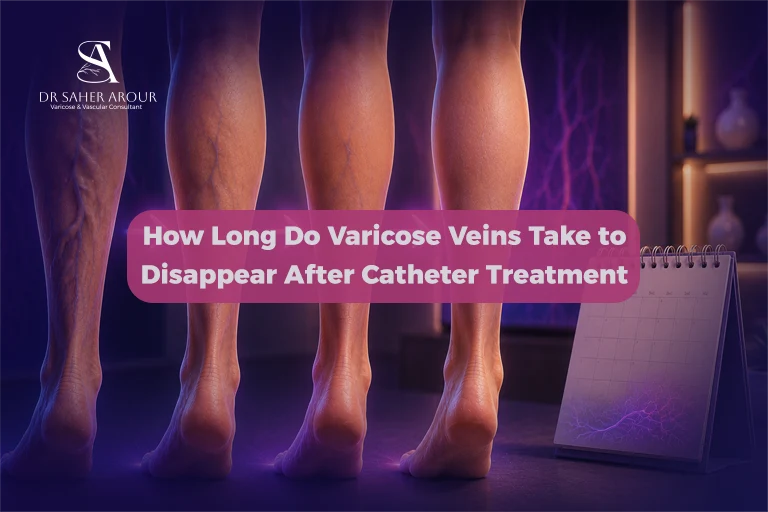
How long do varicose veins take to disappear after catheter treatment?
Treated veins do not disappear the moment your procedure ends. While an early duplex ultrasound confirms the vein is successfully closed, the visible changes on your skin take a bit more time. [1]
A catheter procedure seals the vein from the inside, leaving your body to clear away the tissue naturally. Both Radiofrequency Ablation (RFA) and Endovenous Laser Ablation (EVLA) shut these veins down effectively. At the 1-month mark, occlusion rates hit 98.35% for RFA and 98.04% for EVLA [2]. This means the treatment has already worked internally, even while the varicose vein disappearance timeline plays out on your skin.
This success holds steady. At one year, occlusion remains strong at 93.13% for RFA and 94.18% for EVLA [2]. The vein stays securely closed as your body quietly absorbs it.
Week by Week : What Actually Happens to the Treated Vein
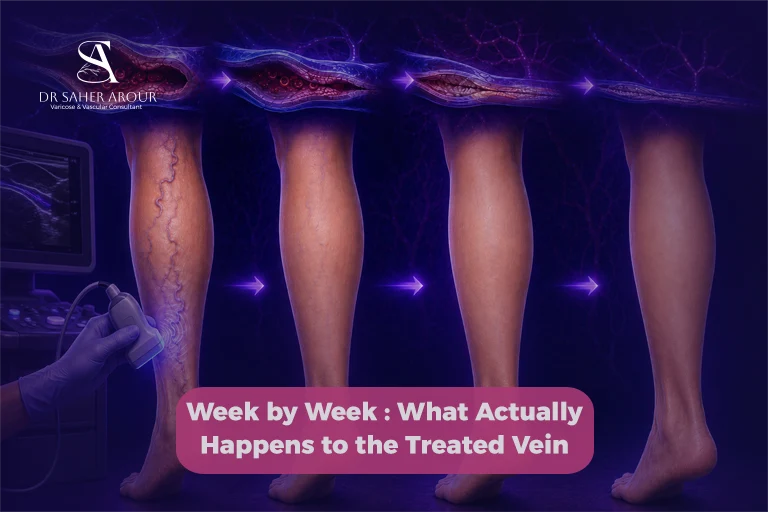
Days 1 to 7 : The Vein Looks the Same or Darker
In the first few days, the treated vein might look a bit more obvious or feel firmer to the touch. This happens because your body is reacting to the heat energy used to seal the vein. It’s quite common to notice some vein bruising.
You might also experience short-term events like hyperpigmentation (a harmless skin darkening), mild inflammation (thrombophlebitis), numbness, or rarely, a blood clot in the treated area (EHIT/DVT) [1].
Between 1 week and 12 months, about 18.1% of treated legs show minor symptoms like pain, mild swelling, or skin pigmentation [3]. Don’t let these early signs worry you: they are a standard part of the initial healing phase.
Weeks 2 to 4 : The Vein Begins to Flatten
As you move into the second and fourth weeks, that initial inflammation settles down. Inside your leg, the problem vein is securely sealed. Some medical protocols even schedule a duplex ultrasound at 1 and 4 weeks to double-check this closure and ensure healthy blood flow elsewhere [4].
Even if the vein is still visible after EVLA on the surface, clinical tests at this stage almost always confirm that the faulty blood flow has completely stopped.
Weeks 4 to 8 : Visible Improvement in Most Patients
By the one-month mark, what you see on the outside starts matching the healing on the inside. Patients often ask how long RFA takes to work, but the internal fix is already complete. Your skin’s appearance is just catching up.
The risk of a postoperative venous thrombotic event is exceptionally low at this stage: just 0.78% for RFA and 0.87% for laser ablation [2]. The vein simply keeps shrinking safely.
Months 2 to 3 : The Vein Is Partially Absorbed or Significantly Reduced
We often use the 3-month mark as a standard early follow-up checkpoint [1]. At this stage, your body’s natural absorption process has progressed beautifully.
Keep in mind that we rely on a duplex ultrasound to definitively confirm anatomical success after endovenous ablation. Visible improvement alone isn’t the true medical measure of vein closure success [5].
Months 3 to 6 : Final Result for Large or Complex Veins
If you had large or complex veins, your body just needs more time to clean up the tissue. Doctors continue monitoring these cases. Published protocols vary: one randomized trial checked patients with ultrasound at 2 days, 6, 12, and 24 months [6].
Another schedule used scans at 12 days, 1 year, and 2 years [7]. Throughout these longer periods, your system steadily clears away the remnants of the closed vein.
Why Some Veins Disappear Faster Than Others
Every person heals at their own pace, and the specific treatment method you had plays a subtle role. Overall, RFA and EVLA share very similar success rates for closing the main surface veins [2]. Interestingly, data looking at treatments since 2016 showed a slight edge for RFA at 93.27% compared to 91.24% for laser at 1 year [2].
When weighing the two, this meta-analysis found that RFA resulted in slightly fewer minor burns, bruising, pain, and numbness, but did show a bit more skin pigmentation than laser ablation [2].
Factors That Speed Up Absorption
Sticking to your proper aftercare, specifically your Catheter-Based Varicose Vein Treatment follow-up instructions, makes a real difference.
Using compression stockings is a big topic, and practices vary significantly: always follow the specific advice your clinician gives you [8].
Here is what the medical evidence generally suggests for your recovery timeline:
- Typical duration: Surgeons typically recommend wearing compression stockings for about 10 days, though this ranges from 2 days to 6 weeks depending on the case [8].
- Pain reduction: Wearing them for 1 to 2 weeks, compared to just a day or two, noticeably reduces pain during that first week [9].
- Solid baseline: One major review suggested 1 week of compression after thermal ablation as a highly practical baseline [9].
- Long-term results: By 3 years out, studies found no additional benefit from prolonged compression after RFA [10].
Factors That Slow Down Absorption
Occasionally, technical factors inside the vein prevent it from fading quickly. Incomplete closure is rare, happening in about 1.8% of cases at 1 week and just 1.1% at 1 year [3].
Medically, we define this as a vein that remains wider than 3 mm with detectable backward blood flow [3]. We also know that recurrence after EVLA can happen if the vein partially reopens (recanalization) or if new faulty flow develops [11].
In one trial: at 1 year, 2 veins reopened completely and 3 partially reopened after laser treatment [7]. By year 2, just 2 more treated veins showed partial reopening [7].
What Is Normal vs What Warrants a Follow-Up Call
Normal : Do Not Be Alarmed
Minor skin changes and mild discomfort are part of the healing journey, and they do fade. A brownish mark along the vein, known as hyperpigmentation, is a highly recognized post-treatment event, with RFA showing a slightly higher odds ratio of 1.75 compared to laser [2].
It’s temporary for almost everyone. In one clinical trial checking patients at 12 months, hyperpigmentation was seen in only 1 laser case, 1 foam case, and 0 surgery cases [12].
Looking further ahead, between 1 and 3 years out, only 11 out of 2,098 treated legs still showed any skin pigmentation [3]. In that same 1 to 3 year window, any persistent symptoms dropped to a tiny 2.2% [3].
Contact Your Surgeon If You Notice
While the vast majority of recoveries are entirely smooth, routine postoperative duplex ultrasound scanning is highly recommended to rule out rare issues [13].
Observed deep vein thrombosis (DVT) rates are extremely low: just 0.7% after RFA and 1.0% after EVLA. Minor heat-induced clots near the junction (EHIT) are also rare, sitting at 0.2% for RFA and 0.9% for EVLA [13].
If you ever experience sudden, heavy leg swelling or severe pain, don’t wait: contact your doctor right away for a quick checkup.
The Role of the 3-Month Follow-Up Ultrasound
That 3-month clinic visit is the perfect time to assess how well your body responded. A treated vein that is still slightly visible on your skin can actually be completely, technically closed. Duplex ultrasound is our definitive confirmation method, not just the physical appearance [14]. We assess treatment success by looking at the scan to ensure there is absolutely no blood flow left in the treated vein [5].
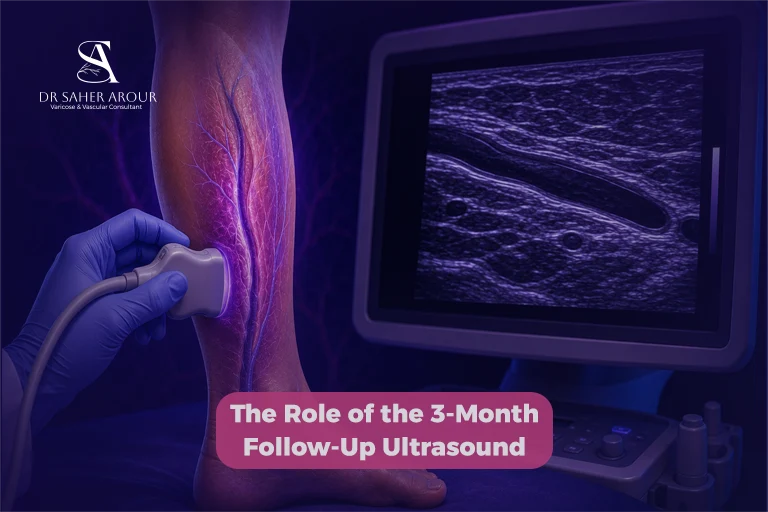
During this appointment, we’ll verify the seal. The long-term numbers are very reassuring: at 1 year, anatomical success rates are 88.5% for EVLA, 88.2% for traditional surgery, and 72.2% for ultrasound-guided foam [12]. Better yet, the clinical recurrence rate at 1 year is much lower for the catheter laser (4.0%) compared to traditional surgery (20.4%) [11].
Sometimes, your body needs a tiny bit of extra help; at long-term follow-up, only 16 out of 2,324 treated legs required repeat foam sclerotherapy [3] to tidy up remaining small branches. Any remaining Varicose Veins After Surgery can be managed easily once we confirm the main faulty vein is securely shut down.
| Treatment Method | 1-Year Anatomic Success Rate | 1-Year Clinical Recurrence |
| EVLA (Catheter Laser) | 88.5% [12] | 4.0% [11] |
| Traditional Surgery | 88.2% [12] | 20.4% [11] |
| UGFS (Foam) | 72.2% [12] | Not specified |
FAQ Section : People Also Ask
Is it normal for the varicose vein to look worse immediately after laser treatment?
Yes. It is common for the treated vein to appear darker, firmer, or more visible in the first 1 to 2 weeks due to inflammation and trapped blood. This is part of the normal healing process and usually improves over time.
How long should I wear compression stockings after varicose vein catheter treatment?
Compression stockings are typically recommended for several days to a few weeks after treatment, depending on the procedure and your doctor’s advice, to reduce swelling and support vein closure.
Why is there a brown mark along my treated vein : will it go away?
This is called hyperpigmentation and can occur after vein treatment due to blood breakdown under the skin. It often fades gradually over weeks to months, though in some cases it may take longer.
Can I tell if my varicose vein treatment worked without an ultrasound?
Not completely. While symptoms and visible improvement are helpful signs, duplex ultrasound is the most reliable way to confirm that the treated vein has closed successfully.
What happens if the treated varicose vein comes back?
In some cases, veins can partially reopen (recanalization) or new veins may develop. If symptoms persist or return, your doctor may recommend follow-up treatment such as sclerotherapy or repeat ablation.
References
- [1] Early technical closure is typically confirmed at 1 month and 3 months by duplex ultrasound; cosmetic disappearance is not instantaneous.
- [2] 1 month occlusion: RFA 98.35%; LA/EVLA 98.04%.
- [3] At 1–3 years, 11/2,098 legs still had skin pigmentation.
- [4] Some protocols use duplex at 1 and 4 weeks for occlusion and thrombosis surveillance.
- [5] Treatment success/obliteration is assessed by duplex ultrasound evidence of no flow in the treated vein.
- [6] For thermal ablation in this trial, occlusion remained about 94% at 1 year and about 91% at 2 years.
- [7] At 1 year in this trial, 2 veins reopened completely and 3 partially reopened after EVLT.
- [8] compression practice varies significantly; regimen should follow procedure-specific clinician advice.
- [9] meta-analysis recommendation was 1 week of compression after ETA.
- [10] At about 3 years, this follow-up study found no additional benefit from compression after RFA.
- [11] Recurrence after EVLA can occur from neoreflux or recanalization.
- [12] At 1 year, anatomic success: EVLA 88.5%, surgery 88.2%, UGFS 72.2%.
- [13] routine postoperative duplex ultrasound scanning is recommended in this context.
- [14] duplex ultrasound is the confirmation method, not appearance alone.