
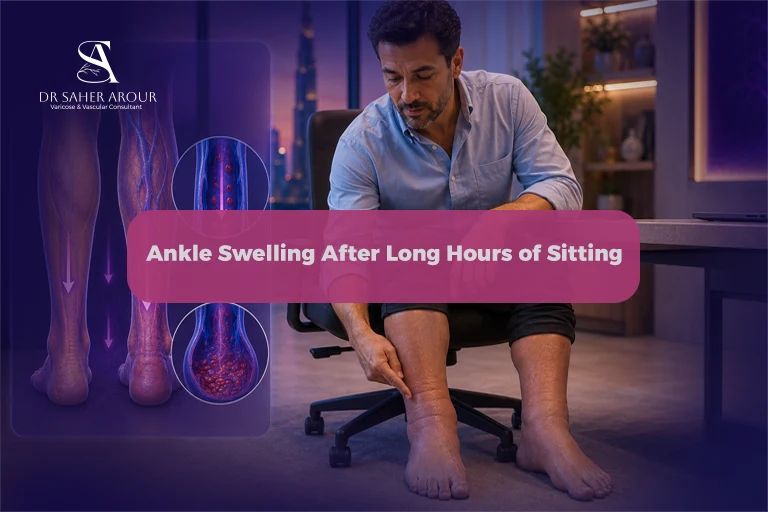
Ankle swelling after sitting all day is usually a harmless fluid buildup from gravity, but it can sometimes indicate an underlying vascular or systemic problem, especially if accompanied by pain.
If you notice office worker leg swelling after long hours at your desk, you are not alone. When you sit for extended periods without moving, blood struggles to travel back up to your heart, causing fluid to pool in your lower legs. We need to look into this closely to understand if your swelling is just a normal reaction to gravity or a real sign of poor vein health.
Here is exactly what you need to understand about this symptom before you worry:
- Gravity can substantially worsen edema formation in the leg [1].
- Slight daily edema normally resolves with night rest and leg elevation [2].
- A deeper vascular issue might be present if the swelling does not improve overnight.
Table of Contents
What Causes Ankle Swelling After Sitting All Day?
In my clinic, I often explain that ankle swelling after sitting all day is most commonly caused by dependent (gravitational) oedema. This means fluid pools in your lower limbs simply because of prolonged immobility and gravity. Medically speaking, dependent/gravitational oedema is a physiologic fluid-pooling mechanism in the lower limb [1]. This gravitational oedema ankles effect is a very common daily occurrence. It can also be worsened by reduced calf muscle pump activity, allowing venous blood and fluid to accumulate.
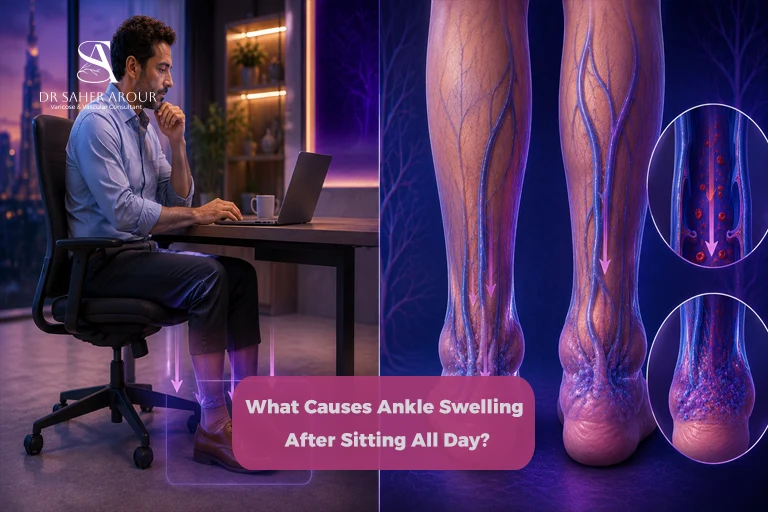
In fact, research shows an increase in calf venous pooling of 17% after prolonged sitting [3]. In some cases, however, it may indicate an underlying vascular, cardiac, or renal condition that requires a proper medical assessment. When considering ankle oedema vascular vs cardiac sources, we examine your medical history carefully to give you the right answer.
Normal Gravitational Swelling vs Vascular Swelling : How to Tell Them Apart
It is completely normal to feel confused about whether your swelling is just from sitting or if it is a sign of a real vein problem. Here is how we usually tell them apart:
| Feature | Normal Gravitational Swelling | Vascular Swelling (e.g., CVI, DVT) |
| Resolution Time | Slight daily edema normally resolves with night rest and leg elevation [2]. | Failure of normal overnight resolution or prolonged dependency can produce edema [2]. |
| Associated Signs | Usually mild, painless, and affects both legs equally at the end of the day. | Major clinical CVI features include dilated veins, edema, leg pain, and cutaneous changes [6]. |
Signs That Your Swelling Is Simply Positional (Normal)
If your puffy ankles happen just from sitting at your desk, the fluid buildup is usually mild and painless. The most reliable sign of normal dependent swelling is that it simply goes away after you rest. As observed in clinical practice, slight daily edema normally resolves with night rest and leg elevation [2]. This means if you wake up in the morning with normal-looking ankles, the swelling was likely just a temporary positional issue from the day before.
Signs That Suggest a Vascular Problem Needs Assessment
When the swelling stays constant or comes with other symptoms, it might not be a simple fluid issue anymore. Failure of normal overnight resolution or prolonged dependency can produce edema [2]. If the swelling remains despite elevating your legs in bed, we need to find out exactly why. You should also watch for changes that happen in only one leg. Unilateral swelling, pain, or visible skin changes are real clinical clues that a doctor should evaluate your vein health to prevent sedentary lifestyle vein damage.
The Calf Muscle Pump : Why Desk Workers Have Worse Vein Health
How the Pump Works in Normal Walking
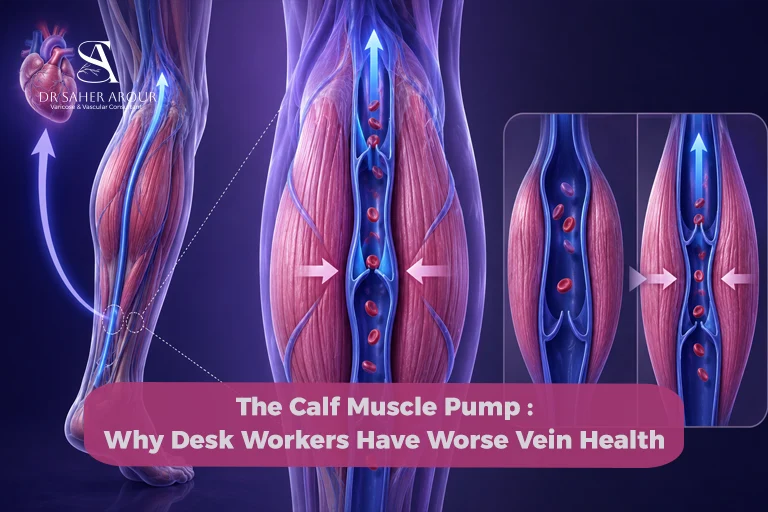
Your legs have a built-in pumping system designed to fight gravity. The calf muscle pump is a major determinant of venous return in the legs [4]. When you walk, your leg muscles actively squeeze your veins, pushing the blood safely back up to your heart. Approximately 90% of venous return during ambulation is attributed to the foot, calf, and thigh muscle pumps [5]. This steady, active movement is what keeps blood from pooling heavily around your ankles.
What Happens When the Pump Is Inactive for Hours
Prolonged sitting reduces calf muscle contractions, which normally help push venous blood back toward the heart. Think of it this way: when you sit at your desk for hours without walking, you are essentially turning off this natural pump. A calf muscle pump failure desk job scenario happens when you stay still for extended periods. This can lead to increased venous pressure and fluid accumulation in the lower limbs (venous pooling), contributing to noticeable ankle swelling. A reduced calf pump function indicates inefficient blood ejection and venous stasis [4]. Without the squeezing action of your muscles, blood naturally pools in your lower legs.
Three Conditions Ankle Swelling Can Signal : Beyond Simple Venous Pooling
Chronic Venous Insufficiency (CVI)
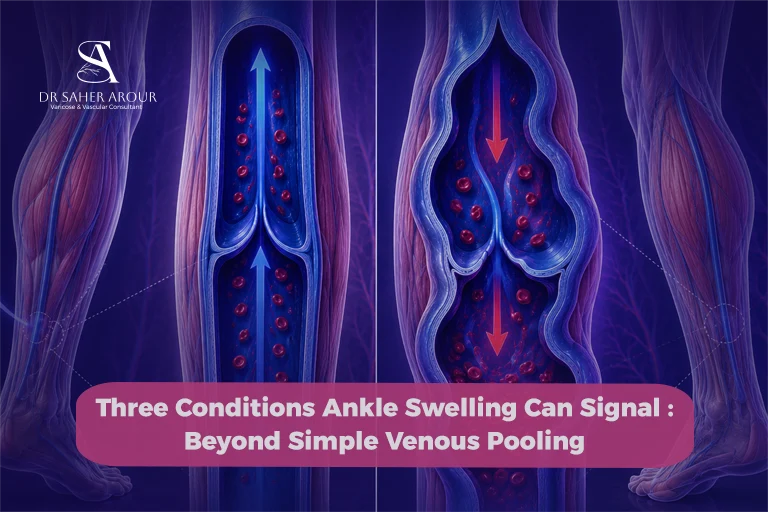
If you have chronic swelling, the tiny valves inside your leg veins might not be closing tightly anymore. CVI mechanisms include valve incompetence, obstruction, muscle pump dysfunction, or combinations [6]. When this happens, blood leaks backward and pools in the lower leg. Major clinical CVI features include dilated veins, edema, leg pain, and cutaneous changes [6]. CVI edema typically begins in the perimalleolar region (the area just around your ankle bone) and ascends up the leg [6]. This CVI edema is usually dependent and pitting [6]. Also, CVI discomfort often worsens after prolonged standing and improves with leg elevation [6].
Deep Vein Thrombosis (DVT) : The Emergency to Rule Out First
A blood clot in the deep veins of your leg is a serious medical issue. When I see patients with sudden, unexplained leg swelling, my first priority is always to rule this out to keep them safe. Acute DVT should be excluded first in the differential of limb swelling and discomfort [6]. Interestingly, reduced calf pump function is linked to a higher risk of this condition, with an adjusted HR for ipsilateral DVT of 1.71 (95% CI, 1.03-2.84) [4].
When doctors evaluate for DVT, they look for specific physical signs. Pitting edema is a formal Wells-rule DVT item [7]. Other Wells-rule items include entire leg swelling and calf swelling greater than 3 cm [7]. However, a low score combined with a simple blood test can help rule it out completely. DVT probability with a Wells score of 1 or less plus a negative D-dimer test is 1.2% (95% CI 0.7% to 1.8%) [7].
Cardiac and Renal Oedema : When the Swelling Isn’t Vascular
Sometimes, the veins in your legs are perfectly fine, but the swelling is coming from elsewhere in your body. If both of your legs swell, it might be related to how your other organs are functioning. A bilateral edema differential includes [8]:
- Congestive heart failure (CHF)
- Nephrotic syndrome
- Severe liver disease
- Hypothyroidism
- Some medications
Key systemic differentials for edema also remind us to consider endocrine disorders or renal disease [6]. Another specific condition to keep in mind is lymphedema. Foot and toe involvement favors lymphedema over CVI [6].
Practical Steps to Reduce Ankle Swelling for Desk Workers
If you have to sit for work, you can still protect your veins. Moving your legs frequently is the best way to activate your calf muscle pump. Try doing calf raises under your desk or taking short walking breaks every single hour. Elevating your legs at the end of the day also gives gravity a fair chance to help blood flow back toward your heart.
Another excellent option is using medical support garments. Studies show that 10–20 mmHg compression had a clear effect on edema and symptoms versus placebo or no treatment (p < .0001) [9]. This means even low-pressure medical compression stockings (10–20 mmHg) can reduce symptoms and oedema [10].
When to See a Vascular Specialist for Ankle Swelling
If your swelling does not disappear by morning, or if you feel heaviness, pain, or notice skin color changes, it is time to get it checked. Swelling that affects only one leg should also be evaluated right away. We will examine you thoroughly to find out exactly what is causing your symptoms, so we can create the right personalized plan for you. You don’t have to live with the fear and discomfort; we are here to help you regain your mobility safely.
FAQ Section — People Also Ask
Is ankle swelling after sitting at a desk dangerous?
Usually not. Mild swelling from prolonged sitting is common, but persistent, painful, or one-sided swelling should be evaluated to rule out vascular or systemic causes.
Why is only one ankle swollen after sitting?
Unilateral swelling is less likely to be simple gravitational oedema and may suggest conditions like venous insufficiency or deep vein thrombosis, which require medical assessment.
Does ankle swelling from sitting mean I have varicose veins?
Not necessarily. Temporary swelling can occur in healthy individuals, but frequent or worsening swelling may be associated with venous insufficiency or varicose veins.
How quickly should ankle swelling resolve after lying down?
Normal dependent oedema typically improves within hours after leg elevation or overnight rest. Persistent swelling despite elevation may indicate an underlying condition.
Do compression socks help with ankle swelling from a desk job?
They can help reduce fluid accumulation and improve venous return, especially in people with prolonged sitting, but they do not treat all underlying causes of swelling.
References
- [1] https://www.nature.com/articles/s41598-022-09028-9
- [2] https://www.bmj.com/content/303/6819/1569
- [3] https://journals.physiology.org/doi/10.1152/jappl.1983.54.6.1673
- [4] https://ashpublications.org/blood/article/137/23/3284/475963/Reduced-calf-muscle-pump-function-is-a-risk
- [5] https://advances.umw.edu.pl/en/article/2024/33/6/671/
- [6] https://www.ahajournals.org/doi/10.1161/CIRCULATIONAHA.118.037915
- [7] https://www.bmj.com/content/348/bmj.g1340
- [8] https://www.kjim.org/journal/view.php?doi=10.3904/kjim.2018.230
- [9] https://www.ejves.com/article/S1078-5884(07)00541-4/fulltext
- [10] https://journals.sagepub.com/doi/10.1177/0268355516689631