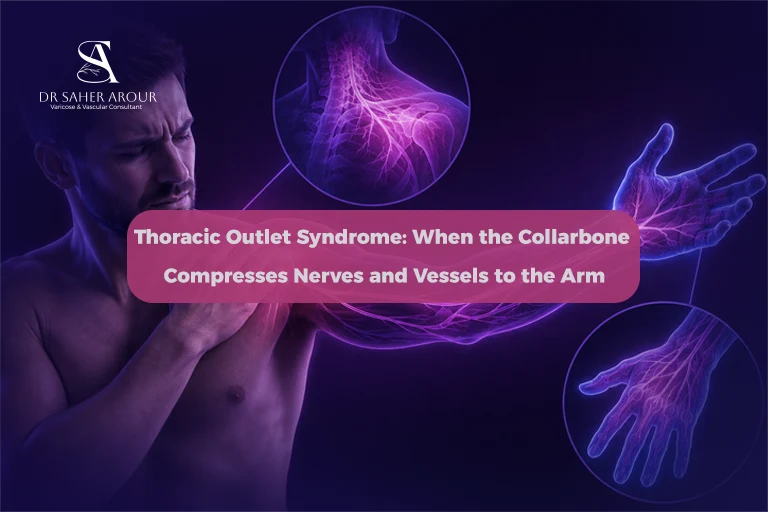
I know how frustrating numbness, tingling, and a heavy, tired arm can be, especially when they stop you from doing everyday things. When you reach overhead and your arm suddenly feels weak or starts to tingle, it might not just be a simple muscle strain.
I understand how exhausting it is to come to the clinic with compressive pain that’s been going on for months. This is often due to thoracic outlet syndrome collarbone compression. The narrow space between your neck and shoulder puts pressure on the sensitive nerves or blood vessels traveling down into your arm.
To figure out exactly what’s going wrong in your shoulder, we start by looking for specific clues in how your arm feels and moves. Here’s what we evaluate:
- Whether your fingers go numb, tingle, or turn pale when you reach up to a high shelf.
- If you feel an unusual heaviness that makes normal arm movement exhausting.
- The exact pattern of your pain.. whether it stays in your neck and chest or shoots all the way down to your fingertips.
Table of Contents
What Causes Thoracic Outlet Syndrome and What Gets Compressed Under the Collarbone?
Thoracic outlet syndrome happens when the nerves or blood vessels (the brachial plexus and subclavian vessels) get squeezed in the tight space just under your collarbone [1].
Instead of a busy tunnel, think of the thoracic outlet as a dynamic, narrow crossing. Medically, it’s the space between your lower neck and upper chest where all the main nerves and blood vessels traveling to your arm must safely pass [3].
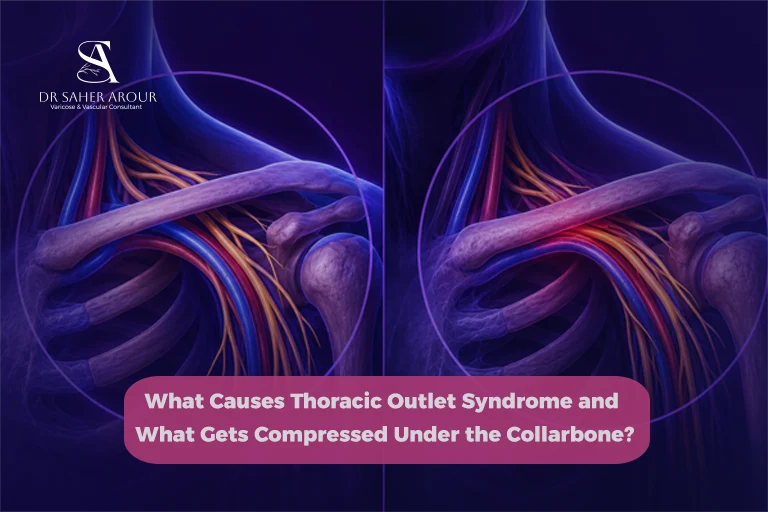
Because your body is constantly moving, this pathway shifts and changes shape. The compression may happen all the time or only when you move your neck and arm [3]. When you lift your arm, your collarbone and first rib can close in like a tight clamp, pinching whatever gets caught between them.
Normal Collarbone Anatomy vs TOS Compression: How to Tell Them Apart
Signs That Your Arm Symptoms Are Simply Positional (Normal)
- Temporary tingling: You experience a brief pins-and-needles sensation if you sleep on your arm wrong or hold a tight posture for hours.
- Quick recovery: Once you relax and lower your arm, blood flows freely again, and normal feeling returns almost immediately.
- No severe pain: The body naturally narrows the space during arm elevation, and healthy nerves and vessels tolerate this brief squeeze without causing lasting or sharp pain.
Signs That Suggest Thoracic Outlet Syndrome Needs Assessment
When these symptoms stop being temporary and start interfering with your daily routine, it’s time to look deeper. I always tell my patients that waking up with numb hands or frequently dropping your coffee mug is your body’s way of asking for help.
- Persistent neurological complaints: Common neurogenic complaints are pain, paresthesia, and muscle weakness in the neck, shoulder, arm, and/or hand [4].
- Activity-triggered worsening: Symptoms often worsen when the brachial plexus is stretched or when your arms are reached above the level of the shoulder [4].
- Loss of function: Simple tasks like driving, holding a hairdryer, or painting a ceiling cause your arm to go painfully numb or feel unnaturally heavy.
The Three Anatomical Spaces: Why Compression Happens Where It Does
TOS classically occurs in three spaces: the scalene triangle, the costoclavicular space, and the subcoracoid space [2]. Before we can relieve the pressure, we need to pinpoint exactly where the pinch is by tracing the path of your nerves.
How Nerves and Vessels Normally Travel Under the Collarbone
Your body’s map for these structures is highly organized. High up in the neck, the scalene triangle contains the trunks of the brachial plexus and the subclavian artery, while the subclavian vein passes beneath the anterior scalene, avoiding the compartment altogether [2]. Because the vein takes a different route here, muscle spasms in your neck usually affect the nerves and the artery first, leaving the vein alone.
What Happens When the Costoclavicular Space Narrows
A little lower down, just beneath the collarbone, everything comes together. The divisions of the brachial plexus and both subclavian vessels traverse this compartment [2]. When the collarbone drops down, or the first rib pulls up, this middle space narrows dramatically. This can crush the blood vessels and nerves at the exact same time, causing a confusing mix of pain and swelling.
Three Forms of TOS: Beyond Simple Compression
Because different structures get squeezed, we diagnose this condition based on what’s actually trapped.
TOS is usually subclassified into neurogenic TOS (nTOS), venous TOS (vTOS), and arterial TOS (aTOS), depending on the appropriate etiology upon presentation [2].
| TOS Subtype | What gets Compressed? | Key Symptoms | Frequency |
| Neurogenic (nTOS) | Brachial plexus nerves | Pain, paresthesia, and muscle weakness | Up to 95% of cases |
| Venous (vTOS) | Subclavian vein | Arm swelling, cyanosis, and heaviness | 3% to 5% of cases |
| Arterial (aTOS) | Subclavian artery | Hand ischemia, pallor, and fatigue | 1% to 2% of cases |
Neurogenic TOS: The Most Common Form
Neurogenic TOS is the most common form, occurring in up to 95% of the cases [1]. It happens when your brachial plexus nerves are squeezed, and your symptoms change based on exactly which part of the nerve network’s trapped.
Compression of the upper plexus (C5-C7) results in pain in the neck, shoulder, chest, and supraclavicular region, along with arm weakness and paresthesia of the first three digits [2]. This paresthesia.. which simply means that uncomfortable burning or prickling sensation you feel in your skin.. can travel all the way down to your fingers. But if the pressure sits lower down, compression of the lower plexus (C7-T1) elicits pain of the medial arm, forearm, and hand, paresthesia of the fourth and fifth digits, and hand weakness or loss of dexterity [2]. We’ll want to catch this early and guide you through treatment, because chronic nTOS may result in thenar, hypothenar, and interossei muscle weakness and atrophy [2]. This means the fleshy parts of your hand could actually begin shrinking and wasting away over time.
Venous TOS (Paget-Schroetter Syndrome): Effort Thrombosis to Rule Out
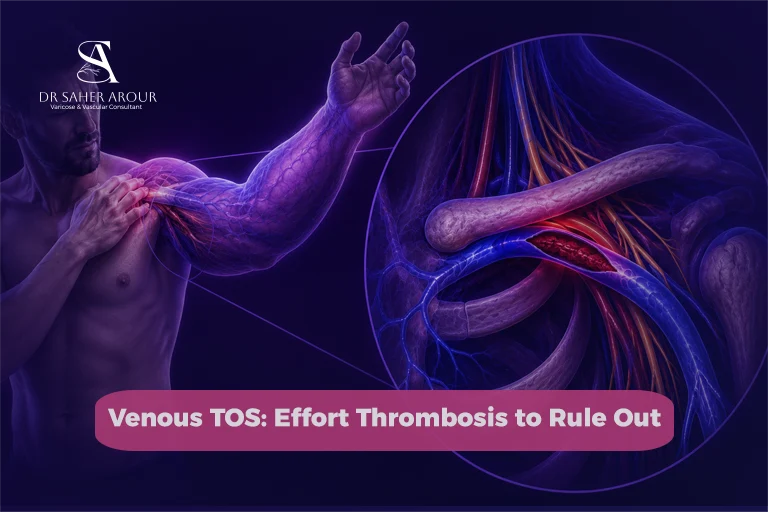
Venous TOS is much rarer, occurring in only 3 to 5% of cases [1]. This happens when the subclavian vein gets violently pinched. Subclavian vein compression in the thoracic outlet can result in venous thrombosis, called Paget-Schroetter syndrome [1]. This is a real blood clot directly caused by the mechanical squeeze on the vein.
Compression of the subclavian vein results in the characteristic symptomatology of vTOS, which includes upper extremity swelling, venous engorgement, cyanosis, feelings of arm heaviness, and pain [2]. You might notice your affected arm looks noticeably larger than the other, and shoulder abduction can exacerbate the pain or heaviness [2]. Finding a clot here requires the exact same urgent care as finding a DVT in the Upper Extremity.
Arterial TOS: The Rarest but Most Dangerous Form
Arterial TOS only happens in 1 to 2% of the cases [1]. Although rare, aTOS is the most dangerous subtype of TOS [2]. When the artery’s crushed, blood flow to the entire arm’s blocked. aTOS commonly presents with hand or upper extremity ischemia due to distal embolization [2]. This means a clot can form at the pinch point and travel down into your fingers. It sounds alarming, but recognizing these signs early gives us a clear window to intervene and safely restore normal blood flow.
Very often, this dangerous form’s caused by an extra bone you’re born with. The appearance of a cervical rib is the most common cause of arterial TOS, especially in patients younger than 40 years [5]. This extra rib grows just above the normal first rib, leaving almost no room for the artery to pass. Medical data shows that a cervical rib was significantly more prevalent in patients with TOS than in healthy individuals, with pooled prevalence estimates of 29.5% and 1.1%, respectively [6].
Practical Steps to Reduce Arm Symptoms for At-Risk Workers and Athletes
If you spend your day working overhead, like painting, stocking high shelves, or playing sports, you’re placing a lot of repetitive stress on your thoracic outlet. Quitting your job or sport’s rarely an option, so we focus on small daily adjustments to protect your shoulder from further nerve damage. Start by evaluating how you move. Avoid sleeping with your arms stretched high over your head, and lower your computer keyboard to take the strain off your neck and shoulders. Posture correction may improve your symptoms, especially if you’ve got the neurogenic type, by physically opening up the costoclavicular space. Unlike managing Chronic Venous Insufficiency or Varicose Veins, changing your physical shoulder mechanics can directly reduce the squeezing force on your nerves.
When to See a Vascular or Neurology Specialist for Arm Symptoms
Don’t ignore arm pain that gets worse when you reach up. We need to evaluate your shoulder if you start dropping objects, if your hand muscles look thinner, or if the pain keeps you awake at night. We use specific physical exams like the Adson test, alongside advanced imaging like MR neurography or Duplex Doppler ultrasound, to see exactly what’s trapped. However, if your arm suddenly swells, turns a bluish color, or your hand becomes cold and pale, you’ll need immediate medical help to rule out a dangerous clot in your subclavian vessels.
FAQ Section: People Also Ask
Is thoracic outlet syndrome dangerous?
It can be serious in vascular forms, especially if blood flow is reduced or a clot develops, but many neurogenic cases aren’t life-threatening.
Why does my arm go numb only when I raise it overhead?
Arm elevation can narrow the thoracic outlet space and temporarily compress the brachial plexus or blood vessels, causing positional symptoms.
Does TOS cause blood clots in the arm?
Yes, venous TOS can lead to effort thrombosis (Paget-Schroetter syndrome) due to compression of the subclavian vein.
Can posture correction alone cure thoracic outlet syndrome?
Posture correction may improve symptoms, especially in neurogenic TOS, but it doesn’t cure all cases.
Do compression symptoms under the collarbone mean I need surgery?
No, most cases are managed conservatively first, and surgery’s considered only in persistent or severe cases.