
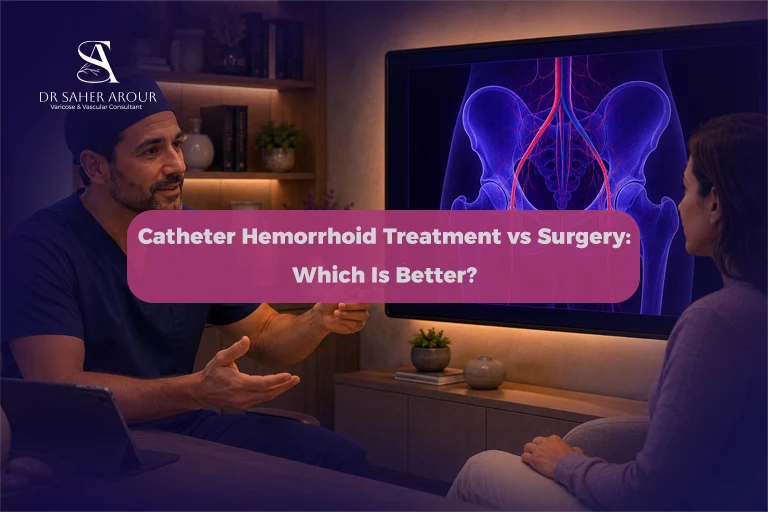
Catheter Hemorrhoid Treatment vs Surgery is a choice you might face when living with daily pain, discomfort, and the constant worry of bleeding that makes you feel completely exhausted. When you finally decide to seek help, comparing your options is often the first step toward getting your life back. The symptoms can be very scary and confusing, and choosing the right path forward requires clear, honest answers from your medical team.
To understand your options, keep this in mind: catheter-based embolization is a minimally invasive procedure offering faster recovery and less pain by shrinking tissue, whereas traditional surgery physically excises the tissue for more advanced, refractory cases.
We evaluate your specific condition carefully to find the right approach for your body and your lifestyle. Whether we are discussing rubber band ligation vs embolization for your grade of disease, or comparing a minimally invasive hemorrhoid treatment against a full surgical operation, both primary options have a real chance to stop your symptoms. However, they work in fundamentally different ways. Here is what you need to know as we begin exploring your personalized treatment plan:
- The embolization option involves no surgical cutting, allowing you to go home the same day and heal quickly.
- Surgical removal provides a definitive fix for larger, more complex cases that conservative management cannot handle.
- Dr. Saher Arour is one of only four doctors worldwide performing the HAE procedure, bringing rare specialized expertise directly to your care.
Table of Contents
Overview : What Each Treatment Actually Involves
To make the right choice, you need to understand exactly what happens inside your body during these treatments. Both approaches share the same goal of giving you lasting relief, but they take very different paths to get there. We want you to feel fully informed about what each procedure asks of your body, without being overwhelmed by confusing medical jargon.

Catheter-Based Hemorrhoidal Artery Embolization (HAE) : In One Paragraph
Hemorrhoidal artery embolization (HAE) is a minimally invasive procedure providing relief for patients with symptomatic internal hemorrhoids, by reducing the blood supply to the abnormal hemorrhoidal tissue [1]. When I sit down with patients in the clinic, I often describe this as simply turning off the water supply to a leaking pipe, rather than removing the pipe itself. Blocking these specific arteries shrinks internal hemorrhoids and stops bleeding effectively [1]. Because we work entirely from the inside of your blood vessels using a tiny tube, there is no cutting or stitching in your sensitive tissue. The swollen veins simply shrink down naturally over time, helping you heal without open surgical wounds.
Traditional Hemorrhoidectomy : In One Paragraph
Surgical treatments include excisional hemorrhoidectomy, which involves the direct surgical excision of the diseased tissue [2]. This procedure is indicated for large third-degree and fourth-degree hemorrhoids when standard medical management has failed [3]. In clear practical terms, the surgeon physically cuts out the swollen, diseased tissue. While it is a bigger physical trauma to your body, we highly recommend this removal when the condition is severe. It is a highly effective, time-tested way to remove the physical problem completely, even though it requires more downtime for healing.
Side-by-Side Comparison : The 8 Most Important Factors
When you are weighing your options, staring at medical terms can feel overwhelming. Instead of getting lost in medical jargon, let’s look at exactly how the catheter procedure compares to traditional surgery in terms of what you will actually feel, experience, and go through in your daily life.

This comparison will help you see the practical differences clearly.
| Comparison Factor | Catheter-Based Embolization (HAE) | Traditional Surgery (Hemorrhoidectomy) |
| Anesthesia Type | Twilight sedation (you stay breathing on your own) | General anesthesia or deep spinal block |
| Procedural Pain | Very low to none | Significant pain during the healing weeks |
| Recovery Speed | Back to routine in a few days | Several weeks of restricted activity |
| Hospital Stay | Outpatient (same-day discharge) | Often requires overnight observation |
Anaesthesia Required
HAE is routinely performed with moderate twilight sedation (meaning you are in a deeply relaxed, sleepy state but breathing entirely on your own without a breathing tube) as an outpatient procedure [1]. This is a huge relief for many patients who want a no general anesthesia hemorrhoid option to avoid the risks and grogginess of being completely put under. You will feel comfortable during the procedure and wake up quickly. On the other hand, traditional surgery almost always requires a general anesthetic or a deep spinal block to ensure you feel absolutely nothing while the tissue is physically removed.
Pain During and After the Procedure
HAE patients typically experience less post-procedure pain compared to those undergoing standard surgical treatments [1]. Conversely, excisional hemorrhoidectomy is associated with more postoperative pain, requiring a careful balance between the benefits and the overall complications [4]. Since we do not cut into the highly sensitive nerve endings of the lower body during the HAE procedure hemorrhoids treatment, your pain levels stay very low. Surgery, by its nature, involves significant pain during the first week or two of recovery, requiring strong prescribed medication and very careful home care routines.
Recovery Time and Return to Normal Life
HAE is an outpatient procedure where patients go home the same day and enjoy faster recovery times than surgery [1]. You can usually walk out of our clinic just hours after the procedure with nothing more than a small bandage on your wrist or leg. Most people can get back to their normal daily routine, including work and light activity, within a day or two. A long hemorrhoidectomy recovery time means traditional surgery requires you to rest for several weeks, take time off work, and follow strict hygiene routines as the surgical wounds heal.
To give you a clearer idea, here is what the first few days of recovery generally look like depending on the path you choose:
- Mobility: Embolization patients usually walk comfortably the same day, while surgery patients require extended bed rest to manage pain.
- Wound Care: The catheter method only requires keeping a tiny pinhole bandage clean, whereas surgery requires frequent sitz baths and complex local hygiene.
- Comfort Level: Catheter patients manage mild pelvic pressure with over-the-counter medication, but surgical patients need dedicated pain management plans.
Recurrence Rate
Both treatments carry a risk of the condition returning over time. Studies looking at symptom improvement show there is insufficient evidence to judge a clear, definitive long-term difference in recurrence between the specialized arterial techniques and standard hemorrhoidectomy [4]. This means both options have a strong chance of keeping the problem away if you are the right candidate. Neither treatment guarantees absolute permanence if you do not maintain healthy lifestyle habits, but both provide excellent, reliable relief.
Who Is a Candidate
HAE is specifically indicated as a treatment for symptomatic internal hemorrhoids [1]. If you are experiencing frightening bleeding in the bathroom but the tissue has not permanently fallen outside the body, you are likely a great fit for the catheter approach. Surgery is generally for patients who have large, external tissue that cannot be pushed back inside or managed with simpler methods. We will evaluate your specific anatomy thoroughly to ensure you fall into the right category for success.
Availability : How Rare Is HAE?
HAE must be performed by an Interventional Radiologist who is specialized in procedures navigated through blood vessels [1]. It is a technique growing in popularity but remains less widely available than conventional surgery across standard hospitals [4]. Finding a specialist who safely performs this technique can be challenging because it requires advanced imaging equipment and dedicated vascular training. Dr. Saher Arour is one of the few specialists globally who offers this targeted care.
Who Should Choose the Catheter Option?
If your main struggle is seeing blood every day, and you have a busy life that you simply cannot pause for weeks of painful healing, the catheter option is an excellent path to explore. We find that patients who want a minimally invasive approach to stop their bleeding do very well with embolization. It gives you the chance to fix the underlying vascular issue without facing a major operation.
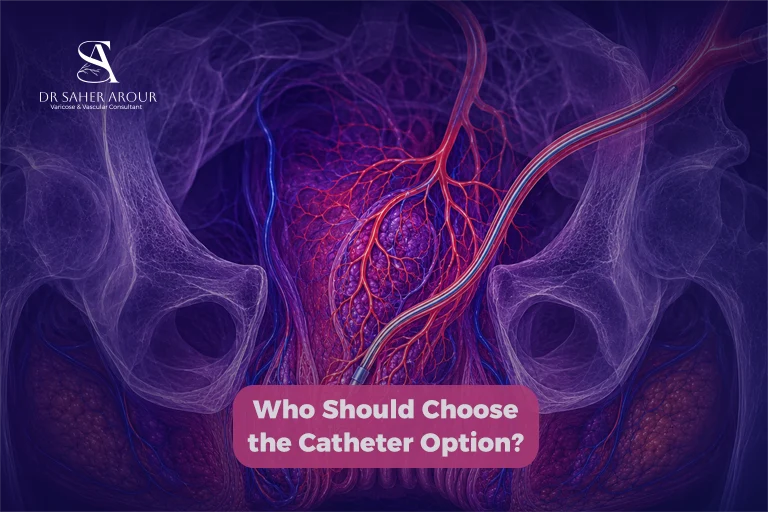
We sit down with you to review your medical history and your lifestyle. If you want to learn more about how we evaluate you, you can read our detailed guide on the Catheter-Based Hemorrhoid Treatment service page, or visit our main educational hub about البواسير. The goal is to give you a personalized plan that gets you back to your life safely.
Who Still Needs Traditional Surgery?
We never push a patient toward surgery unless it is truly the safest and most effective option for their specific body. However, surgical hemorrhoidectomy is necessary for large third-degree and fourth-degree hemorrhoids when medical management has failed [3]. When the swelling is very large, causing severe physical blockage, or drops outside the body permanently, removing the tissue surgically gives you the most reliable fix.
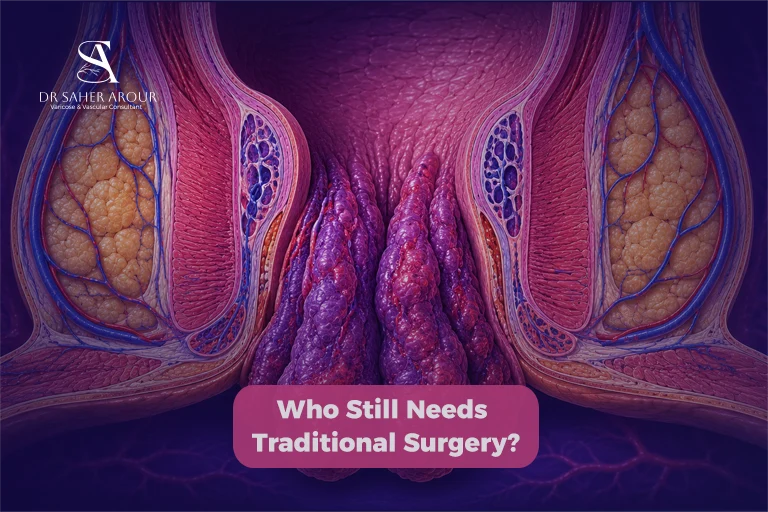
If we find that the catheter approach will not solve your specific problem, we will explain exactly why. It is always better to address the issue properly the first time than to try a smaller procedure that will not work for an advanced grade of disease. My ultimate priority is your long-term comfort, so if surgery is the only path to give you that lasting relief, we will make sure you understand every step of the process so you feel entirely safe and supported.
Frequently Asked Questions
Is catheter hemorrhoid treatment available in Dubai?
Yes, but availability depends on finding a specialized center with an expert interventional radiologist. If you are looking for a highly specialized hemorrhoid treatment Dubai, our clinic provides access to this advanced, minimally invasive care, and we can help coordinate your consultation.
Does catheter hemorrhoid treatment work for Grade 4 hemorrhoids?
Usually, no. Advanced Grade 4 disease requires surgical evaluation because the tissue has prolapsed permanently outside the body. Surgery is the indicated approach when the disease has reached this large, final stage [3].
Is hemorrhoidal artery embolization covered by insurance in UAE?
Coverage varies depending on your specific insurance provider and your medical records. Many providers cover it when it is medically necessary to stop bleeding, but we always help you communicate with your provider to secure pre-approval before we start any procedure.
How do I know if I am a candidate for HAE?
We determine this during a private, comfortable consultation. We review your bleeding history, assess the grade of your condition, and see how you have responded to simpler treatments. If you have internal bleeding without severe external prolapse, you are likely a strong candidate.
References
- [1] Hemorrhoidal Artery Embolization (HAE) https://www.uclahealth.org/medical-services/radiology/interventional-radiology/HAE
- [2] Hemorrhoidectomy https://emedicine.medscape.com/article/1829854-overview
- [3] Hemorrhoids – StatPearls https://www.ncbi.nlm.nih.gov/books/NBK549864/
- [4] Surgical interventions for hemorrhoids