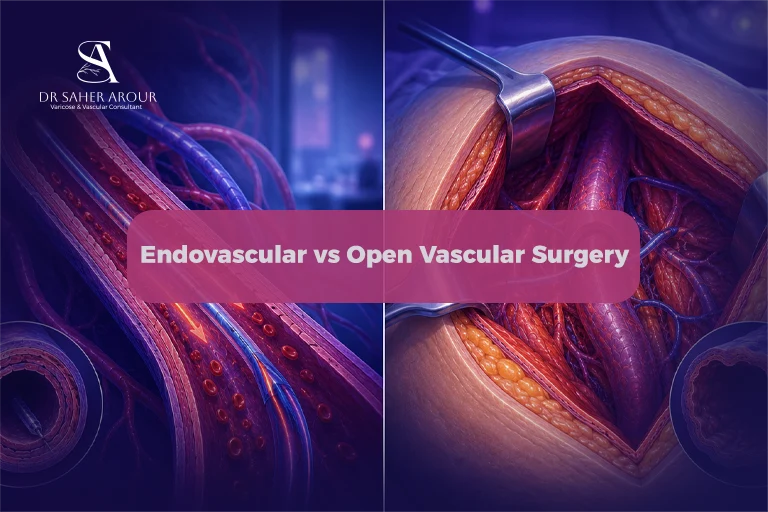
I understand how stressful it can be to find out you need vascular surgery, especially when terms like “endovascular” and “open repair” get thrown around. That is why you might be wondering about endovascular vs open vascular surgery: which is right for you?
Many people ask me if they can avoid a large incision entirely. The good news is that we can now treat many selected vascular conditions from inside the blood vessel itself. But this isn’t a universal rule. The safest approach depends heavily on your specific case.
To clear things up, I’ll explain:
- how endovascular and open procedures differ physically.
- what these differences mean for your hospital stay and your long-term recovery.
- which method fits specific conditions, like aortic aneurysms.
Table of Contents
What Is Endovascular Surgery? : The Core Principle
The word “endovascular” simply means treating the problem from “inside the blood vessel.” Instead of making a large cut through your skin and muscle, we rely on a very tiny puncture, usually in your groin or arm. Through this small entry, we carefully guide a thin, flexible tube called a catheter directly to the damaged area. We use real-time X-ray imaging in the operating room to see exactly where we are going.
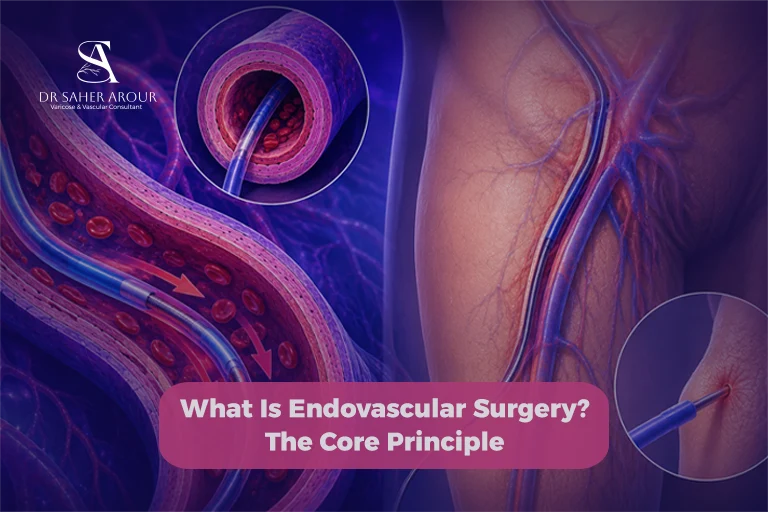
Once we reach the target, we can open up blockages using balloons, place metal stents to keep the artery open, or deliver medications directly to the site. Because we don’t open your chest or abdomen, the immediate physical stress on your body is much lower. This is the core of minimally invasive vascular surgery—fixing your body’s plumbing without tearing down the walls to get there.
What Is Open Vascular Surgery? : When the Scalpel Is Still Needed
Open vascular surgery means making a direct incision so we can look at the affected blood vessel with our own eyes and fix it with our own hands. We might need to physically clear hard plaque out of an artery or sew a new bypass graft securely into place. While we lean toward catheter-based options whenever possible, open surgery remains an essential tool.
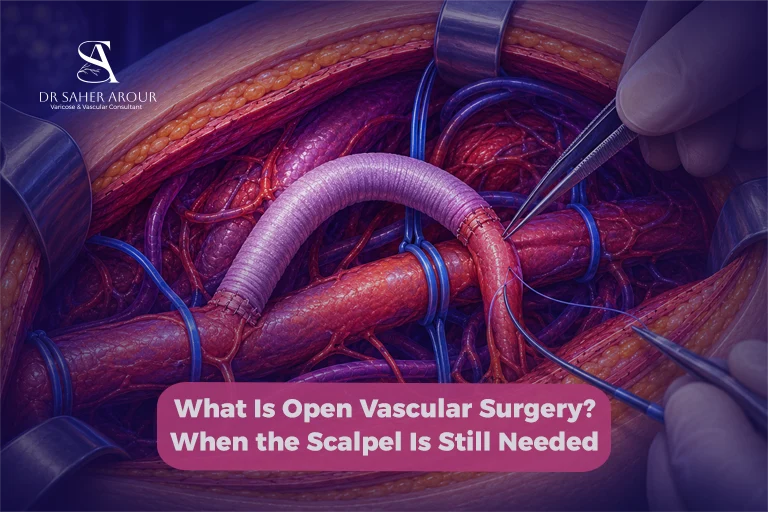
In selected cases, open surgery is required as the primary option, not just a backup plan. A catheter alone might not be safe if your vascular problem involves:
- Complex anatomy: where the blood vessels are too twisted to navigate safely from the inside.
- Heavy calcification: where rock-hard plaque blocks the way and needs to be physically removed.
- Tight branching arteries: where the disease sits near vital junctions that demand precise, manual reconstruction.
When we need direct visibility to rebuild a complex artery, open surgery gives us the absolute control necessary to secure a lasting repair. We accept the larger incision because it gives you a much more durable result.
Condition-by-Condition Comparison : Which Approach Applies?
Not every vascular issue follows the same rules. Some conditions respond beautifully to a simple catheter procedure, while others still require a traditional open approach to be fixed safely.
| Condition | The Catheter-Based Option (Endovascular) | The Traditional Option (Open Surgery) |
| Varicose Veins | Sealing the vein with heat or glue | Physical removal (Stripping) |
| Hemorrhoids | Blocking the feeding arteries | Cutting out the tissue |
| Aortic Aneurysm (AAA) | Placing a stent from the inside (EVAR) | Sewing a new tube directly |
| Peripheral Artery Disease | Opening the blockage with a balloon/stent | Routing blood around it (Bypass) |
Varicose Veins : Often Treated with Catheter-Based Techniques
Swollen, twisted veins can make standing difficult. In the past, the main fix was an open surgery called “surgical stripping,” which meant pulling the damaged vein out through small cuts. Today, we handle this much more gently from the inside. We insert a tiny catheter directly into the affected vein and use heat energy or a safe medical glue to seal the vessel shut. This lets your body naturally reroute the blood flow to nearby healthy veins. Keep in mind that the right choice depends on how wide your veins are, which we map out closely during your varicose veins evaluation.
Hemorrhoids : The Catheter-Based Option vs Traditional Methods
Hemorrhoids are simply swollen blood vessels in the lower rectum. The traditional treatment involves physically cutting out this swollen tissue. However, a newer catheter-based approach handles the problem differently. We use tiny tools inside the blood vessels to block the specific arteries feeding blood to the hemorrhoid. By cutting off that blood flow from the inside, the swelling naturally shrinks over time.
Aortic Aneurysm : EVAR vs Open Repair
An abdominal aortic aneurysm (AAA) is a serious, balloon-like swelling in your body’s main blood vessel. Treating it requires choosing between an endovascular approach—known as EVAR (Endovascular Aneurysm Repair)—and traditional open repair. If an aneurysm has already ruptured, EVAR gives you an early survival benefit over open repair [5]. Even in planned, non-emergency situations, EVAR has clear early advantages. It significantly lowers 30-day mortality, showing a lower perioperative mortality with an odds ratio of 0.54 compared to open surgery [1]. Looking at large pooled randomized trials, the 30-day mortality strongly favors EVAR with a pooled odds ratio of 0.19 [2]. And because we don’t open your abdomen, EVAR reduces your hospital stay by an average of about 296.75 hours compared to open repair [2].
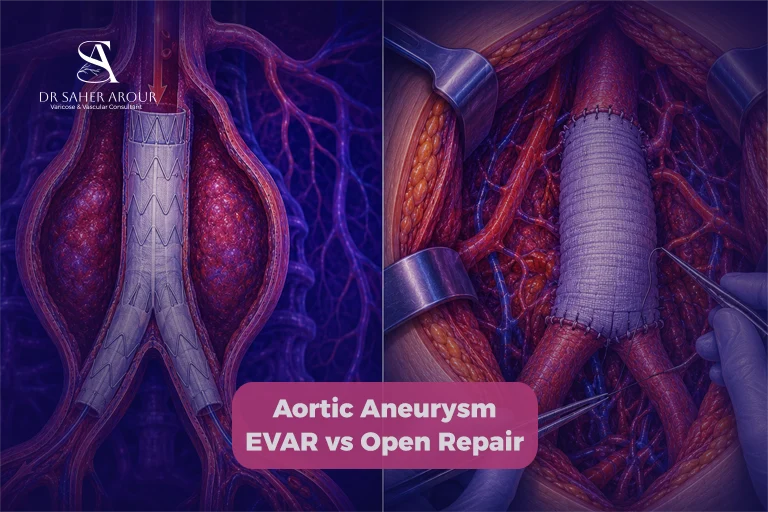
But to make a safe decision, we have to look at the long-term reality. The long-term mortality becomes similar between the two techniques in modern cohorts, with survival curves converging after 1 to 3 years [3]. In modern patient groups, there is no significant long-term mortality difference between EVAR and open repair [4].
Please know that EVAR isn’t a perfect fix. Patients face a higher reintervention risk with an odds ratio of 2.12. This means you might need another procedure later to fix issues like a slipping stent [4]. There is also a higher rupture risk post-EVAR over time, showing a secondary rupture rate with an odds ratio of 4.84 [4]. Because of these specific risks, lifelong imaging follow-up is required after EVAR [4]. On the other hand, while open surgery causes more immediate physical stress, it actually results in lower reintervention rates in long-term follow-up [4].
Peripheral Artery Disease : Angioplasty, Stenting, or Bypass
Plaque buildup in your leg arteries cuts off blood flow, causing deep, cramping pain when you walk. We have to restore that flow to keep your legs healthy. The endovascular approach uses angioplasty: we guide a balloon to the exact spot of the blockage and inflate it to push the plaque aside, sometimes leaving a stent to hold the vessel open. Open surgery usually means creating a physical bypass. We take a healthy piece of your own vein, or a synthetic tube, and stitch it in place to route the blood around the blocked area entirely. Finding the right peripheral artery disease treatment depends completely on where your blockage is located and its length.
Stroke : Mechanical Thrombectomy in Selected Cases
A stroke occurs when a blood clot blocks oxygen to your brain. In selected cases, we use a catheter-based procedure called mechanical thrombectomy to solve this. We access your blood vessels through a small puncture, guide a specialized device right up to the blocked artery, physically grab the clot, and pull it out. This lets us clear the blockage from the inside out without opening the skull. This specific stroke intervention requires highly specialized imaging and must be done very quickly after symptoms start.
Recovery Comparison : Why Endovascular Often Offers Faster Recovery
How we fix your blood vessel completely changes how you recover. Because endovascular procedures use a tiny puncture instead of a large cut, the immediate shock to your muscles and skin is very low. For example, EVAR reduces your hospital stay by hundreds of hours compared to an open abdomen repair [2].
Without a large surgical wound, you can usually sit up, walk, and eat normally much sooner, with a lower risk of surface infections. But please remember: a fast recovery today does not mean the vascular condition is gone forever. Endovascular solutions trade an easy recovery now for the need to check the repair closely for the rest of your life. You will feel better faster, but you must keep your follow-up appointments so we can make sure the stents stay exactly where we put them.
When Open Surgery Is Unavoidable
You might come into the clinic hoping for a quick endovascular fix because it sounds so much easier. I completely understand that hope. But the truth is, your safety depends heavily on your specific anatomy and the detailed imaging from your CT scans or ultrasounds.
In selected cases, open surgery is required to ensure a physically stable repair. A catheter-based approach could be physically unsafe if:
- Your blood vessels are too twisted: A stent needs a stable, healthy segment to sit securely.
- The plaque is heavily calcified: Rock-hard blockages often demand direct physical removal.
- The disease is near a complex junction: When the problem sits right where other important arteries branch off, we need direct, manual control.
I never view open surgery as a failure of modern medicine. It is simply the right tool for complex anatomy. We accept the longer recovery time because open surgery gives us the direct visibility needed to sew a strong, lasting graft into place.
Questions That Determine Your Best Approach
I want to reassure you that when we examine your case, we don’t just look at what we see on the screen. We take your daily life and your overall comfort into consideration. Together, we will answer a few practical questions to find the safest path forward for you:
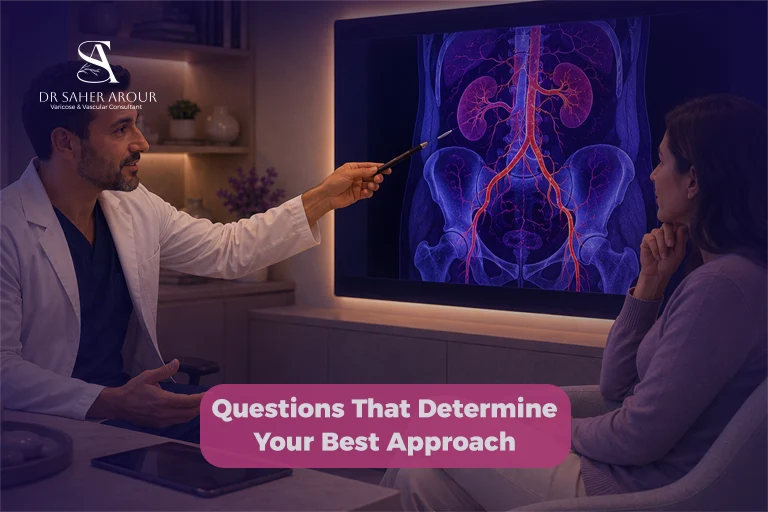
- Can a catheter safely reach the problem? If your arteries are very narrow or highly twisted, pushing a tube through them from the inside might simply not work.
- Will a stent sit securely? We need a solid, healthy segment of your blood vessel for the device to attach firmly. If the shape isn’t right, a stent could slip over time.
- Is your body ready for open surgery? We look closely at your heart and lungs. If you are physically strong, open surgery can be a very safe option that gives you a durable, long-term fix.
- Can you commit to lifelong follow-ups after EVAR [4]? Endovascular repair requires strict, yearly imaging. If traveling to the clinic every year is difficult for you, an open repair might actually be the safer long-term choice.
Your honest answers to these questions, combined with what your scans actually show, will guide our final decision together.
Frequently Asked Questions
Is endovascular surgery safer than open surgery?
In the short term, yes. You face lower early complication and mortality rates, especially for aortic aneurysm repair [1]. However, long-term survival rates become similar between both methods over time [3]. Your true safety depends on choosing the approach that fits your exact anatomy.
How do I know if my condition qualifies for endovascular treatment?
It comes down to three specific factors: your blood vessel anatomy, the severity of the blockage, and your overall physical strength. We use detailed imaging, like CT scans or ultrasounds, to see instantly if a catheter can safely fix the problem or if open surgery is required.
What are the downsides of endovascular surgery compared to open?
The main downside is the need for long-term maintenance. You will need lifelong imaging check-ups, and you face a higher chance of needing a touch-up procedure later. For example, EVAR carries a higher reintervention risk with an odds ratio of 2.12 [4]. Additionally, if your arteries are heavily twisted, this approach simply won’t work.
Can endovascular procedures be repeated if they don’t work?
Yes, in many cases we can revise or repeat an endovascular treatment. However, it depends entirely on your specific condition and what was done during the first procedure. That is why we always plan your initial surgery carefully, ensuring we never close off future medical options.
References
[1] EVAR was associated with reduced peri-operative mortality (OR 0.54, 95% CI 0.51–0.57, p < .001)
[3] EVAR and open repair show convergence in long-term survival after initial benefit