If you are looking into sclerotherapy varicose veins Dubai what it is? is likely your first question when exploring options to clear away uncomfortable or unsightly leg veins. It is normal to feel worried when you notice twisted, blue lines tracking down your legs, wondering if open surgery is your only path back to comfort.
Sclerotherapy offers a reliable, non-surgical treatment choice that addresses these concerns directly inside the clinic room, without any need for a hospital stay.
- It targets tiny spider veins and smaller varicose veins with great precision.
- The procedure uses a specialized fluid to safely seal off problem vessels without large cuts.
- It directly relieves the heavy, aching feelings that often drag down your legs.
- You can walk right out of your session and return to your normal daily routine immediately.
Table of Contents
What Sclerotherapy for Varicose Veins Does Inside the Vein
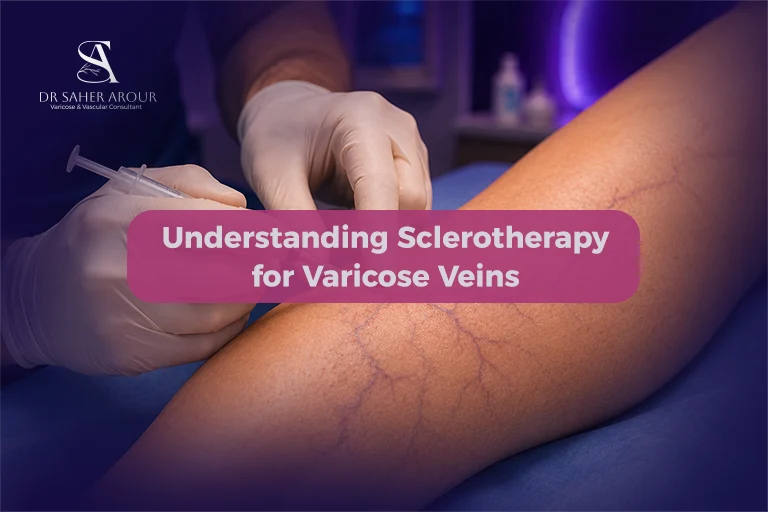
Sclerotherapy is a clinical treatment where we inject a liquid or foam solution directly into a damaged vein to cause it to collapse and naturally fade away. Leg veins rely on tiny, one-way valves to pump blood back up to your heart against gravity. When these valves weaken, blood pools backward, forming a visible varicose vein or a web of spider veins. To see how these types differ, view our guide on Spider Veins vs Varicose Veins.
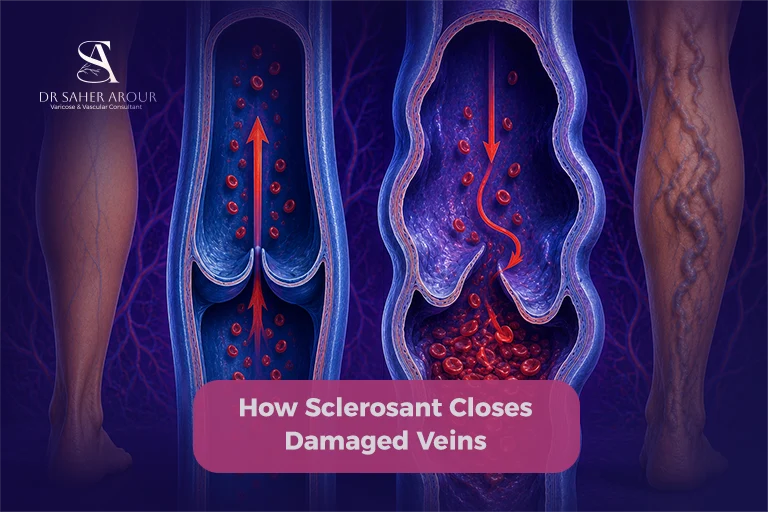
The injected solution, known as a sclerosant, creates a controlled irritation inside the inner lining of the blood vessel. Think of this solution as a medical adhesive designed to clean up your circulation from the inside. This forces the vein walls to seal and stick together, blocking the faulty, backwards flow of blood. Your body naturally transforms this closed vessel into a tiny strand of scar tissue, absorbing it completely. The blood naturally finds its way into healthier, deeper veins nearby, easing your physical discomfort.
Liquid vs Foam Sclerotherapy — When Each Is Used
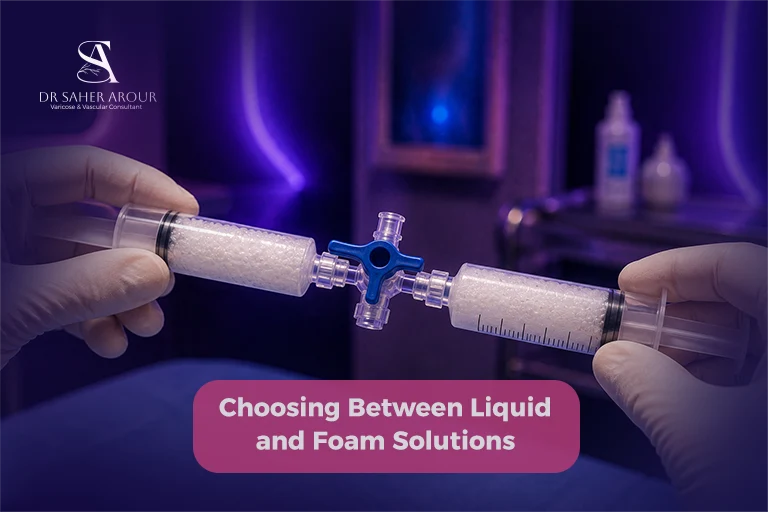
We choose between two primary forms of sclerosant depending entirely on the size and depth of your problem veins. Matching the consistency to your specific vein architecture is essential for a successful outcome:
- Liquid Sclerotherapy: Works beautifully for the smallest surface vessels, such as fine spider veins and tiny reticular lines. The liquid passes effortlessly through an extremely fine needle, coating the inner track of these superficial vessels. However, because a pure liquid can quickly mix with flowing blood and dilute, it loses its strength inside larger, high-pressure vessels.
- Foam Sclerotherapy: Used for larger or deeper veins. By mixing the liquid sclerosant with air or a safe medical gas, we create a consistency similar to shaving cream. This foam does not dilute when it hits your blood; it pushes the blood out of the way, keeping the medication in direct contact with the vessel wall long enough to seal it shut. For deep branches, we combine this with live imaging to perform Catheter-Based Varicose Vein Treatment or ultrasound-guided sclerotherapy to ensure precision.
Who Is Sclerotherapy Suitable For?
Every pair of legs is different, which is why a thorough evaluation here in the clinic is always our starting point to check the size and pressure of your veins.
Ideal Candidates — Spider and Small Varicose Veins
You are likely an ideal candidate for a sclerosant injection if you have prominent spider veins or small, localized varicose veins that do not stem from a severe breakdown in your deep valves. If you feel a persistent heavy ache or mild swelling, this spider vein injection treatment provides very tangible physical relief. It is also an excellent option for clearing away residual surface lines that stay visible after a patient treats deeper venous issues with methods like endovenous laser ablation (EVLA).
When Sclerotherapy Is Not the Right Choice
Sclerotherapy is not suitable for everyone. To be completely responsible with your health, we must avoid these injections entirely if you fall into any of the following categories:
- Women who are currently pregnant or nursing.
- Patients with a personal history of deep vein thrombosis (DVT) or a known acute blood clotting disorder.
- Patients whose ultrasound reveals that the main deep vein valves have completely failed. Treating surface branches alone in this case is just a temporary cosmetic fix that will not solve the root issue.
Step by Step — What Happens During a Sclerotherapy Session
A standard sclerotherapy session is straightforward, usually taking less than an hour right here in our clinic room. You will simply rest comfortably on an examination table while we cleanse the target area on your leg with an antiseptic solution. Using a microscopic needle, we deliver the sclerosant injection directly into the damaged veins. If the target vessels sit deeper beneath the skin surface, we use ultrasound-guided sclerotherapy to safely track the needle’s tip in real-time.
As the solution goes in, you might feel a mild stinging or a brief pinch, but this passes within seconds. Because this physical sensation is minimal and highly manageable, the procedure does not require any anesthesia. Once the injections are finished, we apply gentle pressure and place a small compression pad or bandage over the site to keep the vein walls firmly pressed together.
After the Session — What Is Normal and What Is Not
Knowing exactly what to expect during your recovery lets you go home with total peace of mind. I always tell my patients that seeing minor changes on your skin is just a sign that your body is already starting to clean and heal those vessels.
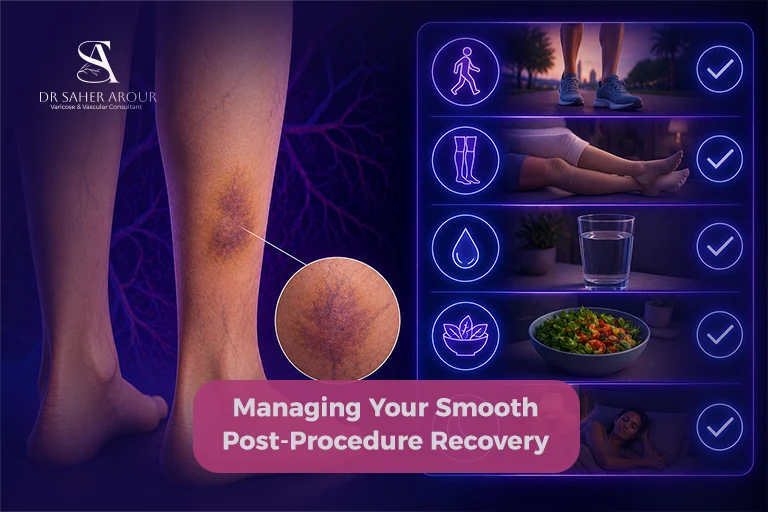
Normal Side Effects in the First 2 Weeks
- Minor bruising, slight redness, or tiny raised bumps at the injection sites, which typically fade away over a week or two.
- Treated veins feeling slightly firm or looking a bit darker under the skin before they break down and disappear completely.
Warning Signs That Require Follow-Up
While serious complications are rare, you must watch out for specific warning signs. Let us know immediately if you develop any of the following:
- Sudden, severe swelling in one leg.
- Sharp, localized pain in your calf.
- A high fever without an obvious cause.
- Any blistering or open sores on the skin at the injection site.
How Many Sessions Will You Need?
While some very thin spider veins might fade after just a single visit, most people need two to four sessions to get optimal, thorough results. We space these appointments several weeks apart to give your body enough time to safely collapse and begin dissolving the treated vessels completely.
When we discuss your sclerotherapy results timeline, it helps to be completely realistic about how vein disease works over the long term. Across all types of modern vein care, varicose vein recurrence is a well-recognized long-term outcome following treatment [1]. Clinical studies show that overall recurrence rates after varicose vein treatment range between 10% and 30% at mid to long-term follow-up [2]. To put this in perspective, even deep treatments like endovenous laser ablation (EVLA) carry a clinical recurrence rate of approximately 20.9% at 5 years [3], even though EVLA maintains an exceptionally high long-term occlusion success rate above 90% [3]. Traditional surgical treatment actually shows a higher recurrence rate compared to EVLA over long-term follow-up [3].
Why do veins sometimes return? The underlying causes of recurrence generally fall into these specific medical patterns:
- Disease Progression: Recurrence often occurs due to disease progression in previously healthy veins that naturally break down over time [4]. Ongoing everyday risk factors like obesity, pregnancy, and prolonged standing continuously strain your circulation [6].
- Incomplete Diagnosis: In some scenarios, an incomplete diagnosis or untreated refluxing veins leave hidden pressure behind, contributing directly to surface recurrence [4].
- Early Recurrence (6–12 Months): When recurrence happens quickly, it is usually driven by the recanalization of treated veins [5] or tiny new blood vessel formations known as neovascularization [4].
- Late Recurrence: Long-term recurrence is more often due to entirely new venous disease developing in previously untreated segments rather than a failure of the vein we already closed [5].
This explains why compression therapy improves symptoms but does not eliminate your long-term recurrence risk completely [6].
Frequently Asked Questions
How long does sclerotherapy last?
Results can be long-lasting for treated veins, but new veins may appear over time because the underlying venous condition can persist. Multiple sessions may be needed for optimal results. Overall recurrence rates vary between 10% and 30% depending on follow-up duration [2]. Late recurrence is often due to new disease in untreated segments rather than failure of the treated vein [5].
Does sclerotherapy hurt?
Most patients experience mild discomfort during injection, described as a brief burning or stinging sensation. The procedure is generally well tolerated and does not usually require anesthesia. The needle used is extremely thin, making the brief physical sensation highly manageable for almost all patients who visit our clinic.
Can I exercise after sclerotherapy?
Light walking is usually recommended soon after treatment, while strenuous exercise should be avoided for several days depending on medical advice. Wearing compression therapy garments helps manage symptoms, but it is important to know that compression does not eliminate the risk of new vein recurrence over time [6].
What is the difference between sclerotherapy and laser vein treatment?
Sclerotherapy vs laser veins depends on the vein size: sclerotherapy involves injecting a sclerosant to close the vein, while laser treatment uses light energy. Sclerotherapy is commonly used for spider veins and small varicose veins. Deeper methods like endovenous laser ablation have high success rates above 90% [3].
References
[1] National Center for Biotechnology Information (NCBI) – Varicose Vein Recurrence Long-Term Review
[2] National Institute for Health and Care Excellence (NICE) Guidelines – Varicose Veins Management
[3] PubMed – Long-term Outcomes of Endovenous Laser Ablation vs Surgery
[4] PubMed Central – Mechanisms of Varicose Vein Recurrence and Disease Progression
[5] PubMed – Early and Late Recurrence Windows in Venous Insufficiency Treatments
[6] National Center for Biotechnology Information (NCBI) – Venous Insufficiency and Compression Therapy Risks